The US suspect accused of torching Mississippi’s largest synagogue posted an antisemitic cartoon on Instagram shortly before his attack, and built a website for a strange brand of Christian “scripture-backed fitness” that relied heavily on Jewish sources. But little in his online presence would have indicated beforehand that he was preparing for an arson attack.
On Monday, Stephen Spencer Pittman, 19, confessed to setting the Beth Israel Congregation on fire at around 3 a.m. Saturday morning, according to a criminal complaint filed in the federal Southern District court of Mississippi. He referred to the temple as the “synagogue of Satan” during his confession, and said he laughed as he told his father what he did.
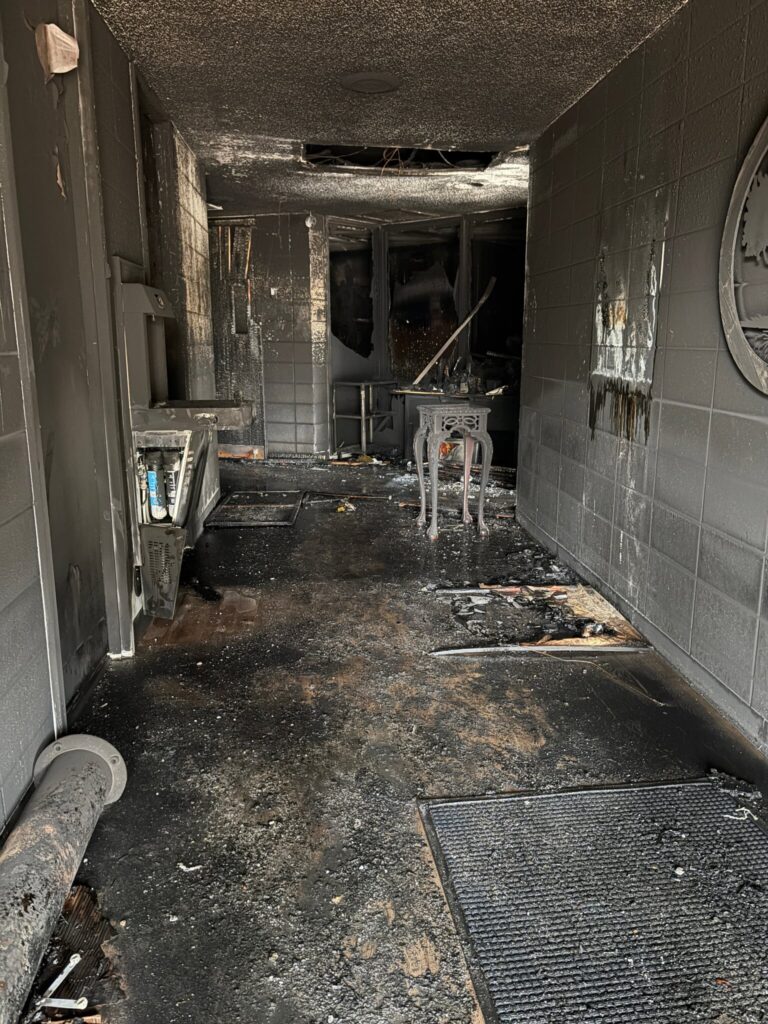
The blaze destroyed portions of the synagogue building and rendered the synagogue unusable for the foreseeable future.
Pittman is expected to face preliminary court hearings on Tuesday, January 20. He is charged with first-degree arson against a place of worship, a crime that comes with a prison sentence of five to 30 years and restitution for damages caused. If the court determines that his actions were motivated by hate, that term may be doubled, according to a statement by the district attorney.
The federal government has not yet filed hate-crime charges against Pittman.
Get The Times of Israel’s Daily Edition
by email and never miss our top stories
By signing up, you agree to the terms
According to the local news site Mississippi Today, Pittman grew up in Madison, one of Mississippi’s wealthiest cities, and seemed like an unlikely person to commit a hate crime. He was an honor roll student at the private Catholic school he attended, and played on the baseball team at Coahoma Community College, where he studied after graduating high school. Until shortly before he attacked Beth Israel on January 10, he mainly used his numerous social media accounts to post about baseball, Christianity and his exercise routines.
But Pittman’s friends said he “changed a lot” in recent years, the report said, as he began bragging about money on social media and promoting questionable health trends as part of a “Christian diet.”
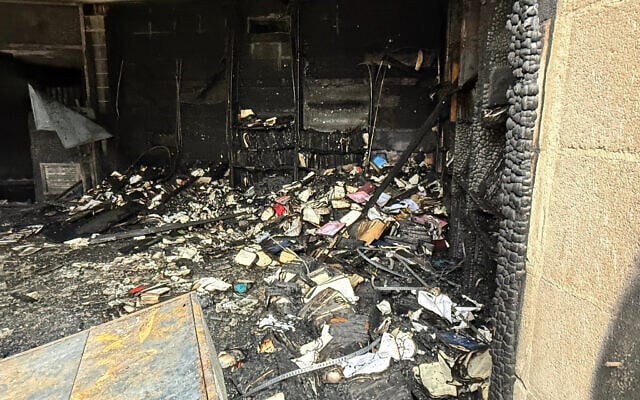
This photo provided by Beth Israel Congregation shows damage sustained during a fire on January 10, 2026, at Beth Israel Congregation, in Jackson, Mississippi. (Beth Israel Congregation via AP)
Posts included videos of himself cracking raw eggs into his mouth and talk of “testosterone optimization,” aligning him with online subcultures where “maxxing” masculinity, finances and fitness overlap with nationalist religious beliefs.
On his Instagram account, Pittman described himself as an Entrepreneur and “Lawyer of God.”
On December 5, about a month before he attacked Beth Israel, Pittman bought the domain name for his new site, One Purpose, which uses a mix of religious references to offer “Scripture-backed fitness, brotherhood accountability [and] life-expectancy maxxing.” The site is capped with an image of God’s ineffable name in Hebrew, and includes references to Jewish fast days and the seven biblical species of Israel as part of its $99 per month membership offer.
Details of the attack
On January 10, just hours before he broke into Beth Israel and set it on fire, Pittman posted a cryptic antisemitic video on his Instagram account.
“A Jew in my backyard,” a woman shouts in a cartoon video, pointing at a short yellow figure with a long nose that appears to be stealing bags of money. “I can’t believe my Jew crow didn’t work.” She then pushes him into a swimming pool, saying, “You’re getting baptized right now.”

An antisemitic video posted by Stephen Spencer Pittman shortly before he allegedly torched the Beth Israel Congregation in Jackson, Mississippi, on January 10, 2026 (Screenshot used in accordance with Clause 27a of the Copyright Law)
The clip is said to use video from the Comedy Central show “Drawn Together,” and was posted by an account called jew_inbackyard_daily that posts antisemitic material.
Shortly after posting that video, Pittman drove to Beth Israel Congregation, where investigators said he used an axe to break through one of the windows. Once inside, security camera footage from inside the synagogue showed him allegedly pouring gasoline along the wall and couch of the synagogue lobby before setting it on fire with a torch.
According to the complaint, Pittman texted his father photos from the scene of the crime, saying, “My plate is off,” apparently referring to his license plate, and “Hoodie is on.”
According to an affidavit filed by FBI agent Nicholas Amiano, the father pleaded with his son to return home, but he “replied back by saying he was due for a homerun and ‘I did my research.’”
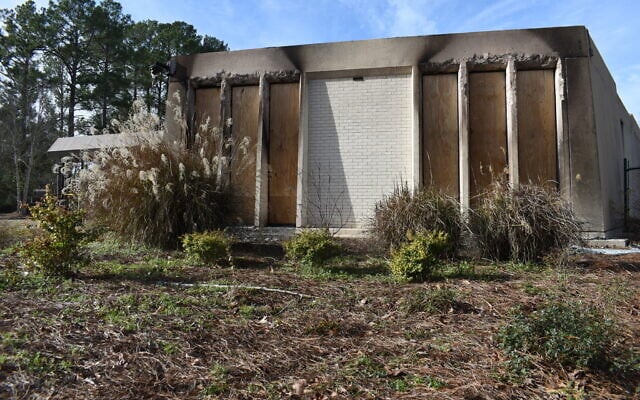
Boards cover the charred remains of the Beth Israel Congregation library in Jackson, Mississippi, January 12, 2026. (AP Photo / Sophie Bates)
“Pittman laughed as he told his father what he did and said he finally got them,” the affidavit said.
Pittman burned his ankles, hands and face in the process, leading him to seek treatment at the University of Mississippi Medical Center. Local media showed a picture he allegedly posted on Snapchat from the hospital showing heavy burns on his left hand.
Pittman’s father contacted the FBI to turn his son in. The confession was corroborated by data from a Life360 tracking app on Pittman’s phone, Pittman’s text messages to his father, and burns on his body.
He was arrested at the hospital on Saturday evening.
Pittman appeared before the US District Court on Monday via video from a hospital bed, where both of his hands were visibly bandaged. When the judge read him his rights, he responded, “Jesus Christ is Lord.”
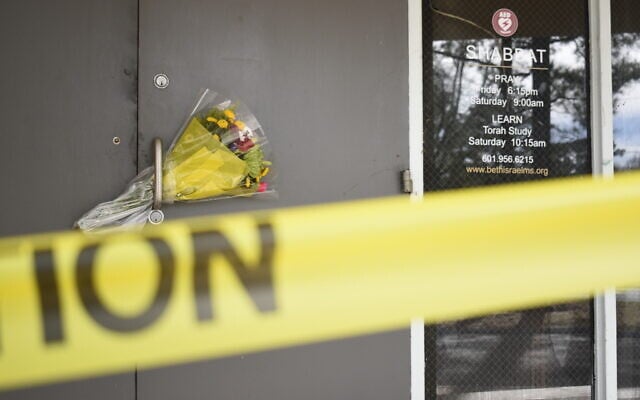
Caution tape and flowers cover the entrance to the Beth Israel Congregation, a synagogue that was set on fire, January 12, 2026, in Jackson, Mississippi. (AP Photo/Sophie Bates)
Damage and response
The blaze destroyed Beth Israel’s library and administrative offices, along with two Torah scrolls stored in the library. The main sanctuary was not damaged, and the Torahs there were later removed for safekeeping. A Torah rescued from the Holocaust and stored in a glass case was not damaged. The building will be closed indefinitely for repairs, synagogue president Zach Shemper said.
In a letter to congregation members, Shemper said the response and support from local churches and the wider American Jewish community had been “overwhelming.” He noted that a church across the street had opened its Parish Hall for Beth Israel members to gather together.
Services at Beth Israel will continue as scheduled in alternative locations that have yet to be finalized, Shemper said. “Several churches have extended kind offers for Beth Israel congregants to use their buildings as a worship space as we rebuild.”
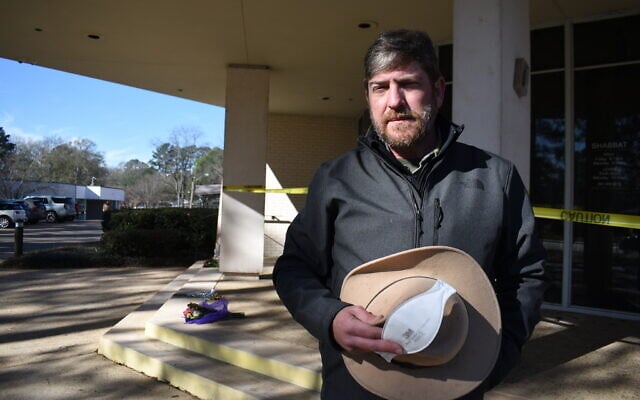
Beth Israel Congregation President Zach Shemper stands for a portrait in front of the synagogue’s closed entrance on Tuesday, Jan. 13, 2026, in Jackson, Miss. (AP Photo/Sophie Bates)
Local officials and Jewish organizations around the world have condemned the attack.
Beth Israel Congregation is the only synagogue in the city of Jackson, and is believed to be the largest of the 14 or so synagogues in Mississippi. The Reform temple was established in 1860, the first one built in the southern US state that today is home to about 3,000 Jews.
The synagogue has previously faced other fires, as well as bomb threats, noted the synagogue’s president, Zach Shemper.
The synagogue was attacked in 1967 by members of the white supremacist Ku Klux Klan hate group who targeted its rabbi, Perry Nussbaum, for his work supporting civil rights.
As antisemitism has risen across the world since the Hamas massacre of October 7, 2023, in Israel, synagogues across the United States have increasingly faced bomb threats, vandalism and other attacks. Recent years have seen several hate attacks on US synagogues, including the 2018 terror attack on the Tree of Life Synagogue in Pittsburgh, in which a gunman killed 11 people and wounded six others during Shabbat services.
The synagogue has put out a call for donations on its website, saying it has already received tremendous support from the community.