Listen to the audio version of this article (generated by AI).
Since being announced this month, the 2025 Dietary Guidelines for Americans (DGAs) have received significant attention.
The guidelines, updated every five years by the Department of Health and Human Services, have direct implications for Americans accessing food through federal food assistance programs, such as SNAP, WIC and the National School Lunch Program. But beyond that, most Americans don’t follow the guidelines. Whether these new ones will influence our diets remains to be seen. If they do, that influence will be both for better and for worse — because, while many of the DGAs directives are science-backed and evidence-based, others are not.
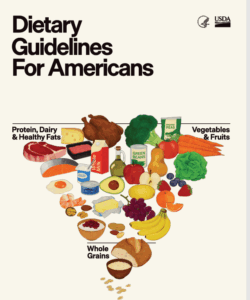 Food pyramid from the federal 2025 Dietary Guidelines for Americans. (Credit: HHS)
As a registered dietitian, professor of nutrition and member of the Dietary Guidelines Advisory Committee — whose 2025 Scientific Report was meant to guide the development of the DGAs — I want everyone to have the right answers to the perennial question of how to eat healthfully. If you’re looking to tweak your eating habits, here’s what I suggest taking and leaving from the DGAs.
Do emphasize produce
There’s nothing new or controversial about the DGAs recommendation to eat two servings of fruits and three servings of vegetables per day. This message has been included in many previous editions of the DGAs and is consistently agreed upon by a wide variety of health and medical organizations.
Almost everyone needs to increase their produce intake; the DGAs offer a great goal. And if you can eat even more than those five recommended servings, you’ll benefit.
Do minimize highly processed foods — but not necessarily all of them
The DGAs message to minimize highly processed foods is largely a welcome one in encouraging people to cut down on low nutrient foods. The caveat here is that not all highly processed foods are indeed low in nutrients. For example, a container of yogurt, a box of whole grain crackers and a packaged loaf of wheat bread technically fall into the category of highly processed, but do have nutritional value. When considering highly processed foods, you should prioritize cutting out the ones with added sugar and sodium.
Do limit saturated fat and emphasize healthy fats — especially if they’re plant-based
The DGAs define healthy fats as any fats in a “natural whole foods state”— a wide umbrella underneath which both plant- and animal-based fats fit. But current nutrition research tells us that healthy fats — mono- and polyunsaturated fats, including essential fatty acids — are most abundant in plant sources, particularly nuts, seeds, plant and seed oils, avocados, and olive oil. It’s okay to consume some fats found in animal sources like meat and butter. But when the DGAs mention cooking with butter and beef tallow as viable alternatives to cooking with olive oil, that’s inaccurate. Butter and beef tallow contain far fewer essential fatty acids than olive oil — and all of them contain fewer than plant and seed oils, such as sunflower oil and canola oil.
“When considering highly processed foods, you should prioritize cutting out the ones with added sugar and sodium.”
The DGAs also recommend keeping intake of saturated fat — found in high levels in foods including butter, palm and coconut oils, cheese, and red meat — to less than 10% of total daily calories. This is good advice, as diets low in saturated fat and high in healthy fats (plant-based!) are associated with a lower risk of cardiovascular disease. But this is where the dietary guidelines get contradictory: They seem to encourage high intake of animal products (more on that below), which would make it difficult to also achieve a limited intake of saturated fat.
Don’t assume you need to increase your protein intake
The new food pyramid illustrating the DGAs may give the impression that you need to eat more protein. For some people, that may be true; for most people, it’s not. Protein deficiency isn’t much of an issue in the US, and most Americans already eat the daily amount the DGAs recommend, between 1.2 and 1.6 grams of protein per kilogram of body weight. Each day, the grams add up, through obvious, concentrated sources like meat and less obvious sources like grains, which don’t pack a protein punch on their own but do contribute to total consumption.
So while for most people total protein consumption can stay the same, one adjustment worth considering is spreading out protein consumption more evenly throughout the day. Many of us eat a large amount of protein at dinner, when we’re winding down from the day, and eat too little protein at breakfast, when we’re fueling for the day. Moving protein around in your diet may be healthier and more practical than adding more protein.
Don’t neglect plant-based proteins
The DGAs direct people to consume “a variety of protein foods from animal sources…as well as a variety of plant-sourced protein foods.” The new food pyramid prominently features illustrations of steak, chicken, ground beef, salmon, tinned fish, shrimp, eggs, cheese and yogurt. Smaller illustrations below these animal-based proteins depict nuts and a bowl of rice and beans.
The DGAs don’t give proper due to plant sources of protein and all of their health benefits, even as more and more nutrition research directs us to swap them in for animal sources as often as possible. Plant proteins don’t necessarily have to be your main source of protein. But anytime you switch chicken or hamburgers for beans, peas or lentils, you get a punch of protein along with much-needed nutrients you otherwise wouldn’t have, such as folate and fiber (which Americans generally do need to consume more of, given our low intake of produce). Plus, more and more research demonstrates the environmental and climate benefits of eating plant-based foods in place of meat — particularly red meat.
Don’t neglect whole grains
At the bottom tip of the new food pyramid are whole grains. The pyramid gives an outsized proportion to animal foods relative to whole grains, seemingly suggesting that whole grains intake should be low. In fact, most of us should increase our whole grains intake — especially if we eat too little produce, and therefore are getting too little fiber.
The DGAs recommend between two and four servings per day — a great goal, as most of us are only eating around one daily serving. If the pasta is whole wheat, if the bread is whole grain, or if the rice is brown, don’t shy away.
(Opinion columns published in The New Lede represent the views of the individual(s) authoring the columns and not necessarily the perspectives of TNL editors.)
Featured Image: By Yuniaz/Unsplash +

Teresa Fung, a registered dietitian, is a professor of nutrition at Simmons University and an adjunct professor of nutrition at Harvard T.H. Chan School of Public Health. She served on the Dietary Guidelines Advisory Committee to review scientific evidence that formed the 2025 Dietary Guidelines Scientific Report.