Daybreak will not be published on Monday, Jan. 19, which is Martin Luther King Jr. Day.
House Agriculture Committee Democrats are setting up an election-year battle over farm and nutrition programs.
Today, the committee’s top Democrat, Angie Craig of Minnesota, and some of her colleagues will unveil the Farm and Family Relief Act. Craig wouldn’t provide any details Monday of what’s in the legislation. “What I would say is that farmers and families need relief, and it needs to be relief in a way that we’re not back here one year from now,” Craig told Agri-Pulse.
Why it matters: House Ag Committee Chair Glenn “GT” Thompson, R-Pa., says he wants to move a farm bill in February to address programs left out of last year’s One Big Beautiful Bill Act.
Rural lending, food inflation take spotlight at Senate hearing
Helping rural banks access capital and higher grocery bills were topics at a Senate hearing Wednesday on growing the small business ag economy.
Small Business Committee Chair Joni Ernst, R-Iowa, says there’s been progress under the Trump administration in boosting loans under the Small Business Administration’s 7(a) loan program. That provides guarantees to lenders, allowing them to issue loans to small businesses, including family farms.
Yet many banks still find it “incredibly difficult to fully and actively participate in the 7(a) loan program due to unnecessary red tape and overly complex requirements,” the Iowa Republican said.
Ernst says she’s asked SBA Administrator Kelly Loeffler to report on what the agency is doing to encourage higher rural bank participation in the SBA loan programs, as well as what it’s doing to reduce compliance and paperwork headaches for lenders so they can reach more rural and ag small business owners.
Massachusetts Sen. Ed Markey, the panel’s highest-ranking Democrat, said the ag economy is “being crushed” by Trump’s policies, including immigration crackdowns that make it harder for businesses and small farms to find workers.
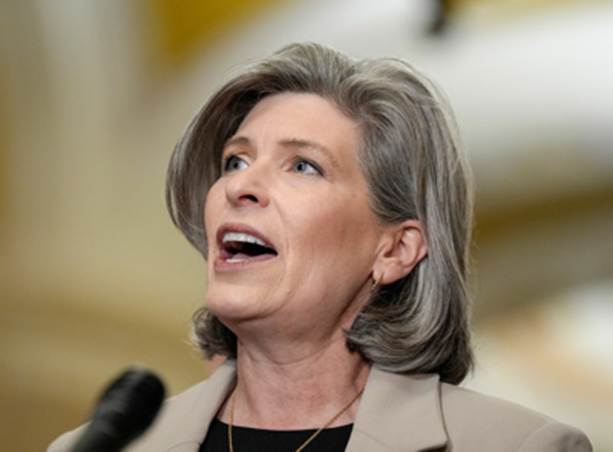 Sen. Joni Ernst, R-Iowa (AP Photo/Mariam Zuhaib)
Tariff verdict wait continues
Importers will have to wait for clarity on the fate of President Donald Trump’s emergency tariffs. The Supreme Court held off on issuing a decision on Wednesday.
The justices did release three decisions on Wednesday, but the highly anticipated tariff case was not one of them. The tariff case didn’t feature on Friday’s decision day either.
Ryan Majerus, an international trade lawyer at King and Spalding, told Agri-Pulse that the longer the justices take to issue the decision, the less likely it will be a unanimous one.
“It’s probably unlikely we will get a 9-0 decision,” he said in an email, adding that the justices are likely “debating the key issues and drafting separate opinions.”
Take note: The tariffs haven’t dented China’s growing trade surplus. Beijing posted the largest trade surplus ever seen on Wednesday at $1.2 trillion in 2025 – a 20% increase on 2024’s surplus. The surplus is widening on growing exports to Europe, Africa, Latin American and Southeast Asia.
Sugar users call on USDA to adjust refined sugar definition
A group representing U.S. sugar users wants USDA to adjust its definition of refined sugar to make sure manufacturers have access to affordable sugar during emergencies.
The U.S. allows a quota of refined sugar to enter the country at reduced tariff rates each year, which is open to sugar with a polarity of 99.5 degrees. Sugar polarity basically refers to sugar molecules’ ability to attract water, allowing sugar to dissolve easily. A higher polarity indicates a higher sucrose concentration signifying greater purity.
“The current 99.5 degrees polarity cut point is outdated and not consistent with modern standards of food manufacturing. Industrial users typically require a polarity of 99.8 to 99.9,” Richard Pasco, president of the Sweetener Users Association, wrote to USDA this week.
The U.S. can’t set new conditions on the basic tariff-rate quota under World Trade Organization rules, it can limit access to any additional quotas offered during a supply crunch. Pasco wants USDA to limit access to any additional quotas to sugar of 99.8 degrees polarity or higher.
“We favor this definition because it will ensure access to sugar that meets industrial users’ quality needs and will maximize the efficiency of the refined [tariff-rate quota],” Pasco argues.
Senators unveil bipartisan bill to boost chemicals made from crops
Renewable chemicals made from biomass such as corn and soybeans is the focus of bipartisan legislation that backers say would encourage development of new markets for farmers.
The Renewable Chemicals Act from Sens. Pete Ricketts, R-Neb., and Chris Coons, D-Del., calls for a targeted, short-term tax credit for qualifying renewable chemicals, or an investment tax credit for renewable chemical production plants.
It’s the latest attempt to leverage agriculture heavy regions, like the Midwest, to spur bio-manufacturing hubs that help growers and strengthen local economies, especially in areas that have lost industrial jobs over the last several decades.
“It will bring more ag-driven manufacturing to Nebraska,” Ricketts said. “Bio-based products are common sense. They’re a win for consumers, the environment, and our farmers and ranchers.”
The bill calls for a credit up to 15% of the sales price of each pound of renewable chemical. Producers also would have the option of taking a 30% investment tax credit.
USDA funding for digesters targeted in new petition
A collection of more than 30 groups wants USDA to stop funding anaerobic digesters through the Rural Energy for America Program, or REAP. The collection says the money should be spent on solar and wind projects.
Food & Water Watch, the Center for Food Safety and the Institute for Agriculture and Trade Policy are among the groups saying that digesters contribute to consolidation of dairy operations as well as water and air pollution. Their petition cites examples of spills from digesters and says that during the digestion process, they can leak “about 15% of the methane they initially capture.”
The groups say REAP gives more money to digesters than to solar or wind projects.
The other side: But Bruce Knight of Strategic Conservation Solutions who has worked with clients on REAP digester applications, defends their use.
They meet or exceed regulatory requirements, he says. In addition, “You’re putting the digestate into a more usable and manageable form for it to be able to return to the ground. The “renewable” system, he says, “gives us nutrients for the land, makes milk production possible, makes livestock production possible, and produces energy.”
Knight also says no one has shown that digesters cause consolidation of the livestock industry.
Final Word
“We lost a generation, probably two generations, of milk drinkers, and it devastated those rural communities. Well, that day ends today with your signature.”– House Ag Committee Chairman Glenn “GT” Thompson at a signing ceremony for the Whole Milk for Healthy Kids Act.
Kim Chipman, Philp Brasher, Steve Davies, Noah Wicks, and Oliver Ward contributed to today’s Daybreak.