Editor’s note: This article is a humor column.
Dear Hoos,
Welcome back to Grounds! We understand that your Winter Break may have been filled with involuntarily opening Canvas 15 times per day, worrying about your internship prospects from your childhood bedroom or believing every single post you saw on Rush Yak.
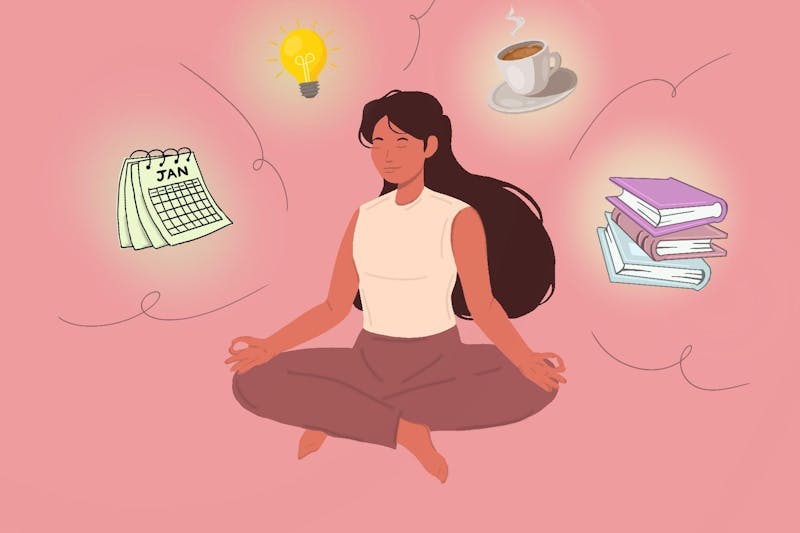
With the spring semester underway, Student Health would like to remind you to take care of yourselves during this exciting time of academics, extracurriculars and social obligations. That’s why we’ve created these four simple mindfulness exercises you can easily integrate into your already-overbooked schedule.
1. Box breathing
Seek out a tranquil sanctuary for reflection — we recommend taking advantage of Food Truck Fridays, or spending time on the Tralcony on a Thursday night. Sit down on the floor as comfortably as you can, even if people are standing or moving around you. Close your eyes — unless you’re in Edgar Shannon Library during midterms, in which case please keep them open in case you lose out on an empty seat.
Inhale for four counts.
Hold for four counts.
Exhale for four counts, and visualize the stress leaving your body as that one student finally leaving the study spot you’ve been eyeing since the beginning of your generational lock-in in the East Wing of Shannon.
Hold for four counts.
If your thoughts begin to wander towards unfinished readings or your club event, gently redirect your attention back to your breath. These thoughts are not urgent. Canvas and Google Calendar will remind you of them again shortly.
2. Gratitude reflection
Take a moment to reflect on three things you’re grateful for.
Start small — perhaps your phone charger still working despite bending at a deeply concerning angle.
Move outward — the thrill of realizing you watched a two-hour movie without taking a break to scroll Instagram Reels.
Finish strong — your deep appreciation for all of your professors posting lecture slides after class instead of before.
Remember — gratitude is about focusing on what you have, not what you are missing, such as a normal sleep schedule or the ability to read for pleasure.
If it helps, you may write your gratitude list in a 2026 planner you will stop using by February.
3. Grounding through sensory awareness
As you walk to class, take note of your surroundings using your five senses like the following example.
Five things you can see — brick, brick, brick, Veo, someone crying.
Four things you can hear — construction, birds chirping, brakes hissing on a 30-minutes-late bus, someone crying.
Three things you can feel — cold air, backpack straps, existential dread.
Two things you can smell — Newcomb Hall Starbucks, someone still waiting to take their first shower of 2026.
One thing you can taste — regret because you skipped breakfast.
This exercise helps bring you into the present moment, which is happening whether you are ready or not. Enjoy it while it lasts.
4. Affirmations for academic resilience
Look in the mirror of your communal bathroom, and repeat the following affirmations silently or aloud —
I am more than my productivity.
Rest is important.
I do not need to be involved in everything.
It is okay if I am not optimizing every second of my day.
If any of these feel untrue, that’s okay because they probably are. These affirmations are all about acknowledging your thoughts without judgment, then continuing to sign up for things anyway.
Student Health hopes these exercises help you feel balanced and emotionally resilient as you navigate the spring semester. Please remember that burnout is real, but with proper mindfulness, hydration and time management, it can be postponed until at least after midterms.
If you are feeling overwhelmed, support is available. Student Health offers counseling services, wellness workshops and additional posters in high-traffic restroom stalls.
Wishing you a peaceful, productive and exceptionally busy start to the semester.
Warmly,
Student Health and Wellness