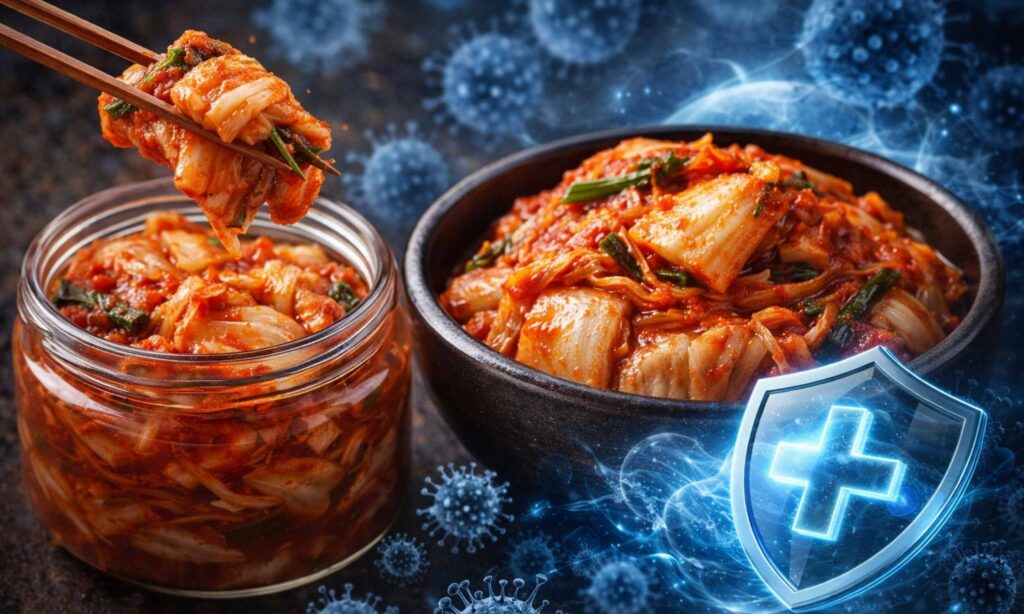
As flu season tightens its grip, a familiar fermented side dish is drawing new attention for how it tunes the body’s defenses.
In a recent study, adults who added kimchi powder to their routine showed immune changes linked to clearer threat response and steadier control of inflammation, with one preparation standing out.

The research followed adults in South Korea for twelve weeks as they consumed a daily kimchi powder made through either traditional or starter-guided fermentation, allowing scientists to compare how each version affected immune cells in the blood.
South Korean researchers ran a controlled trial using kimchi powder and watched immune changes build over time.
The work came from the World Institute of Kimchi (WiKim), a government-funded center that studies fermentation and health.
Leadership came from Dr. Wooje Lee, whose team at WiKim focuses on how fermented foods affect immune and metabolic health.
For the immune-cell analysis, researchers sequenced samples from 13 overweight volunteers drawn from a larger study listed in the registry.
Kimchi and immune cells
Blood samples provided peripheral blood mononuclear cells, a mix of circulating immune cells that include T cells and monocytes.
Using single-cell RNA sequencing, a method that reads gene activity in individual cells, the team compared before and after patterns.
That approach produced 88,403 RNA snapshots of gene expression, letting rare immune subsets show up instead of being averaged away.
Because the signal came from many cells, the RNA patterns highlight subtle regulation rather than a broad, whole-body alarm state.
Cells that show threats
Researchers saw more activity in antigen-presenting cells, immune cells that display germ bits to other cells, after kimchi powder intake.
These cells used MHC class II, major histocompatibility complex proteins that hold antigen pieces on the surface, to activate helper T cells.
Gene patterns suggested more antigen uptake, and lab tests showed kimchi-treated immune cells pulled in and processed more protein targets.
Stronger antigen presentation can sharpen recognition of viruses and bacteria, but it does not guarantee fewer infections in daily life.
Avoiding an immune overreaction
Alongside antigen-presenting cells, CD4+ T cells, helper cells that steer other immune cells, moved toward a more regulated response.
Gene signals suggested defense activation paired with restraint against unnecessary immune response, limiting extra inflammation.
“Our research has proven for the first time in the world that kimchi has two different simultaneous effects: activating defense cells and suppressing excessive response,” said Lee.
That kind of tuning could lower the risk of immune-driven tissue damage, though the study did not track actual illness outcomes.
Starter culture changed the result
Fermentation method mattered because the starter-culture powder triggered stronger immune signaling than the naturally fermented version in this analysis.
The starter used a strain called Leuconostoc mesenteroides, and controlled fermentation can favor specific bacteria and metabolites.
Those differences hint that manufacturing choices can change the immune-active compounds that survive drying and storage.
Even so, both powders moved immune cells in the same direction, so results should not be read as a winner-take-all contest.
Signals behind the gene changes
Lab work helped connect the blood-cell gene signals to specific responses triggered when immune cells met kimchi extracts.
The extracts pushed interferon-gamma, an immune messenger that boosts antigen display, toward a pattern that raised MHC class II genes.
When researchers added ruxolitinib, a drug that blocks a key immune switch, the rise in MHC class II genes largely disappeared.
Because some activity remained even with the blocker, the powders likely work through more than one pathway inside cells.
Immune response from kimchi
Changes in antigen presentation were followed by signs that helper T cells matured faster toward effector and regulatory roles.
The data suggested more cells entered late-stage states, meaning they were ready to either attack targets or calm responses down.
Both kimchi powders increased a small group of proliferating T cells, hinting at renewed turnover rather than exhaustion.
Helper-cell remodeling could matter most for viruses that need coordinated responses, yet the work leaves open how long those shifts last.
What stayed mostly steady
Several immune cell groups barely moved, which is important when people worry about overstimulating the immune system.
Cells that make antibodies and cells that kill infected targets stayed stable in the blood, even as antigen presenters became busier.
That pattern suggests a targeted adjustment, where the system changes how it communicates without flipping every immune switch on.
For people with autoimmune concerns, the stability is reassuring, but the findings still need testing in larger and diverse groups.
Kimchi and human immune systems
Another experiment linked fermented foods to lower inflammatory proteins and a richer microbiome, the community of microbes living in the gut.
In the kimchi trial, participants took 3,000 mg of powder daily, equal to about 1 oz of fresh kimchi.
Choosing a fermented food in rotation is reasonable, but the study cannot say which recipes, doses, or people get the benefit.
“We plan to expand international research on kimchi and lactic acid bacteria in relation to immune and metabolic health in the future,” said Lee.
Across these analyses, WiKim researchers showed kimchi powder can strengthen antigen presentation while keeping most other blood immune cells steady.
The next step is larger trials that track real infections, since foods can support immune habits but cannot replace medical care.
The study is published in npj Science of Food.
—–
Like what you read? Subscribe to our newsletter for engaging articles, exclusive content, and the latest updates.
Check us out on EarthSnap, a free app brought to you by Eric Ralls and Earth.com.
—–