KPop Demon Hunters, the most-watched movie ever on Netflix, is filled with plenty of supernatural elements, but there’s at least one scene that reflects a good dose of reality behind some supernatural claims you might hear from time to time. This injection of skepticism was presented in such a fun, irreverent manner, you almost don’t even notice it happening.

Setting up the scene
Rumi, the lead singer of Huntrix, is having a problem with her voice. Whenever she wants to hit a high note, she suddenly chokes on it, and her singing cuts short abruptly. Her bandmate Zoey has about 57 ideas to fix Rumi’s voice, but she starts with her favorite, which she believes is “totally legit!”
 Rumi is having a problem with her voice.
“He’s got this special tonic,” Zoey says about the man they’re about to meet. “Apparently it can heal anything from sore throats to relationship problems.”
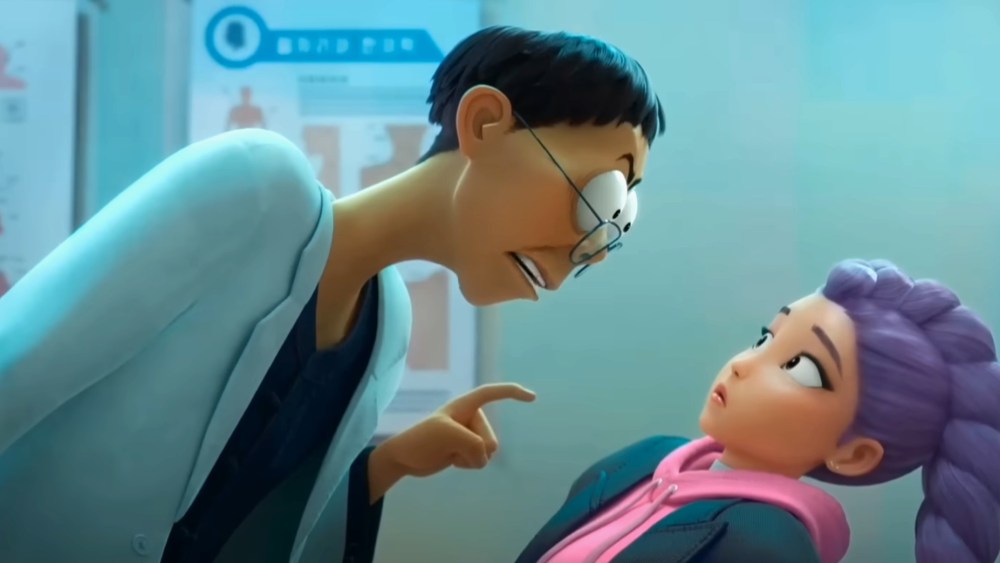
That man happens to be a character named Healer Han. However, instead of examining Rumi’s throat directly, he tries to examine her in a more “holistic” manner — by staring menacingly into her face, and then also right into her friends’ faces. “In order to heal a part, we must understand the whole”, he claims.
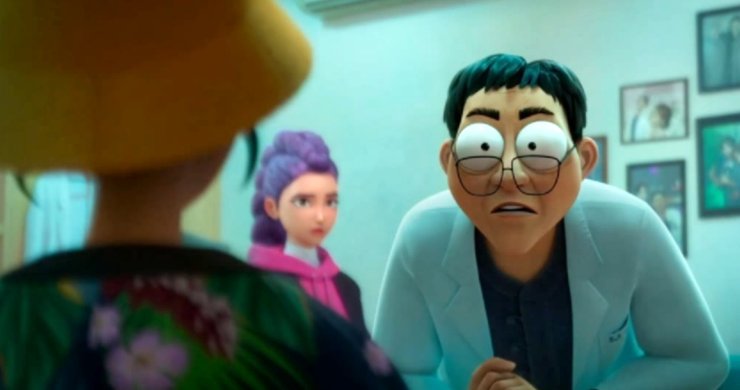 I seeee …!!
Can Healer Han really do anything good for Rumi’s predicament, or is he just a charlatan pretending to be useful? Here are some of the ways we can tell he’s not quite as “legit” as Zoey thinks he is.
– He is NOT a medical doctor
Notice that the character is never referred to as “Doctor Han” in the movie. Despite some fans calling him that, there’s no evidence presented that he has any kind of medical degree. His official name in the credits is, indeed, Healer Han.
One should be dubious of those wearing the veneer of medicine, such as white lab coats and diploma-looking documents, without having the proper accreditations to back them up.
– Failure to diagnose
Han’s holistic deductions could not properly identify the actual cause of Rumi’s voice problems. Not even close! He spent more time analyzing the ladies’ personality traits than he did bothering to notice the rather demonic patterns encroaching upon her neck.
– The ultimate banality of his actual advice
“Focus is good,” Han says at one point. “But focusing on one part leads to ignoring other parts, making you separated, isolated … emotionally closed off.” There sure seem to be many fans on social media defending him for giving good, honest advice here.
These types of statements are not necessarily wrong, but they are, at the very least, incredibly simplistic. They seem rather obvious once you hear them, but aren’t really worth very much. They fail to address any of the actual issues on the table.
Imagine going to a financial advisor for personalized assistance with your specific needs, and his only advice is “buy low, sell high!” Han seems to be no better when it comes to the field of healing people.
– Shady “psychic” techniques
So-called “psychics” probably don’t get any information from the spirit world, but a lot of them do elicit information from their marks. “Hot reading” means the performer already knew something about their target in advance, and they merely pretend to have first learned the information through spiritual contact. “Cold reading” is more like an educated guess — the performer isn’t really sure something is true or not, but they put a statement out there that they can either quickly retract or attempt to elaborate on, depending on the reaction of their marks.
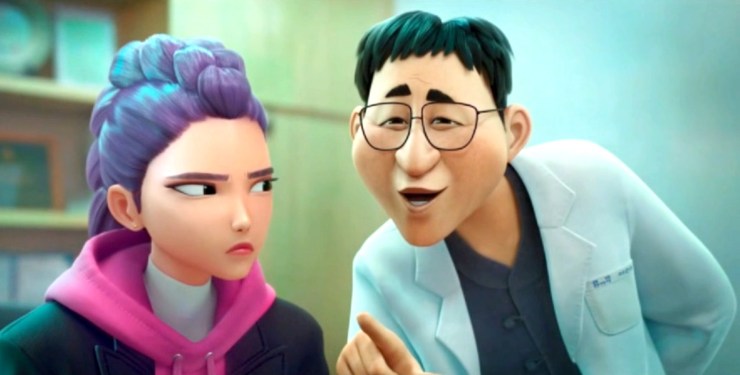
When Han sees Zoey’s agreeable nature, he correctly deduces she has an “eagerness to please, maybe a little too eager”. This is an example of cold reading; even if Han didn’t know about this trait in advance, he could easily have guessed it by observing Zoey for even a few minutes.
Han also, seemingly miraculously, figures out that Rumi “refuses to go to the bath house” with her friends. I believe this is a case of hot reading. It’s reasonable to assume the superstar band might have mentioned this bath house issue in a magazine interview he read somewhere, and Han’s body language seems to suggest he’s rattling off something he already knew, rather than deducing it on the spot.
– Use of “red flag” words
Healer Han’s tonics are described as “earthy” and “herby.” These types of words appeal to “nature,” so they all sound nice and pleasant. But in reality, they have no bearing on how efficacious something actually is. Double-blind published studies are always better to rely on, than words that merely sound pleasant. Even if the process of publishing isn’t always perfect, scientific papers still have a lot more scrutiny and accountability behind them than any of the alternatives.
Han’s claims that his tonics heal anything at all are, of course, very dubious. The real world is never that convenient, unfortunately.
– Celebrity endorsements
Healer Han seems rather eager for celebrity endorsements. Of course, having a celebrity endorse a product doesn’t necessarily mean the product is bad, but the history of such endorsements shows us it can be a mixed bag. We all know that celebrities do not always endorse good products.
If a service provider of any sort seems to lean too heavily on famous folks to vouch for them, with less focus on building a reputation within their own industry, that’s a reason to be concerned.
– The products are outright fraudulent
Of course, we find out several scenes later that Healer Han’s tonics were actually nothing more than grape juice pouches with his label stickered onto them. All of that ridiculousness could have been avoided had Rumi paid attention to the warning signs listed above.
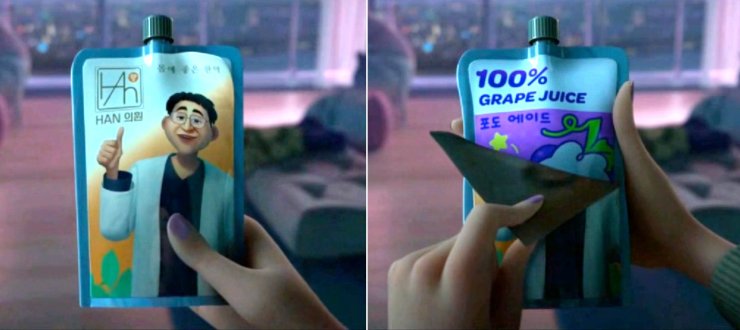 Okay tonics, let’s do this!
Han’s motivations are not necessarily important to make these points. Whether or not he was in cahoots with the main villain, Gwi-Ma (as some Internet theories suggest), Healer Han is clearly a fake, a phony, and a fraud. Although, his scenes were at least kinda funny.
How many will really notice or care?
Thanks to the popularity of KPop Demon Hunters, Healer Han is likely to be a very well-recognized character for a while. (I saw at least two people cosplaying as him at Dragon Con in 2025!)
However, the question must be asked, how many of today’s kids will actually heed these lessons? Unfortunately, based on what we know about human nature, it’s unlikely we’ll ever see wellness grifters like Han ever truly disappear, but depictions like this help remind us of what to watch out for.
AIPT Science is co-presented by AIPT and the New York City Skeptics.