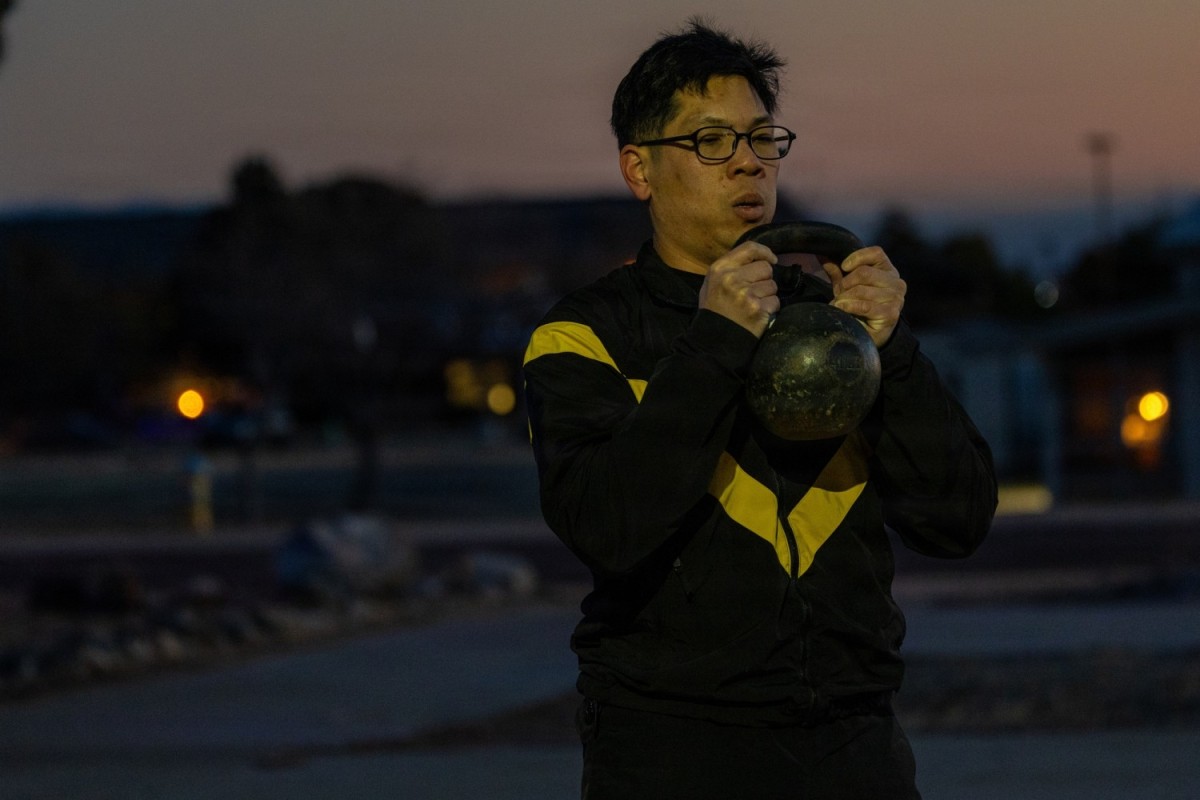
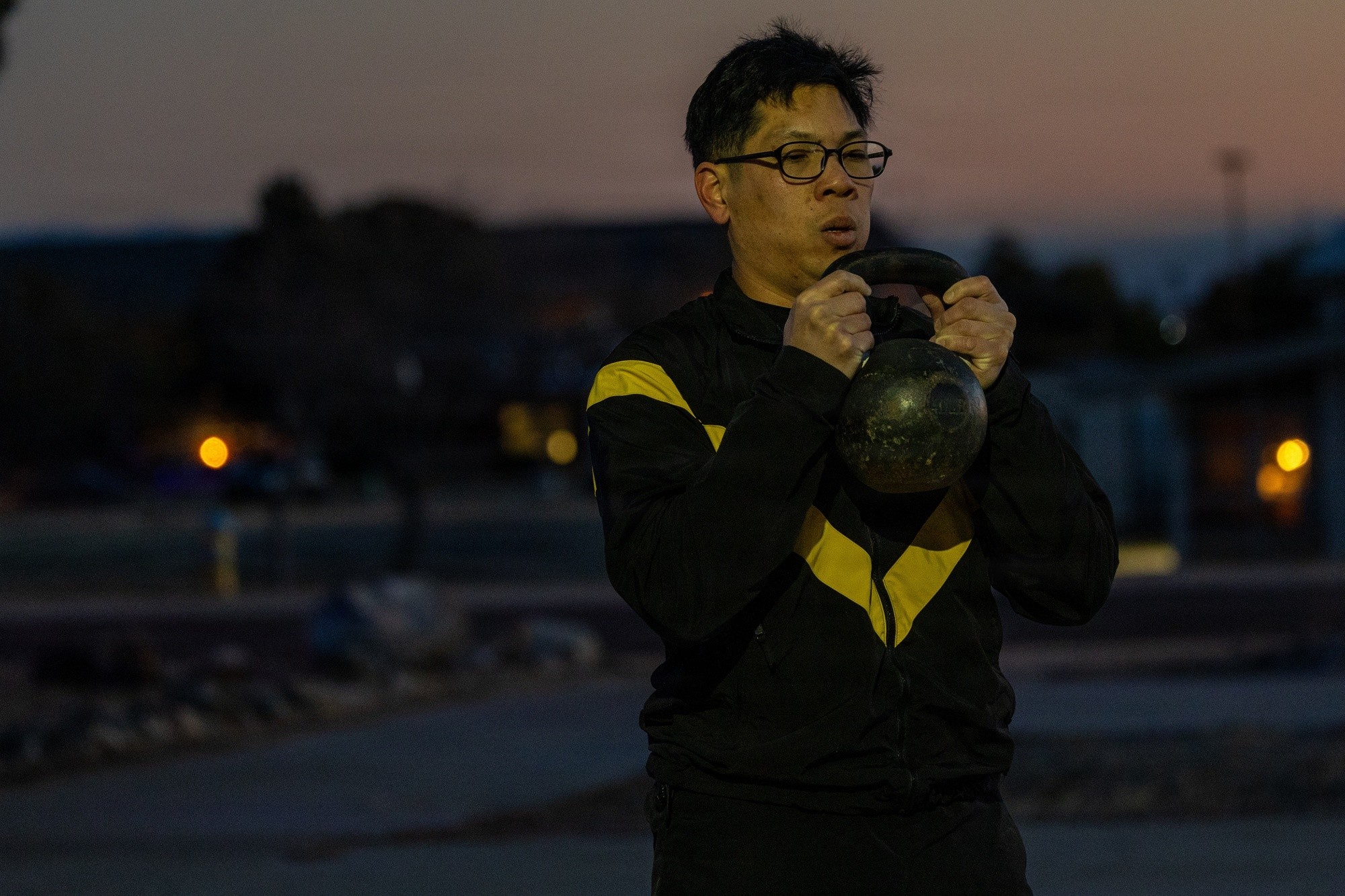
U.S Army soldier assigned to the Joint Task Force–Southern Border (JTF-SB) conducts kettlebell squats with Holistic Health and Fitness Professionals from the 101st Airborne Division (Air Assault) to enhance operational readiness by delivering integrated physical training, recovery, nutrition, and mental readiness support at Fort Huachuca, Ariz., Jan. 20, 2026. JTF-SB executes full-scale, agile, and all-domain operations in support of U.S. Customs and Border Protection to protect the territorial integrity of the United States and achieve 100% operational control of the southern border. (U.S. Army Photo by Spc. Janean Carr)
(Photo Credit: Spc. Janean Carr)
FORT HUACHUCA, Ariz. – Holistic Health and Fitness (H2F), professionals from the 101st Airborne Division (Air Assault) are reinforcing soldiers’ readiness by delivering integrated physical training, recovery, nutrition, and mental readiness support to soldiers assigned to Joint Task Force–Southern Border (JTF-SB). Ensuring soldiers remain mission-ready throughout sustained operations Fort Huachuca, Ariz., Jan. 19, 2026.
As soldiers support border security missions for extended periods, H2F teams help sustain operational effectiveness and reduce the risk of injury and fatigue. This initiative underlines the Army’s holistic approach to readiness, connecting physical, mental, and nutritional health to mission success.
“Integrated support synchronizes physical training, recovery, nutrition, cognitive performance and spiritual readiness, which is often overlooked,” said David J. Siu, H2F program director for the 3rd Mobile Brigade, 101st Airborne Division (Air Assault). “To sustain effectiveness under operational stress, it creates a lethal, resilient force and enables soldiers to maintain peak physical and cognitive performance throughout extended operations.”
Leaders emphasized that sustained readiness during extended operations depends on a balance between training demands, recovery and leader oversight.
“We’ve learned you can’t just push nonstop all the time,” said Sgt. 1st Class Jeremy L. Armstead, a geospatial intelligence imagery analyst for JTF-SB. “It’s about making sure soldiers train correctly, recover properly, and maintain habits that support long-term performance. Part of keeping soldiers’ mission ready is teaching them to take care of themselves, starting with basics like staying hydrated.”
Each day begins with structured physical readiness training tailored to the mission’s specific demands. Rather than traditional workouts, H2F coaches emphasize functional movement, injury prevention and strength development specific to operational tasks. Trainers provide real-time feedback to ensure soldiers maintain proper form and remain aligned with Army fitness standards, even in a high-tempo environment.
“For this particular mission, we met with senior leaders and soldiers deployed here to identify the biggest stressors on the ground and within this operational environment,” said Nicole Boger, 101st Combat Aviation Brigade H2F program director. “From there, we tailored programs based on a detailed analysis of each soldier’s job. For some, that means mastering movements on uneven terrain while carrying extended loads. For others, it involves supporting high cognitive workloads in offices and during briefings. We also implement micro-movement movement routines and heat-acclimatization protocols specific to this operational area.”
Beyond physical training, H2F professionals conduct individual and group consultations focused on sleep optimization, mental readiness and nutritional fueling. These sessions help soldiers adapt to irregular schedules, environmental stressors and prolonged duty cycles, factors that can affect both performance and resilience during operations.
“Staying on track is critical when you’re deployed or on temporary duty for extended periods,” said Sgt. 1st Class Carl M. Kately, an intelligence operations clerk for JTF-SB. “Having access to H2F gives us the tools to help soldiers maintain high performance levels.”
Recovery is treated as an essential component of readiness. H2F professionals work with soldiers to address mobility limitations, manage minor injuries and prevent long-term issues that could degrade combat effectiveness. Through guided stretching, corrective exercises, and education, H2F teams help soldiers remain mission-capable while minimizing time lost to injury.
“The recovery piece ensures that the soldier, which is the most important weapon system the Army has, remains mission-capable,” said Siu. “It allows tissue repair, hormonal restoration, and cognitive reset.”
Leaders emphasize that the program’s impact extends beyond individual performance.
By sustaining soldier readiness throughout prolonged operations, H2F directly supports unit effectiveness and operational continuity.
“No matter where they are supporting the border mission or any other mission, this integrated approach has been shown to reduce non-deployable soldiers and sustain combat power in any operational environment,” said H2F professionals.
As JTF-SB operations continue, H2F professionals remain embedded alongside soldiers, reinforcing readiness as an ongoing commitment. Through integrated support and deliberate coaching, the program ensures soldiers remain physically and mentally prepared to meet the demands of sustained operations while safeguarding their long-term health and performance.
(U.S. Army Story By Spc. Janean Carr, 40th Public Affairs Detachment)