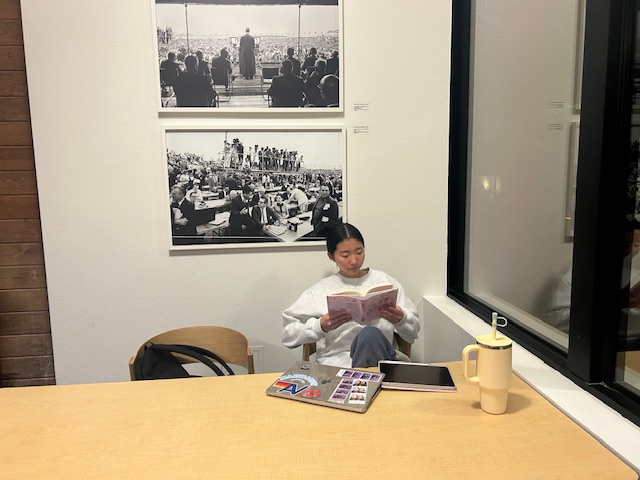
Since starting her digital fast, Elise Choi has found more time for reading, among other benefits.
Courtesy: Elise Choi
I’m a high school junior, which means I’ll be putting on a cap and gown next year. But before I do, I’d really like to see California formally integrate digital wellness into existing health education classes.
Feb. 2-6 is National News Literacy Week, which is about teaching students to evaluate media and become “active consumers of news and information.” So, it feels like a good moment to ask: How do we equip students to navigate and thrive in an increasingly complex media environment dominated by mobile devices, social media and artificial intelligence (AI)?
In early January, the California Department of Education published new AI guidance for TK-12 schools, calling for AI literacy across subject areas to support safe, effective, responsible AI use. While encouraging, the instructional guidance is optional, unfunded, and doesn’t quite address the mental and emotional impacts of these technologies, like companion chatbots, addictive algorithms, gaming, filter bubbles and deepfakes.
We need to go one step further.
Nearly all California youth (94%) in a recent survey said they were experiencing mental health challenges. The CDC (Centers for Disease Control and Prevention) has said that schools can help “reverse the trend” through education. In 2021, California passed SB 224, which requires mental health instruction in middle and high schools. That instruction includes recognizing warning signs, symptoms of mental health conditions, available treatments and coping skills. What’s missing now is the digital piece.
Just as we teach about alcohol, drugs, nutrition, and sex, we need to talk about the harms encountered in the digital world. My generation is growing up in that world.
In recent years, California has passed important laws regulating technology (chatbots, social media and school cellphone use), but we also need to address these issues from an education standpoint. We need practical skills, like:
Understanding that apps are designed to keep our attention and how to set boundaries
Learning how late-night scrolling affects sleep, energy and brain development
Talking about social comparison and how online media influences self-image
Managing group chats, online conflict and FOMO (fear of missing out)
Understanding how algorithms, AI and synthetic media (e.g, deepfakes) work and how to verify information
Adopting healthy screen time habits
Experts have been calling for an education solution. The American Psychological Association’s 2025 advisory recommended comprehensive AI literacy education to prevent online exploitation, manipulation and harm to youth. In 2023, the U.S. Surgeon General urged policymakers to “support the development, implementation and evaluation of digital and media literacy curricula in schools” to support general student well-being.
I’m currently on day 45 of a self-imposed social media fast (no TikTok, Snapchat, Instagram or YouTube). Not surprisingly, I’ve finally been able to finish two books that were gathering dust on my nightstand, study without constantly checking my phone and complete all my assignments in half the time. What I was not expecting, however, was that I would feel noticeably calmer, be more present in every conversation, feel more grounded because I have time to think in silence, and tolerate boredom.
Don’t get me wrong, I love technology. But we must be mindful of its effects and set boundaries. What I hope for is a culture shift in how we interact with media and technology, and for students to become critical thinkers rather than mindless consumers.
As home to many of the world’s biggest and most powerful social media and AI companies, California has a unique responsibility to set the standard for digital wellness education. And honestly, it seems like a no-brainer.
•••
Elise Choi is a student at the Orange County School of the Arts and policy director for GENup, a youth-led education advocacy organization. In addition to conducting a California media literacy study with the Media Education Lab, she is working with a coalition of advocates and educators to advance digital wellness legislation in California this year.
The opinions expressed in this commentary represent those of the author. EdSource welcomes commentaries representing diverse points of view. If you would like to submit a commentary, please review our guidelines and contact us.