 Jeanne Reilly, director of school nutrition at Windham Raymond School District, stands in the Windham High School cafeteria as staff serves students lunch. Reilly says the new guidelines are in line with how schools are trying to cook more from scratch. (Shawn Patrick Ouellette/Staff Photographer)
The food pyramid is back — and flipped upside-down.
The Trump administration rolled out new dietary guidelines earlier this month, including some advice that counters longstanding nutrition research, and Maine nutrition experts have mixed feelings about the changes.
The administration re-adopted the iconic “food pyramid” graphic — which was set aside in 2011 in favor of a segmented plate model known as MyPlate — to illustrate their advice.
But the pyramid is now flipped, with animal proteins, fats, full-fat dairy and produce toward the top (where most of your calories should come from) and whole grains at the bottom.
It’s a reversal of priorities that Maine dieticians and nutrition authorities say could be problematic, maybe even dangerous, and might set Americans up to fail.
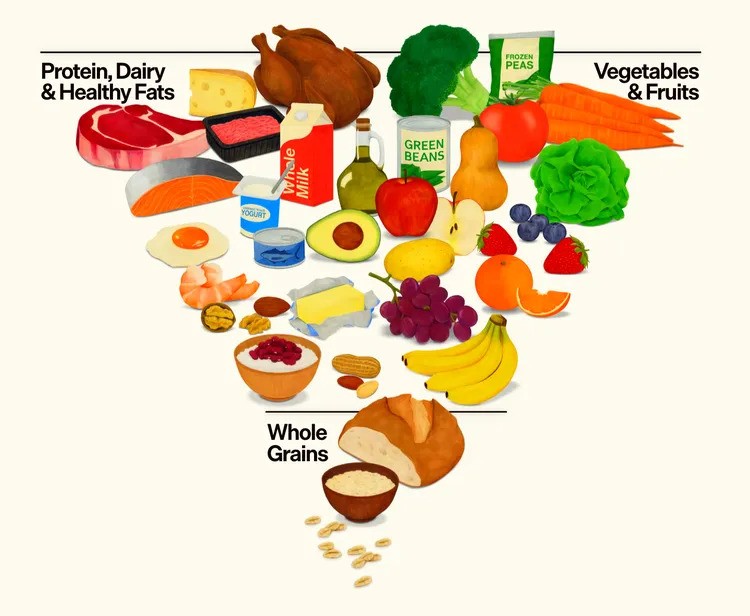 The 2026 food pyramid. (Courtesy of HHS/USDA)
Several experts said they liked the emphasis on whole foods, promoting fruits and vegetables and warning against ultra-processed foods.
But the strong emphasis on protein doesn’t align with most lifestyles, they said.
The guidelines now call for people to eat 1.2 to 1.6 grams of protein per kilo of body weight, a 50% to 100% increase from the previous guidelines, which were released in 2020. For example, a 180-pound person would be advised to eat 98 to 131 grams of protein daily, equal to roughly 12 ounces to a pound of meat or seafood (about 4-6 servings).
“The fact of the matter is, Americans don’t have any problem eating protein,” said Leslie Ouellette-Todd, owner-dietician at Nourished Lifestyles in Scarborough. She doubts there’s sufficient research to show people should be eating more protein.
“If you overeat protein, and your body doesn’t need to make muscle because you’re not working out, you’re not just going to automatically turn that protein into muscle mass,” she said. “If it’s not needed, that protein is going to be stored as fat.”
‘CONFUSING AT BEST’
The new guidelines emphasize eating animal protein as well as full-fat dairy, contrary to past recommendations. But at the same time, they stick to the previous limit on saturated fat — no more than 10% of total daily calories.
Full-fat dairy and animal proteins — particularly red meat — can be high in saturated fat. Extensive research has shown that saturated fat can increase bad cholesterol (LDL) and the threat for heart disease, though recent studies indicate saturated fat in dairy is not as detrimental.
“While the limits on saturated fat have remained in the guidelines, the guidance does not actually help a person maintain those limits,“ said Michele Polacsek, public health professor and director of the Center for Public Health Practice at the University of New England. “It’s confusing at best, and what we need for the public is clarity.”
That contradiction can also complicate the public’s understanding of their health.
Ouellette-Todd said statements like HHS Secretary Robert F. Kennedy Jr. saying the administration is “ending the war on saturated fats,” conflict with the written guidelines and may make it more difficult to build trust with her clients.
“They’ll say, ‘This document is telling me not to worry about saturated fat, but you’re telling me to worry about it,’” she said. “What we’re struggling with now is that people will believe the nutritionist with no degree on TikTok over the dietician who has spent 20 years in nutrition research.”
Polacsek said encouraging Americans to eat more red meat and full-fat dairy was shocking because it goes against decades of scientific evidence.
She and other experts said the U.S. Department of Health and Human Services, which spearheaded the new guidelines, should have stressed the importance of including plant-based proteins in your diet.
 Dietician Leslie Ouellette-Todd, owner of Nourished Lifestyles in Scarborough, questions the push for more protein in the new dietary guidelines. (Courtesy of Leslie Ouellette-Todd)
Kim McDevitt, lead dietician at Longevity Maine in South Portland, said that putting a raw red ribeye steak in the upper-left corner of the new food pyramid, where the eye is naturally drawn first, “isn’t the most optimal.”
She counsels clients to eat a variety of protein sources — including seafood, legumes (beans), poultry and eggs — and to limit red meat to no more than once a week. McDevitt acknowledged the debate over how much protein people actually need, but said she believes higher protein intake helps preserve muscle during the aging process.
“I think, and the research is showing, that higher protein intake is good for us and leads to better health outcomes,” she said.
GUT MICROBIOME
Skeptics still lauded a number of features in the new 10-page guidelines, a far more streamlined document than the 164-page guidelines from 2020. They applauded the advice to limit added sugars, refined carbohydrates and highly processed foods, and for keeping the cap on sodium at 2,300 milligrams a day.
Dietician Joan Lavery-McLaughlin, head of Nutrition Works in Portland, also liked that the new guidelines are the first to make mention of gut microbiome and its importance to your overall health. But she finds that fiber gets short shrift, noting that protein is mentioned 17 times in the document, and fiber just twice.
“Fiber is so much more important to having a healthy gut microbiome than protein, and that’s not communicated at all,” she said. “To me, that’s a huge oversight.”
Only 5% of men and 9% of women consume the recommended daily amount of fiber (25 to 30 grams a day from food, not supplements), according to the American Society for Nutrition. Lavery-McLaughlin said plant-based protein foods like beans deliver a more complete bundle of crucial nutrients than animal proteins, including fiber and complex carbohydrates.
The new guidelines on alcohol are another sticking point. Past versions offered specific quantities: no more than one drink daily for women, two for men. The World Health Organization says no amount of alcohol is safe to consume, and the U.S. Surgeon General issued a warning last January that said research has found alcohol to be a cancer risk.
But the current guidelines state simply that most people should “consume less alcohol for better health.”
“Someone can think, ‘Well I usually have five a day, so now I’ll have four.’ That’s in the right direction, but it’s still too much,” said Ouellette-Todd. “I’m still going to tell our clients that ideally, you’re not having more than one or two a day. And that’s what the science has told us.”
QUESTIONABLE PROCESS
Rebecca Boulos, Maine Public Health Association’s executive director, said her main concern with the new guidelines is how they were developed.
An advisory committee of independent dietary experts convened in 2022 to review the latest research, draft new guidelines and make them available for public comment before release, the same rigorous process since the guidelines were first introduced in 1980.
But the Trump administration disregarded the advisory committee’s draft, and convened its own committee to craft the guidelines, without the standard public review or comment period.
“I worry that if we’re not continuing to follow these robust, transparent processes, we’re going to find ourselves adopting recommendations that aren’t going to meet the needs of the population, and that’s really problematic for protecting public health,” Polacsek said.
SCHOOLS NEED SUPPORT TO IMPLEMENT
Jeanne Reilly, director of school nutrition for the Windham Raymond School District, said the guidelines’ instruction to eat more whole foods “ties into what we’re doing with school nutrition programs. I really believe school meals are helping make America healthy again.”
 A gyro on whole-grain flatbread made with local beef and scratch tzatziki sauce with fruit and milk at Windham High School. (Shawn Patrick Ouellette/Staff Photographer)
As many as 70% of the 3,900 breakfasts and lunches they provide each day in her district are scratch-cooked, Reilly said, twice as much whole-food cooking as in 2012. But the effort takes funding, staff and equipment. Reilly estimated her district will need another dollar of funding per meal (now about $4.60) to cook even more meals from scratch.
But she lamented that the current administration has cut federal funding reimbursement for buying local foods, and eliminated other school nutrition support programs.
“The government needs to acknowledge that our being successful and compliant is tied to having the funding and training we need,” Reilly said.
Still, Reilly likes what she sees in the guidelines overall, and believes they offer sound direction for students and the general public.
“If Americans really focused on eating as much fresh, local, minimally processed whole foods as possible,” she said, “it would take their diets forward in a great way.”