
(Photo by Atstock Productions on Shutterstock)
In A Nutshell
72% of testosterone-promoting accounts had financial ties to the products they were selling, yet zero posts cited scientific evidence for their claims
Influencers are rebranding “low T” as a problem for men in their 20s and 30s, linking it to gym performance and masculinity rather than age-related decline
Testosterone therapy carries serious risks including cardiovascular events, infertility, and erectile dysfunction: none of which were mentioned in the social media posts analyzed
The business model preys on men’s insecurities about sexual performance and relationships, co-opting empowerment language to sell tests and treatments through affiliate links and discount codes
Not a single post presented scientific evidence. Yet collectively, they reached nearly 7 million followers and racked up more than 650,000 likes. Welcome to the testosterone influencer economy, where medical doctors, fitness coaches, and wellness gurus are selling hormone treatments to millions of men without citing a single study to back up their claims.
Research published in Social Science & Medicine exposes the troubling financial machinery behind social media content about testosterone testing and treatment. Researchers from the University of Sydney and University of Copenhagen analyzed 46 highly engaged posts on Instagram and TikTok and found that 72% of accounts had financial ties to testosterone products. Despite making sweeping medical claims about hormones, masculinity, and male health, zero posts presented evidence to support what they were selling.
Instead, these influencers leveraged personal anecdotes, shirtless selfies, and fear-based messaging to drive men toward purchasing tests and treatments. Two-thirds of posts provided direct links for followers to buy tests, book consultations at testosterone clinics, or apply discount codes. The messaging used by these accounts is straightforward: your masculinity is at stake, and these influencers have the solution. Never mind that mass testosterone screening lacks clinical justification, or that the treatments carry serious health risks.
The Money Trail
Of the 46 posts analyzed, 33 came from accounts with clear financial stakes in testosterone products. Some influencers owned wellness brands selling testosterone tests directly to consumers. Others operated online testosterone clinics or sold “testosterone booster” supplements. Some disclosed sponsorships or gifting, including from pharmaceutical companies. Several used affiliate links that generated commission on every test purchased.
Testosterone therapy sales in the United States exceed $400 million annually, occurring alongside social media promotion that has been shown to increase uptake of testing and treatment. Among the individual influencers posting testosterone content, 31% presented as medical doctors. Some identified as functional medicine practitioners or hormone specialists. Others described themselves as performance coaches or longevity experts. This mix of credentials created an impression of medical consensus, even as mainstream medical organizations recommend far more conservative approaches.
What makes this particularly troubling is that none of these posts mentioned what medical research actually says. Testosterone levels naturally decline with age, and most men with low measured testosterone are healthy and don’t need treatment. Normal testosterone varies widely across men, depending on age, genetics, and lifestyle. Mass screening for low testosterone in men without specific symptoms is not clinically warranted.
Yet a longevity influencer with over 1 million TikTok followers insisted that testosterone levels “should be 700-1000 – NO MATTER YOUR AGE.” A naturopath with 70,000 followers warned about “less strong erections that are not as strong as they should be,” medicalizing normal variation. Posts promised testosterone would help men “become your best self” and achieve muscular physiques, better relationships, and improved sexual performance. Not one mentioned that testosterone therapy has been associated with sexual dysfunction in some cases, including the very problems it claims to treat.
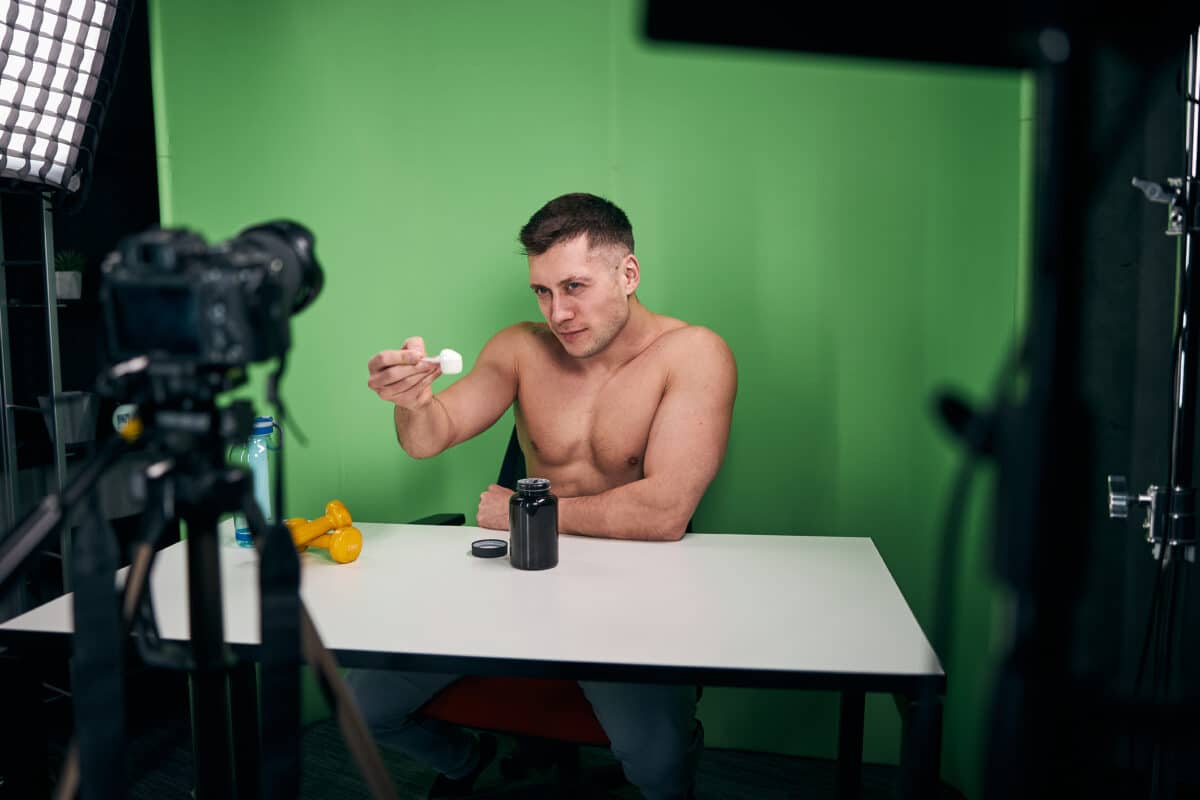
Testosterone and masculinity are not as intertwined as many influencers looking to profit claim. (Credit: Svitlana Hulko on Shutterstock)
How Personal Stories Replaced Science
Social media has transformed how pharmaceutical products reach consumers. Traditional advertising required disclosure of risks and regulatory oversight. Influencer marketing operates in a grayer area, where personal testimonials and lifestyle content blur the lines between advice and advertising.
The testosterone posts deployed sophisticated persuasion tactics. Influencers shared personal stories of struggling with low energy, poor gym results, or relationship problems, then credited testosterone treatment with transforming their lives. When a muscular medical doctor who owns an online testosterone clinic shares his experience having testosterone “as low as a 70-year-old man,” followers see authenticity rather than marketing.
Posts frequently positioned testosterone testing as an act of health empowerment. A functional practitioner told followers to “be your own advocate” and not let doctors dismiss their concerns. A hormone clinic urged men to “Get tested to begin optimizing your testosterone levels and your life today.” This co-opted the language of patient empowerment, repurposing it to sell products.
Here’s the problem: a fitness influencer’s before-and-after photos, showing increased muscle mass after starting testosterone, function as “proof” more persuasive to many followers than published studies. The muscular body becomes evidence of effectiveness, even though many factors influence physique beyond hormone levels.
The financial incentives shape the content. Influencers have no reason to discuss testosterone therapy’s risks because doing so would undermine sales. Posts rebranded what was historically framed as an older man’s problem into an issue affecting men in their 20s and 30s. One influencer claimed most people “don’t have sufficient testosterone to be a normal healthy person,” dramatically expanding who might consider themselves candidates for treatment.
The Real Cost
The consequences extend beyond wasted money. Reported risks of testosterone replacement therapy when used without clear medical indication include cardiovascular adverse events, male infertility, acute kidney injury, erectile dysfunction, and gynecomastia. Without proper clinical evaluation, men may pursue testosterone treatment for symptoms caused by depression, stress, or lifestyle factors that would be better addressed through other means.
Overdiagnosis represents another harm. Many healthy men have testosterone levels that fall below population averages but experience no symptoms. Testing these men and labeling them as having “low testosterone” creates patients out of healthy people. This medicalization can affect men’s self-perception and mental health, causing them to view normal aging or temporary fatigue as hormonal deficiency requiring lifelong treatment.
Recent research from Movember found a correlation between young men engaging with masculinity content on social media and worse mental health outcomes, along with more stereotypical beliefs about gender. While the relationship is correlational rather than causal, the testosterone posts analyzed in this study contribute to these patterns by suggesting men’s worth depends on their hormone levels and physical appearance. They prey on insecurities about sexual performance and relationships, then offer testosterone products as solutions.
What This Means for Men
The testosterone influencer economy reveals a troubling reality: profit-driven health advice is now packaged as empowerment and delivered by people who look the part. These influencers have inherited disease-mongering tactics pharmaceutical companies used for decades, but with a modern twist. They reach younger audiences through platforms where traditional advertising regulations don’t apply. They blend medical credentials with personal narrative in ways that make skepticism feel like defeatism.
For men scrolling through social media, the takeaway should be simple. When someone with financial ties to testosterone products tells you that your hormone levels define your masculinity, they’re selling something. When they share transformation photos without mentioning risks, they’re not being honest. When they encourage you to bypass your doctor’s skepticism and “be your own advocate” by purchasing their tests, they’re not empowering you. They’re converting you into a customer.
The muscular bodies, the confident testimonials, the promise of becoming your “best self,” it’s all part of a business model that profits from men’s insecurities. Real health advocacy doesn’t come with discount codes.
Disclaimer: This article discusses research findings about social media marketing practices related to testosterone products. It is not medical advice. If you have concerns about testosterone levels or related symptoms, consult a qualified healthcare provider for proper evaluation and evidence-based guidance.
Paper Notes
Study Limitations
The study analyzed English-language posts from accounts with over 1,000 followers, which may not capture all testosterone-related content on social media. The sample was limited to Instagram and TikTok and may reflect an Anglo-centric orientation due to the search methodology using a University VPN in Australia. The analysis focused on posts mentioning sexual symptoms or masculinity, representing a subset of testosterone content. As a qualitative study, the findings describe patterns in the analyzed posts but cannot quantify the prevalence of these patterns across all social media platforms. The researchers note that while they coded 92.5% agreement on themes, interpretation of performativity and gender construction involves subjective analysis. Additionally, posts were sampled at a single point in time, so evolving content strategies may differ.
Funding and Disclosures
BN and TC are funded through Australian National Health and Medical Research Council Emerging Leader Research Fellowships (1194108 and 2009419). This specific work did not receive any funding. BN and EGG are current members of the International Scientific Committee of Preventing Overdiagnosis. The authors declare no competing financial interests. The study received ethics approval with a waiver of consent from The University of Sydney Human Research Ethics Committee (2023/913) as the material analyzed was publicly available.
Publication Details
Authors: Emma Grundtvig Gram (Center for General Practice, Department of Public Health, University of Copenhagen, Denmark; Sydney School of Public Health, Faculty of Medicine and Health, The University of Sydney, Australia), Barbara Mintzes (Sydney School of Pharmacy, Faculty of Medicine and Health, The University of Sydney, Australia), Tessa Copp (Sydney School of Public Health, Faculty of Medicine and Health, The University of Sydney, Australia), Ray Moynihan (Sydney School of Public Health, Faculty of Medicine and Health, The University of Sydney, Australia; Institute for Evidence-Based Healthcare, Bond University, Australia), Anthony Brown (Health Consumers NSW, Australia; Centre for Male Health, Western Sydney University, Australia), Patti Shih (Australian Centre for Health Engagement, Evidence & Values, Wollongong University, Australia), Brooke Nickel (Sydney School of Public Health, Faculty of Medicine and Health, The University of Sydney, Australia) | Journal: Social Science & Medicine, Volume 393 (2026), Article 118903 | DOI: https://doi.org/10.1016/j.socscimed.2025.118903 | Received: 29 May 2025; Received in revised form: 14 December 2025; Accepted: 22 December 2025; Available online: 26 December 2025 | Open Access: Published by Elsevier Ltd. under the CC BY license (http://creativecommons.org/licenses/by/4.0/)