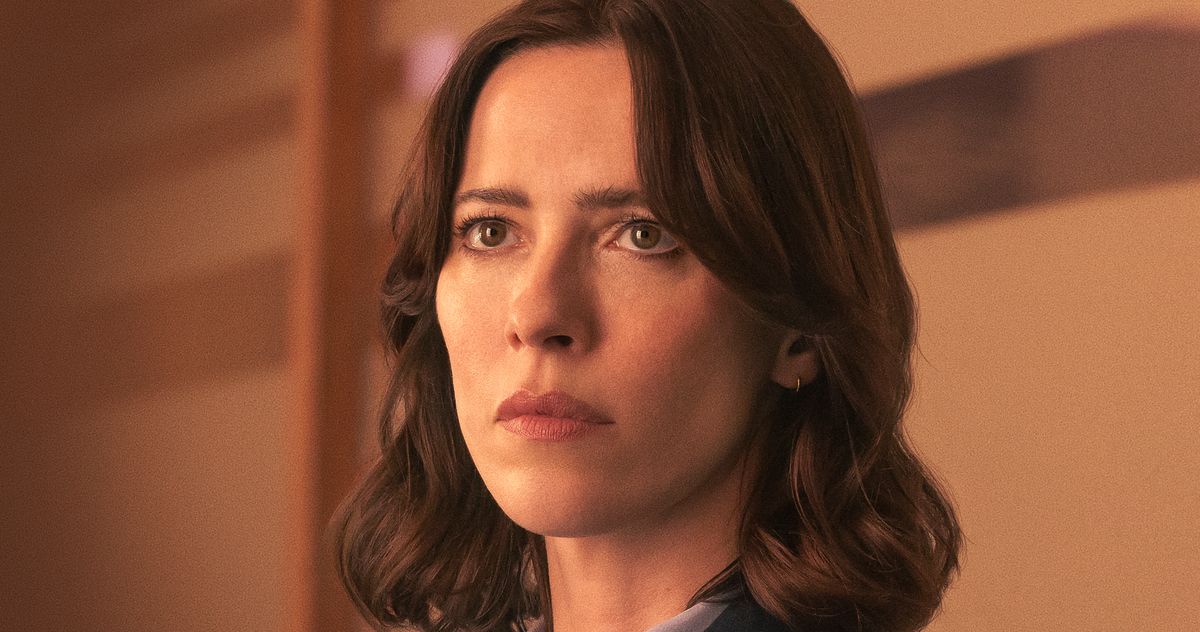
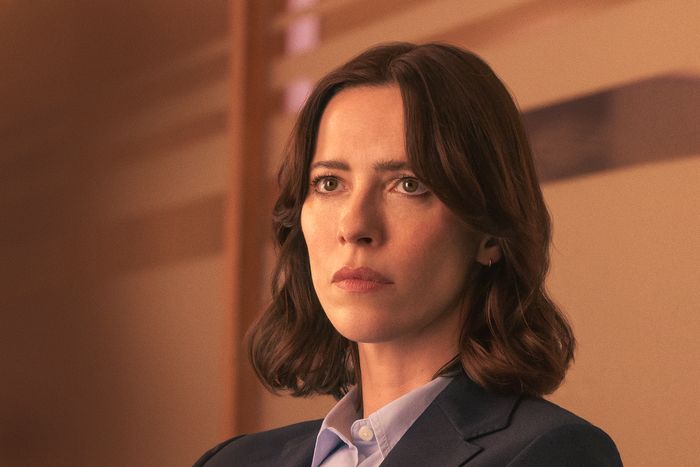
What happens when Rebecca Hall, a statuesque woman with a face meant to be painted by John Singer Sargent, turns into a more beautiful person? It should not be possible!
Photo: Philippe Antonello/FX
The basic conceit of the Grand Guignol thriller that is Ryan Murphy’s The Beauty consists of a thematically underbaked but ultimately pretty fun blend of The Substance and sexually transmitted disease. A crazed scientist (Ashton Kutcher, mostly yelling) has come up with a concoction that makes people molt into their most beautiful selves, but a version of it leaked before it could be fully refined and, in addition to turning people hot (figuratively), the virus turns them hot (literally) until, finally, they explode. (This is what happens to a character played by Bella Hadid in the show’s opening sequence.) But before the artificially hot people of The Beauty explode, there’s a period of time when they are simply carriers for the hotness virus, and during that time, they can spread it by exchanging liquids with other less hot people — mostly through sex, though one case develops after blood hits a character’s eye. Those people become hot in turn, and they continue to spread the infection because now everyone wants to sleep with them.
There’s a perverse streak of what is either Hollywood metacommentary or simple cruelty in the fact that The Beauty has cast actors whom the industry might consider unappealing, then recast them with other, hotter actors once the Beauty takes hold. In the show’s first episode, Jaquel Spivey, who starred in the Broadway production of A Strange Loop, a musical about the experience of being a self-hating fat gay Black man, is introduced as a loathsome incel. Later on, he catches the Beauty virus and turns into Jeremy Pope, another theater actor who has become a Murphy regular and who has cheekbones that, as my co-worker put it, look like they were carved by a gay surgeon. In the third episode, Ben Platt, who is delightful as a Vogue assistant editor gossiping with Meghan Trainor, catches the bug and, as we discover in episode four, turns into a supremely chiseled Isaac Cole Powell (maybe most notable for appearing in Ivo Van Hove’s West Side Story). But the virus doesn’t just turn gay men who might play Seymour in Little Shop of Horrors into gay men who might still get cast as Seymour but controversially, because now Seymour is too hot. It affects women too! Rebecca Hall plays an impossibly chic British FBI agent investigating the string of hot-person body explosions with Evan Peters, who cannot deliver a proper French pronunciation to save his life. In the process of their investigation, Hall’s character ends up catching the beauty bug from a casual hookup she participates in because it’s easier than confronting her feelings for Peters’s character.
What happens when Rebecca Hall, a statuesque woman with a face meant to be painted by John Singer Sargent, turns into a more beautiful person? It should not be possible! Beauty is, sure, in the eye of the beholder, but with her sylvan Pre-Raphaelite bearing, Hall has a striking presence, and the camera loves her, which makes her a very good film actress. But because The Beauty has a plot to carry on with, and because Hall’s agent clearly signed her up for only a few episodes (smart move), The Beauty decides that, once Hall’s character is infected, she’ll explode like everyone else and morph into the actress Jessica Alexander. Alexander is also a gorgeous person and I’m sure lovely. But the camera does not love her in the same way that it does Hall. Alexander does not possess Hall’s je ne sais quoi, which goes beyond the mathematical proportions a plastic surgeon might recommend and toward an innate sense of style. Whenever you see any photos of the cast of The Beauty together, Hall is inarguably eating everyone up around her on the red carpet.
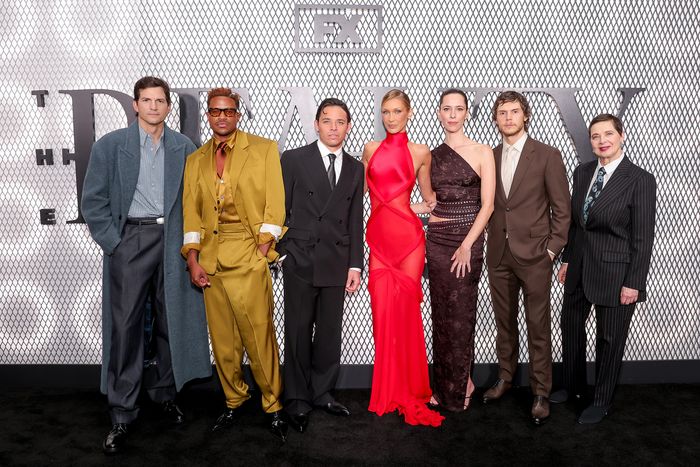
Hall, third from right, though you didn’t need me to tell you that.
Photo: Frank Micelotta/FX via Getty Images
I am not convinced that, if this disease is supposed to project an objective improvement in beauty, it is doing a good job. Early on, the series establishes that Hall’s character is self-conscious about the size of her breasts and has considered getting implants. This is meant to indicate to the audience that she is plain and that we should relate to her feelings of inadequacy because everyone has them. But the show doesn’t take the next step and introduce the idea that the Beauty virus turns you into the type of beautiful you specifically wish you were. There’s a lot of thematic mileage in that; it would be interesting to send up the notion of people rejecting their own distinctive qualities in favor of a generic blandness.
It wouldn’t hurt The Beauty to become two ticks closer to a collegiate philosophy seminar — ask some big questions, or at least have a little fun with the concept. Replace Hall with an actress who has a distractingly gigantic bust or who’s randomly American and blonde. (Have you ever seen Starter for 10? Isn’t it crazy that that movie insists that James McAvoy would think Rebecca Hall is a step down from a supposedly hotter woman played by Alice Eve?) Or play with that trope with the other transformations. There’s no apparent reason that Platt or Spivey turn into, specifically, someone who looks like Pope or Powell, other than “they’re hot.” As in many a Murphy project, spectacle takes precedence over complexity.