“About 15 years ago, Grinds Pouches arguably created the category by targeting the niche market of baseball players who wanted an alternative to chewing tobacco…but today’s nicotine-free mouth pouches (like ULTRA) aren’t marketed necessarily as tobacco use cessation products,” said Joshua Schall, president of J. Schall Consulting. “Instead, they’re packed with caffeine and/or nootropics…providing a healthier (and safer) alternative for consumers utilizing ZYN for cognitive enhancement.”
Fast forward to 2026: Pouches are no longer niche. Take focus pouch brand Ultra for example. Last month, the brand announced it raised $11 million in Series A funding to help accelerate product development, distribution and staffing needs. Despite just launching last May, Ultra has managed to scale at an impressive pace, selling 1,000,000 cans within its first 6 months of launch.
Having celebrity endorsements also didn’t hurt sales. Athletes and investors endorsing or using Ultra include NFL quarterbacks Joe Burrow and Dak Prescott, Olympic skier Lindsey Vonn and UFC fighter Nate Diaz, to name a few.
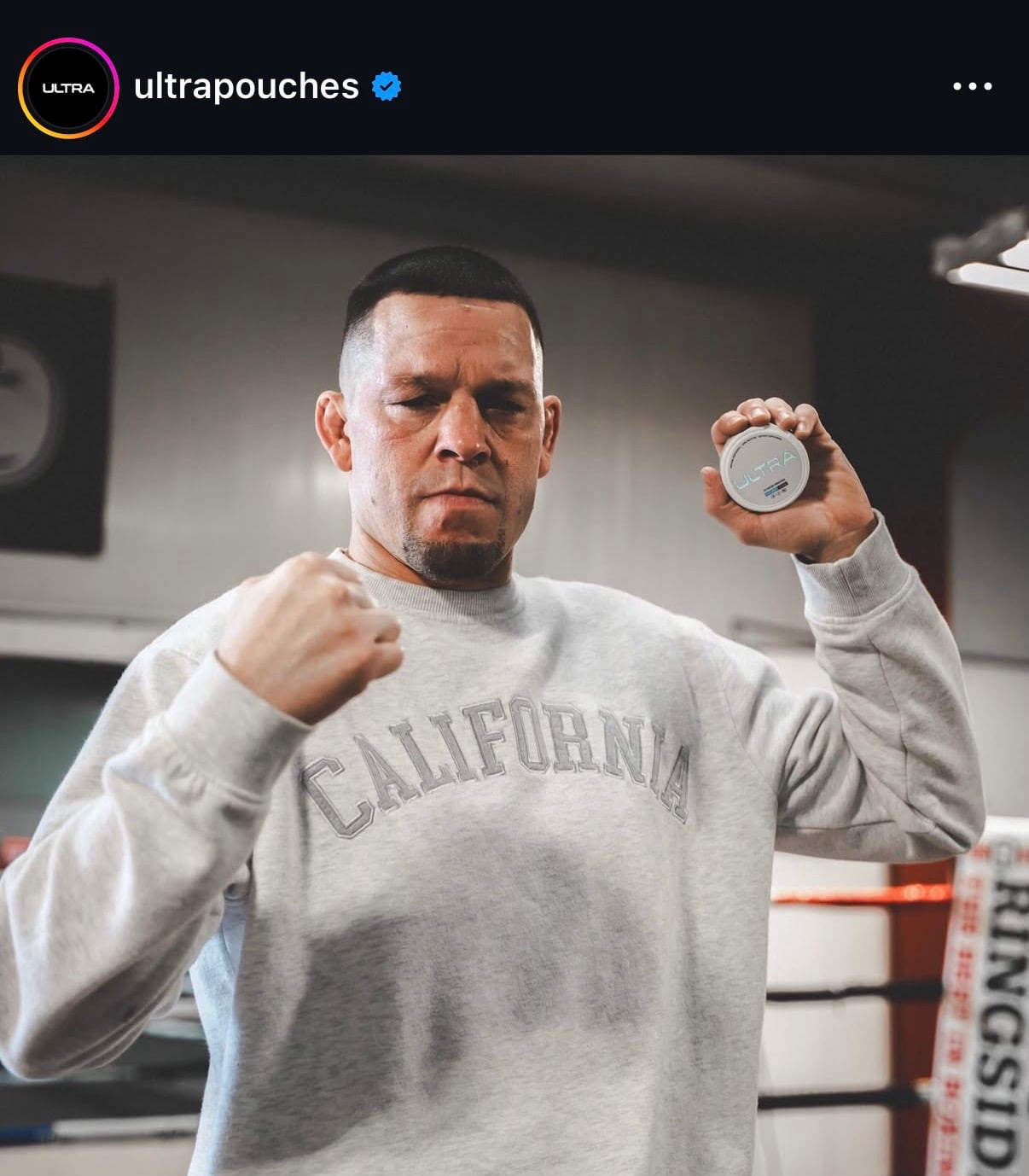 Nate Diaz endorses Ultra Pouches. (Ultra Pouches Instagram)Ingredient profile
Ultra’s hero ingredient is enfinity, the branded ingredient known as paraxanthine, a downstream metabolite of caffeine. Other functional ingredients include L-theanine, Alpha GPC, vitamins B6, B12 and ginseng root extract.
Tom Gourley, North American sales manager at TSI, the exclusive global distributor of enfinity, said paraxanthine offers a wide range of benefits, including enhanced cognitive performance and productivity, improved blood flow and increased thermogenesis.
“These performance attributes make enfinity an attractive option for brands formulating next‑generation energy, workout, nootropic and weight‑management products,” he said.
Not your granpappy’s chew
Gourley told NI that energy continues to be one of the fastest‑growing needs within the active nutrition category, driven by younger consumers who seek cleaner, more consistent stimulation that fits their busy lifestyle.
“As demand evolves, brands are exploring new delivery formats beyond traditional powders to deliver active ingredients quickly, conveniently and in line with modern consumer expectations,” he said.
TSI expects the market for non‑traditional and portable active‑nutrition formats to continue growing as brands focus on convenience, experiential design and multi‑ingredient formulas that support cognitive performance, productivity and clean energy.
“As this category expands, ingredients like enfinity—supported by science and consumer‑preferred experiences—will continue to play an important role in shaping the next generation of energy and nootropic innovation,” Gourley said.
A regulatory blind spot?
How regulators interpret this growing category will also play an important role.
“These types of products seem to be increasing in popularity, and we have yet to see how the FDA will regulate them,” observed Shelly Blackwell, Sr. director of dietary supplement and tobacco consulting services at EAS Consulting Group.
“If they are classified and marketed as a dietary supplement, the product must be ingested, so directions for use would be critical. Additionally, as a dietary supplement, the labeling regulations and cGMP’s would apply. I would imagine a risk would be ensuring the claims are acceptable for dietary supplements, and do not veer into drug type claims (e.g. smoking cessation),” she said.
Asa Waldstein, founder of Apex Compliance, a software that identifies risky marketing terms and suggests lower-risk alternatives, echoed a similar sentiment: “Some pouches are more likely to be considered supplements if they are consistent with ingestion (e.g., swallow) and they avoid sublingual/oromucosal drug-type positioning. Others appear to ‘borrow’ nicotine pouch marketing (e.g., ‘nicotine-free’), which can create classification and consumer-perception issues even though it may be labeled as a supplement.”
“If FDA were to scrutinize the category, I’d expect them to look deeper into manufacturing compliance and adulterant testing,” he added.
Waldstein suggests pouch brands focus on the basics, which include:
Dietary supplement labeling compliance (SFP and label layout)Avoid making sublingual claims Avoid making disease claimsUse caution with common litigation triggers such as “clinically proven,” “Made in the USA” or “All natural”Schall’s crystal ball
Ingredients and regulations aside, a number of other factors at play will help determine the success of this next generation of energy.
“So, what could happen if convergence between ‘mouth pouches’ and ‘energy’ categories strengthen?” Schall asked. “In the next decade, the nicotine-free mouth pouch U.S. market could expand beyond a billion dollars…BUT only if convenience stores believe in (and support) the ‘energy’ category format shift.
CPG is experiencing a cultural shift toward minimalism, as a growing number of active consumers and athletes choose discreet mouth pouches over conspicuous energy drinks with loud logos. While the demand is certainly there, Schall suggests that ultimately the success of this quieter format may not lie in consumer’s hands at all.
“The question comes down to if gatekeepers within this categorically important sales channel see a future where energy drinks are no longer basically aspirational mixtures, representing taste and identity by association…with consumers instead desiring a more discreet, portable performance habit,” he said.