Unlock the Editor’s Digest for free
Roula Khalaf, Editor of the FT, selects her favourite stories in this weekly newsletter.
When we eat, we inevitably end up thinking in economic terms.
When deciding whether to cook, we might think about comparative advantage (you could make dinner from scratch, but your time might be more valuably spent finishing some work). If we’re grabbing lunch near the office, we might run a mental cost-benefit analysis (will that £13 sandwich make me proportionally happier than a £4 meal deal?). And popping out for a Freddo, we’ll undoubtedly think about inflation.
If we thought more about economics when choosing our food . . . would we eat better? For Tyler Cowen, the answer is a thumping “yes.”
The world’s foremost economist-gastronome has been writing about food for the last several decades, on his blogs Marginal Revolution and Tyler Cowen’s Ethnic Dining Guide, as well as his 2012 book ‘An Economist Gets Lunch.’ He recently spoke to Soumaya Keynes on the Economics Show podcast to talk about his updated rules for eating.
Some of Cowen’s rules are common sense: if you’re in a touristy area, go down the road. If you live somewhere that doesn’t have top-of-the-line ingredients, prioritise restaurants where chefs combine those ingredients in a way that takes a lot of skill.
So far, so clear. But some of Cowen’s tips for good eating are a little more off-the-wall. One example: if you want good food, eat where clever people eat. Alphaville’s emphasis below:
Tyler Cowen:
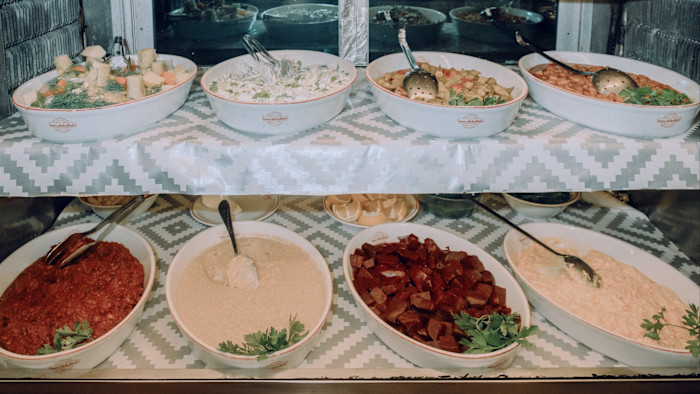
And there’s such density of office space in London you do have a lot of choices . . . It’s a very good place to get pretty good lunch food. So if you’re out, say by Google DeepMind where I was not too long ago, I walked outta the office, I had given a talk and I saw a Turkish place.
It’s the first thing you see as you head to the main road. It was quite good and I knew it would be quite good ‘cause there’s people with some wealth, very high intelligence nearby, and they need something quick, but they want it to be good. And I ate there and I was quite confident and it delivered.
Soumaya Keynes:
You just said very high intelligence. Do you think that that’s correlated with your ability to discern good food?
Tyler Cowen:
Of course, you know, it correlates with many things. Your ability to discern what are good books or good newspaper articles. It’s correlated with intelligence. And if there’s anywhere that has high intelligence, it’s Google DeepMind.
Now, they’re not the only people who work there, but in general, it’s a neighbourhood with a lot of finance, a lot of people who are highly analytical. XTX is nearby and uh, yeah, that makes the Turkish place better on average.
Soumaya pushed back, suggesting the kind of intelligence that DeepMind or XTX people value may not be the kind that helps you find a good lahmacun. Cowen countered:
I’d say there’s a sizeable research literature showing that higher smarts are correlated with skill in many, many, many things. I’ve never seen a paper on smarts and taste in food, but it would be shocking if that were somehow an exception.
At this point, we invite you to think about any computer programmers, software engineers, or high-frequency traders you may know, and whether you think they eat especially well. Answers in the comments below, please.
Meanwhile, if you want to hear more from Cowen and Soumaya, including . . .
How restrictive immigration politics have made Italian food worse
Why French labour laws are ruining the French formule
What to eat in a strip mall
. . . then listen to The Economics Show with Soumaya Keynes, and share your thoughts below. The full transcript is here.