
Get the Popular Science daily newsletter💡
Breakthroughs, discoveries, and DIY tips sent six days a week.
In a British propaganda poster from World War II, an illustration in shadowy tones captures a dramatic nighttime scene: a woman and young girl peer around a black automobile, as if looking for a quick escape. In the woman’s hand is…a basket with carrots?
“CARROTS,” the poster blares, “keep you healthy and help you to see in the blackout.”
The poster, a creation of Britain’s Ministry of Food, was one part of a wartime nutritional propaganda campaign that had all kinds of goals during the war. Amid rations and food shortages, one aim was to encourage the consumption of an oversupply of carrots.
Another was to trumpet the success of John Cunnigham, an ace Royal Air Force fighter pilot nicknamed “Cat’s Eyes” who was known for his nighttime prowess, according to the Battle of Britain London Monument. News stories credited his success with his carrot consumption. In reality, he was using a new radar technology.
“It would have been easier had the carrots worked,” Cunningham later said. “In fact, it was a long, hard grind and very frustrating. It was a struggle to continue flying on instruments at night.”
But even if carrots didn’t help Cunningham, the idea that carrots help your eyes persists nearly a century later—perhaps because there is some level of truth to it. Carrots do support eye health and even our nighttime vision, tells Popular Science Dr. Jonathan Rubenstein, chair of the ophthalmology department at Rush University Medical Center. But there’s a limit to what carrots can do for our eyes.
“People shouldn’t think, ‘I’m going to load up on carrots and I’ll see better,’” Rubenstein says. “That’s not true.”
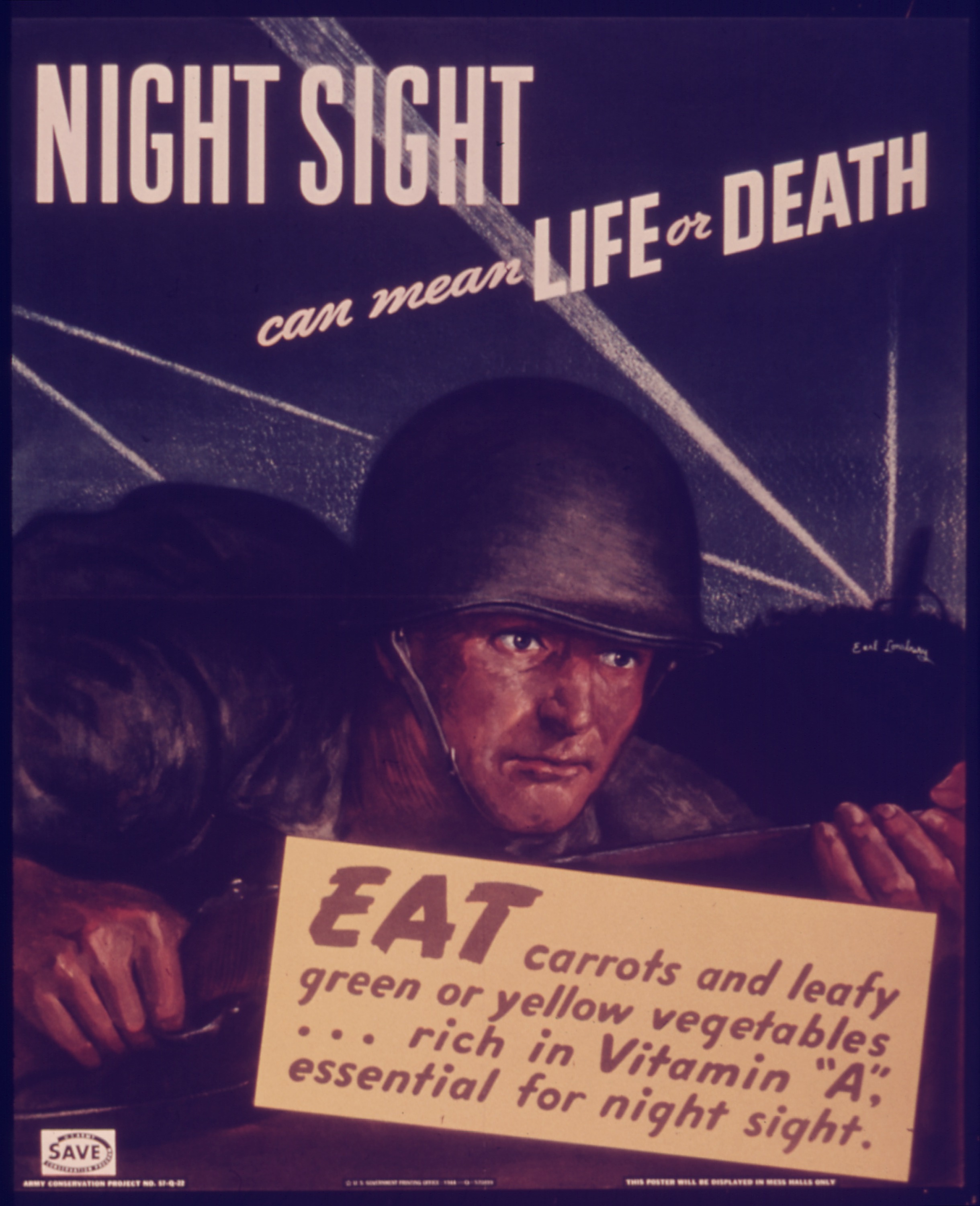 During World War II, carrots were touted for their ability to improve your eyesight, but the reality is more complicated. Image: Public Domain
How do carrots help our eyes?
Carrots are a rich source of beta-carotene, a pigment that gives carrots and other orange colored produce their color. Leafy greens like spinach and kale also are rich sources of beta-carotene, but the green chlorophyll that they contain hides that orange color.
Our bodies are designed to turn beta-carotene into vitamin A. When we eat food rich in beta-carotene, the pigment travels to our intestines where an enzyme breaks it down and converts it into vitamin A.
“Vitamin A is a useful vitamin to have in the body for overall health, but specifically for retina health,” Rubenstein says. Our retinas are thin layers of tissue in the back of our eyeballs that turn light into electrical signals, which travel through the optic nerve to our brains where they’re interpreted as vision.
Retinas include two kinds of cells that detect light—rods and cones. Cones help us to read and see colors, while rods help with night and peripheral vision.
Both rods and cones need vitamin A to function normally, but rods, in particular, are more affected by a vitamin A deficiency, Rubenstein says. Without vitamin A, the rods can’t produce enough rhodopsin, a light-sensitive protein that requires vitamin A as a key component. Without enough rhodopsin, rods can’t work as well. If the rods don’t work well, then your night and peripheral vision suffers.
“The metabolism of how the rods in the retina work can be altered by a lack of vitamin A,” he says.
In fact, night blindness can be a first sign of a vitamin A deficiency, according to the NIH. And a lack of the nutrient is an issue globally. A vitamin A deficiency is a leading cause of preventable blindness, impacting as many as 30 percent of children under age five, research shows.
A vitamin A deficiency also can lead to other issues, including severe dry eyes and scarring of the eye, Rubenstein says. “But we only tend to see a true vitamin A deficiency in underdeveloped countries or in people that are on some sort of very unorthodox fad diet that’s not monitored by healthcare professionals.”
Related ‘Ask Us Anything’ Stories
What should we eat to improve our eyes?
For most of us, a typical balanced diet that includes foods rich in beta-carotene is sufficient to protect our retinas’ rods and cones. “In a normal American population, we get enough vitamin A in our diet that we probably don’t have to eat extra carrots,” Rubenstein says.
In fact, increasing your carrot intake to “super levels,” he says, doesn’t help either. It can lead to carotenemia, a reversible and harmless condition that turns your skin a yellow-orange color after you’ve consumed too much beta-carotene.
What’s more, if you’re focused on eye health, vitamin A isn’t the only nutrient your eyes need. Omega-3 fatty acids from fatty fish, such as salmon, and vitamin E, such as from nuts, could provide some preventative effect for macular degeneration, a common eye disease for older adults, Rubenstein says.
Cataracts is another age-related eye condition that can cause vision loss. There’s some evidence that vitamin C from oranges and other fruits could provide some protection against them, along with not smoking, and, for those who spend a lot of time in the sun, wearing sunglasses that protect against ultraviolet light, Rubenstein says.
In other words, Rubenstein says, the best diet for eye health is a balanced one. He recommends the Mediterranean diet because it’s rich in all kinds of vegetables, fruit, fish and nuts and provides a range of nutrients that can support good eye health. Carrots play just one role.
“Eating carrots doesn’t cure anything. It doesn’t make your eyesight better,” Rubenstein says. “It’s one of the food sources that adds to eye health.”
In Ask Us Anything, Popular Science answers your most outlandish, mind-burning questions, from the everyday things you’ve always wondered to the bizarre things you never thought to ask. Have something you’ve always wanted to know? Ask us.

2025 PopSci Best of What’s New
The 50 most important innovations of the year