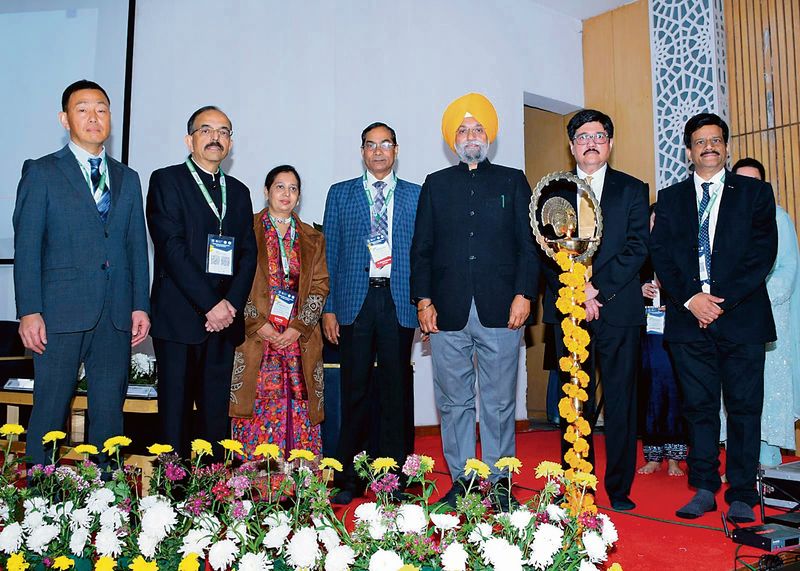
The International Conclave on Sustainable Agriculture, Food, Health and Agri-Logistics (IC-SAFHAL) commenced at Guru Granth Sahib Bhawan, Guru Nanak Dev University, bringing together eminent scientists, policymakers, international experts, clinicians and academicians from India and abroad to deliberate on sustainable and future-ready solutions across agriculture, health and nutrition sectors.
Vice-Chancellor Prof Karamjeet Singh delivered the inaugural address, emphasising interdisciplinary innovation, sustainability-driven research and global institutional partnerships. Dr Pratap Kumar Pati, Coordinator, CARI (Central Ayurveda Research Institute), and an agricultural scientist, played a key role in conceptualising and coordinating the conclave.
Day 1 of IC-SAFHAL demonstrated how converging advances in sustainable agriculture, nutraceutical science, healthcare innovation and nutrition can directly benefit society by improving food systems, preventive health and environmental resilience. “The MoU exchanges, international participation and interdisciplinary dialogue are expected to translate into joint research, technology transfer, skill development and community-level outreach programmes. The conclave sets a strong foundation for science-to-society impact by promoting affordable innovations, sustainable practices and evidence-based wellness solutions for long-term public benefit,” said Prof Pati.
A major milestone of Day 1 was the exchange of two important MoUs aimed at strengthening international and national collaboration.
The first was signed between AIST (Japan) and GNDU, exchanged in the presence of Dr Sunil Kaul, Chief Senior Research Scientist, AIST, Japan, to advance cooperation in life sciences, biotechnology, nutraceuticals and sustainable innovation.
The second MoU was signed between IAPEN and GNDU, and exchanged with Guljeet Kaur, Head, Department of Clinical Nutrition, Fortis Escorts Hospital, to promote academic, clinical and outreach collaboration in nutrition and dietetics.
Another key highlight of the inaugural ceremony was the release of the workshop proceedings titled, “Water Resource Management in Punjab: From Fragmentation to Collective Stewardship” by Dr SS Kukal, Lead, Environment and Climate Change Centre, MGSIPA, Chandigarh, underscoring the importance of integrated and policy-oriented approaches to water governance.
The addresses were delivered by distinguished guests of honour including Dr Nemkumar (Nemy) Banthia, CEO & Scientific Director, IC-IMPACTS, Canada; Dr Motomichi Doi, Deputy Director General, LS-BT, AIST, Japan; and Dr Usha Dixit, Scientist-F, DST, Government of India. The chief guest, Dr Trilochan Mohapatra, former Director General, ICAR and Chairperson, PPVFRA, addressed the gathering and highlighted the need for science-driven, farmer-centric and innovation-led development.
Dr Motomichi Doi (AIST, Japan) and Dr Sowmya Subramanian (McGill University, Canada), also held a session on “Innovating Agriculture for a Sustainable and Smart Future” with coordination by the faculty from Department of Agriculture, GNDU. The session emphasised climate-resilient agriculture, precision farming, biotechnology, biostimulants and circular bioresource utilisation.
Distinguished speakers included Dr Stanford Blade (ICRISAT) who presented recent breakthroughs in dryland agriculture research and innovation; Dr Nobutaka Mitsuda (AIST, Japan) who discussed plant transcription factor engineering for sustainability; Dr Sudesh Kumar Yadav (CSIR-IHBT), who spoke on Himalayan bioresources and sustainable harvesting; and Dr Shingo Sakamoto (AIST, Japan), who highlighted advances in cell wall engineering for future agriculture. The talks underlined the integration of biological inputs and data-driven systems to build resilient agricultural ecosystems.
A session on “Future-Ready Healthcare: Integrating Nutraceuticals and Bioinformatics for Disease Prevention and Wellness” was chaired by Dr Sunil Kaul (AIST, Japan) and led by Dr Radha Kanta Ratho (PGIMER, Chandigarh).