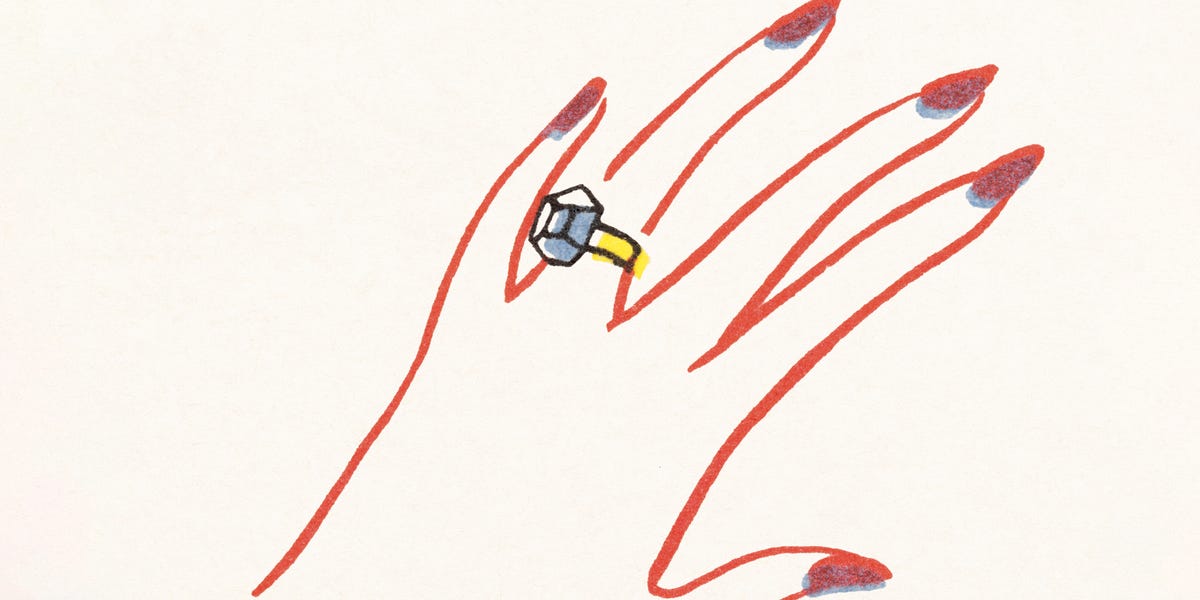
The discourse was relentless. Late last year, after 27-year-old fashion merchandiser Abby Bucco took to social media to innocently debut the vintage engagement ring her mom and fiancé picked out for her, strangers’ commentary immediately poured in. The piece had a sweet origin story: She’d seen an ad for it on Instagram and excitedly showed it to her mom. As it turned out, her mom had seen the same ad days earlier, and she and Abby’s fiancé were already in touch with the owner to buy it. Spectators online, however, didn’t latch onto this adorable coincidence. They were instead fixated on the ring’s specificities.
It was as though every young person with internet access and an opinion felt it was their duty to break down every single thing they saw wrong with its toi et moi structure (when two stones are placed next to each other). One commentator called it a “sensory nightmare,” while others likened its shape to a can opener. Abby tells Cosmopolitan that she liked the intricate piece because of how specifically it represented her, her relationship, and her personal style. “My fiancé has a big personality; he’s unique and fun. Our relationship is unique and fun. My ring is just another extension of us.” And although none of her comment-section warriors will ever have to wear the ring themselves, its backlash became a striking public example of the scrutiny brides face when they prioritize singularity over tradition, something many more are opting to do these days.
Related Story
According to jewelers, demand for custom designs has increased significantly over the past few years, and recent trend reports cite personalization and bespoke elements as common priorities for ring shoppers. The ring-shopping process itself has also become far more collaborative: according to The Knot’s 2024 Jewelry & Engagement Study, 77 percent of proposees had some level of involvement in selecting their ring. That collaboration makes it easier for the final choice to accurately reflect the wearer’s personal style. As a result, couples who dare to be different are turning to vintage rings, specific metal choices (like white gold), unique cuts (think elongated hexagons and Dutch Marquises), and personal details like heirloom stones or band engravings.
“People want to have an identity—they want their ring to be an expression of themselves,” says Susie Saltzman, a New York–based custom engagement ring designer. She attributes the surge in bespoke rings to social media, which has only increased the number of rings we’re served by the algorithm each day, and has over-familiarized us with their popular elements—even when a cool east-west setting or colored-stone trend emerges. “Trends take off overnight, so designs can be replicated quickly and more easily than ever. It leaves us in a sea of sameness.”
Commenters often respond not just to the ring but to how it makes them feel about their own tastes, choices, or expectations around romance and wealth.
So, in this grand year of 2026, as princess and emerald cuts dominate Instagram feeds, why are the refreshing, unique picks still so polarizing? Jade Sammour, founder of jewelry brand Dainty London, says it’s because they challenge the bounds of what we’ve been taught to expect from engagement rings. “Many people celebrate originality, but others subconsciously measure rings against familiar standards tied to status, symmetry, or classic luxury aesthetics,” she says. “When a ring departs too far from those norms, it can trigger reactions that are less about the design itself and more about what the ring represents culturally.”
Jade also theorizes that online critics may be projecting a tad. “There’s a performative aspect to social platforms….Commenters often respond not just to the ring but to how it makes them feel about their own tastes, choices, or expectations around romance and wealth.”
Wedding culture sustains itself on tradition and ritual. While subtle winks of originality are easy to celebrate (like unique ceremony color palettes or the rise of private vow exchanges), it can be difficult for spectators (from your distant aunt to a casually scrolling stranger) to think outside the box when it comes to something as precious as the ring—especially without context about the personal story attached to it. But the “if you know, you know” factor is exactly what draws brides like Abby to one-of-a-kind pieces. “[Getting married] has become a weirdly performative time in your life,” she says. “No one else will have the same ring as you, just like no one has the same relationship as you. Everything about your engagement should feel personal.”
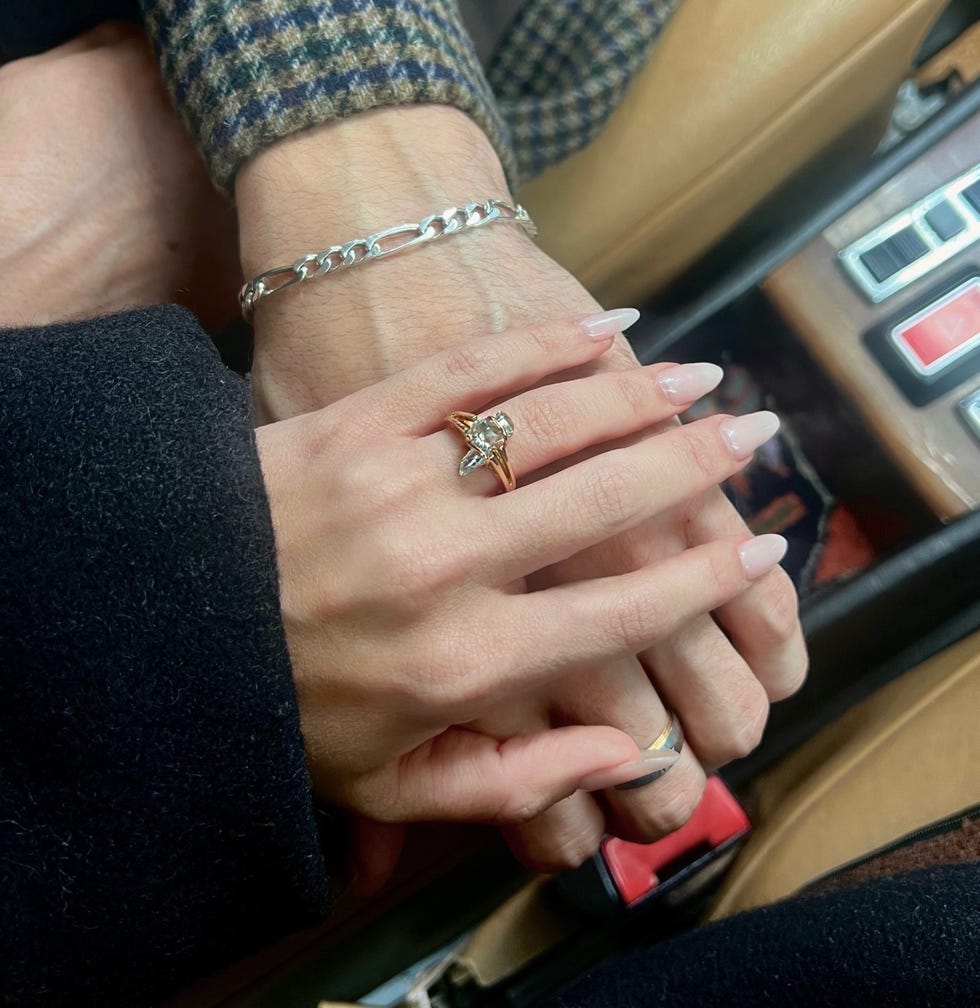
Raya Carmona agrees. The 32-year-old vintage store owner wears a vintage raw, uncut diamond set in a custom gold band designed to wrap around the stone—something she and her partner chose together. It received its fair share of questioning from people in her circle. “I have a big Cuban family with a lot of opinions, so we have this great dynamic where they’re always going to share their opinions, and I’m mostly going to ignore it and do what I want anyway.” Still, her piece allowed her and her fiancé to redefine what “traditional” means for them.
 Instagram
Raya Carmona’s engagement ring
“My favorite thing about my ring is that it still feels semi-traditional to me,” she says. “I love that it’s more of a rock than a diamond [because] it’s really low clarity and weirdly shaped. It challenges the idea that these natural things (diamonds) don’t need to subscribe to the man-made standards that we’ve been taught to hold them to.”
She advises brides looking to subvert ring norms to just block out outside noise. “The most important thing to remember is that you’re the one who has to wear it every day, so your opinion is really the only one that matters,” she says. “If you love something, why let anyone get in the way of that?”
The road less traveled will always invite backlash, no matter the context. What’s important to remember when standing by your unique ring choice is that we, as people, are inherently polarizing. Any piece that accurately reflects the complexity, specificity, and imperfections of our humanity is bound to draw the same “love it or hate it” divide that our unique personalities do.
There’s no requirement for your ring to be something that people—particularly those who only interact with it in passing or on Instagram—need to understand, especially if it exists to tell your story. That awareness is how, in the aftermath of her viral TikTok backlash, Abby found a deeper appreciation for everything only she understood about her ring choice. “I know it’s not for everyone, that’s why I picked it [for me].”
Related Story
Annabel Iwegbue is a culture editor at Cosmopolitan, where she primarily covers pop culture, lifestyle, relationships, and digital trends. She previously wrote for Harper’s Bazaar, The Knockturnal, and Black Film. She’s originally from Charleston, South Carolina, and is currently based in Brooklyn, New York. She holds a B.A. in Journalism and Cinema Studies from New York University. You can check out some of Annabel’s work here and also find her on Instagram and Twitter.