Cell lines
All leukemia cell lines are human-derived. THP1 (Male, TIB-202), HL60 (Female, CCL-240), KG1a (Male, CCL-246.1), and CCRF-CEM (Female, CCL-119) are from American Type Culture Collection (ATCC, Manassas, VA). Molm-13 (Male, ACC 554) and P12-ICHIKAWA (Male, ACC 34) are from Leibniz Institute DSMZ. Molm13, HL60 and KG1a were maintained in IMDM (Gibco™, Thermo Fisher Scientific) with 20% fetal bovine serum (FBS, Gibco™, Thermo Fisher Scientific). THP1, CCRF-CEM, P12-ICHIKAWA, T-ALL1 and BV173 were maintained in RPMI1640 (HyClone™, Cytovia) with 10-20% FBS. All media contained and 2mM L-GlutaMAX (Gibco™, Thermo Fisher Scientific). THP1-CLLlow was generated through sorting natural CLL1low cells from parental THP1 using SH800S Cell Sorter (Sony Biotechnology). Molm13-CD38KO was engineered by genetic knock-out of hCD38 using a CRISPR/cas9 system described below. All cell lines were subjected to Mycoplasma testing routinely, and have been authenticated with STR analysis in the Cytogenetics and Cell Authentication Core of MD Anderson.
Gene Knock-outs
sgRNA of hCD38 (Target sequence: CGGTCTCGGGAAAGCGCT), hCD3ε (Target sequence: CACTCACTGGAGAGTTCT) and hTRAC (AGTCTCTCAGCTGGTACA) were design using CRISPRscan and COSMID algorithms, and generated by an in vitro transcription system established previously47,48. For knock-out of hCD38 in AML cell lines, briefly, 1 µg of CD38 sgRNA and 1 µg Cas9 protein (Integrated DNA Technologies) were electroporated into 0.25 × 10⁶ Molm13 resuspended in 10 µl buffer R with one 1650-V, 20-ms pulse following the manufacturer’s instruction of Neon Transfection System (Thermo Fisher Scientific). Residual CD38-positive Molm13 cells were further depleted using Magnetic MicroBeads (Miltenyi Biotech). For knock-out of hCD3 and hTRAC in T cells, 1 µg of CD3ε sgRNA and 1 µg Cas9 protein were electroporated into 0.25 × 10⁶ activated T cells at day 2 post-stimulation resuspended in 10 µl buffer T with three 1600-V, 10-ms pulses, and maintained in 2 ml CTL medium containing 20% FBS and 10 ng/ml IL7/IL15 overnight followed by retroviral transduction.
Constructs of SSRs and retrovirus production
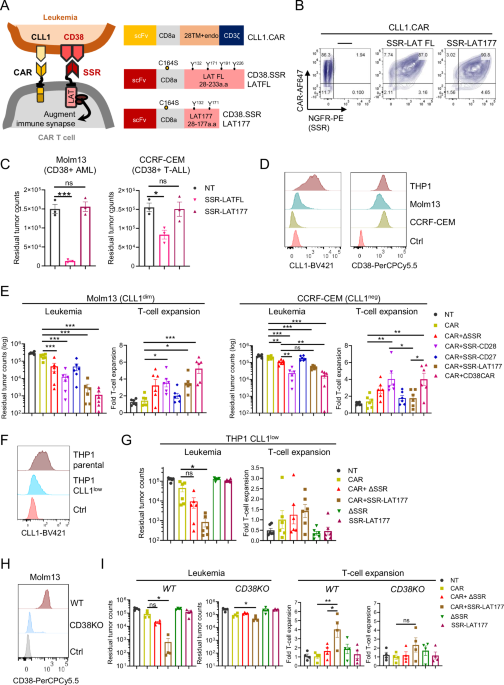
CD38.SSRs were generated by Infusion Cloning (NEBuilder HiFi DNA Assembly, NEB) of synthesized dsDNA of CD38-specific single chain variable fragments (scFv) derived from anti-human CD38 mAb (Clone HB7, Patent No. 770718) with the PCR fragments of CD8α-hinge and transmembrane region including point mutation at C164S and the endo-domains of LAT (28–233a.a or 177a.a) amplified from a human complementary DNA library derived from T cells using CloneAmp HiFi PCR Premix (Takara Bio), followed by Sanger sequencing to confirm identity (Supplementary Fig. 16). CD38 CAR was generated by replacing the endodomain of SSRs with CD28 and CD3ζ domains from a cytotoxic CAR49. To clone GRP78.SSR, the extracellular domain of CD38. SSR was replaced with the PCR fragment of a GRP78-specific peptide CTVALPGGYVRVC fused with a mutant IgG4 hinge and a CD28 transmembrane domain amplified from GRP78.CAR27. Gammaretroviral vector (SFG) supernatant was made from 293 T cells as previously described50. Briefly, 0.6 × 10⁶ 293 T cells were seeded in a well of 6-well plates overnight, followed by transfection with 1.4 µg SFG vector, 1.4 µg Peg-Pam-e (MoMLV gag-pol proteins) and 1.1 µg RD114 (envelope protein) using a polyetherimide (PEI) transfection system under manufacturer’s protocol (PEIpro®, Polyplus). The whole virus supernatant was collected at 48 h or 72 h post transfection and preserved at −80 °C for upcoming transduction.
T-cell activation and transduction
Activated T cells were generated by activating PBMC on 24-well plate pre-coated with 500 µl of 1 µg/ml OKT3 (Ortho Biotech, Bridgewater) and anti-CD28 antibodies (BD Biosciences) for 2 days in 2 ml CTL medium (45% Click’s medium, 45% RPMI1640, 10% FBS and 2 mM L-GlutaMAX). Co-transduction was performed by pre-coating viral supernatant with the CLL1.CAR or Sur-TCR:CD38.SSR ratio 1:1 (1 ml) in RetroNectin (Takara Bio)-coated 24-well plate at 4122 g for 1 h at 32 °C, followed by removal of virus supernatant and spinoculation of 1 × 10⁵ activated T cells in 1 ml CTL medium at 1000 g for 10 mins. The medium was replenished in the next day, and transduced T- cells were expanded and maintained in CTL medium containing 10 ng/ml recombinant human IL7 and IL15. T-cell growth and viability were assessed using Trypan Blue and a hemocytometer. T-cell phenotype was monitored by flow cytometry after T-cell transduction. CAR T cells were collected for functional analysis 7 days post transduction.
For generation of GRP78.SSR armed IL13Ra2.CAR T cells, sequential transduction was performed by transduction of 2.5 × 10⁵ T cells with 500 µl IL13Ra2.CAR viral supernatant on day 2 and 500 µl GRP78.SSR viral supernatant on day 3 post T-cell activation, respectively. CAR expression and T cell phenotype were determined at 5 to 6 days post-transduction.
Co-culture and cytotoxicity assays
To examine the cytotoxicity of CAR and TCR T cells against leukemia cell lines, 20,000 target cells expressing green fluorescent protein and firefly luciferase (GFP.FFLuc) were co-cultured with 5,000 effector cells at a 1:4 E:T ratio without cytokines in each well of a flat-bottom 96-well plate. Residual tumor cells and effector cells were distinguished by GFP expression and quantified on day 0, day 1 and day 3 by flow cytometry using CountBright Counting Beads (Thermo Fisher Scientific), including 7-AAD (BD) to exclude dead cells. To measure cytotoxicity against CD38-postive primary cells, 0.2 × 10⁶ autologous PBMCs isolated from health donors and labeled with 1 μM eFluor 670 (Invitrogen) were co-cultured with 50000 effector cells at 1:4 E:T ratio in 400 µl CTL medium (IL15/1L7 free) in each well of a flat-bottom 48-well plate. Purified NK cells were isolated using EasySep Human NK Cell Isolation Kit (STEMCELL). Residual efluor+ monocytes (CD14+), T cells (CD3+), NK cells (CD3-CD56+) and B-cells (CD19+) were quantified 24 h later by flow cytometry as described above.
To examine the cytotoxicity of IL13Ra2.CAR T cells against solid tumor cells in luciferase-based assays, 30,000 Firefly luciferase (ffLuc)-expressing tumor cells were seeded onto 96-well/white clear bottom plate (Thermo Fisher Scientific) and incubated with varying amounts of CAR T cells to assess cytotoxicity at a range of E:T ratios. Twenty-four hours later, the remaining tumor cells were quantified by luminescence when adding D-luciferin (Perkin Elmer) at 0.3 mg/mL in tumor media. Media only and tumor only served as controls to assess percent cytotoxicity. Luminescence was measured by using an Infinite200 Pro MPlex plate reader (Tecan, Männedorf, Switzerland).
Primary AML
For co-culture with primary AML blasts, 50,000 PBMCs isolated from patients with AML (recruited to the CARMEN study NCT04219163) were labeled with 1 μM eFluor 670 (Invitrogen), and co-cultured with 50,000 effector cells at 1:1 E:T ratio in 200 µl CTL medium (without cytokines) in each well of a flat-bottom 96-well plate. Residual efluor+ AML blasts (CD33 + CD34+) were quantified by flow cytometry. The study was conducted under an IND approved by the IRB and the FDA according to the principles of the Declaration of Helsinki. All participants gave informed consent prior to enrollment and any study procedures.
Colony formation assay
CD34+ cord blood (CB) cells sorted by Magnetic MicroBeads (Miltenyi Biotech) was a gift from the laboratory of Dr. Masataka Suzuki. Two thousand CD34 + CB cells were co-cultured with 20,000 effector cells in a flat-bottom 96 well plate for 5 h, followed by resuspended in 1 ml semi-solid methylcellulose gels containing recombinant cytokines required for colony formation of hematopoietic cells (H4434 Classic, MethoCult, STEMCELL) for 12 days. Colony formation of myeloid cells derived from CD34 + CB cells, including burst-forming units-erythroid (BFU-E) and colony-forming units-granulocyte, macrophage (CFU-GM), were identified and quantified under manufacturer’s instruction.
Flow cytometry
In general, cells were stained with fluorochrome-conjugated antibodies in PBS (1% FBS) for 30 min at 4 °C, and after wash steps, all of samples were acquired by the Northern Lights™ flow cytometer (Cytek Biosciences). Ultimately, the cell populations were gated and analyzed using FlowJo (BD Biosciences). Human BD Fc Block (BD Bioscience) was included for characterization of AML cell and PBMCs to reduce background of myeloid cells. The antibodies used in the studies are further categorized and listed below.
T-cell phenotyping: PE-NGFR (1:200) (clone C40-1457, BD, 557196), AF647-CLL1 CAR idiotype (1:200) (Clone MM162, Monoclonal Antibody Core, University of Texas M.D. Anderson Cancer Center), APC-mTCR beta (1:200) (clone H57-597, eBioscience, 17-5961-82), PerCPCy5.5-CD38 (1:100) (clone HIT2, BD, 551400), BV421-CD3 (1:200) (clone UCHT1, BioLegend, 300434), BV421-HLA-A2 (1:200) (clone BB7.2, BioLegend, 343326), PE-Cy7-CD4 (1:400) (clone L200, BD, 560644), FITC-CD8 (1:100) (Clone SK1, BD, 347313), V450-CCR7 (1:100) (clone 150503, BD, 560863), ECD-CD62L (1:200) (clone DREG56, IOTest, IM2713U), APC-AF750-CD45RA (1:200) (clone 2H4, IOTest, A86050), Alexa Fluor 647-AffiniPure Goat Anti-Mouse IgG, F(ab’)₂ fragment specific (1:200) (Jackson ImmunoResearch, 115-606-006) and Alexa Fluor 647-G4S Linker (1:200) (clone E7O2V, Cell Signaling Technology, 69782).
Characterization of AML cell and PBMCs: BV421-CLL1 (1:200) (clone 50C1, BD, 74929), PerCP-Cy5.5-CD38 (1:100) (clone HIT2, BD, 551400), PE-HLA-A2 (1:100) (clone BB7.2, BioLegend, 343306), BV510-hCD45 (1:200) (clone HI30, BD, 563204), APC-CD3 (1:200) (Clone UCHT1, IOTest, IM2467U), PE-CD14 (1:100) (Clone MφP9, BD, 347497), FITC-CD56 (1:100) (Clone NCAM16.2, BD, 340723) and PE-Cy-CD19 (1:200) (clone SJ25C1, BD, 557835). The nuclear protein Survivin was stained with AF750-survivin (1:40) (clone 91630, R&D, IC886S) using True-Nuclear™ Transcription Factor Buffer set (BioLegend, 424401).
Intracellular staining: APC-IFNγ (1:100) (clone B27, BD, 554702), FITC-TNFα (1:100) (clone Mab11, BioLegend, 502906), BV-421-IL12 (1:100) (clone 5344.111, BD, 562914), APC-CD107a (1:100) (clone H4A3, BD, 641581) and V450-GzB (1:100) (clone GB11, BD, 561151).
Detection of cytokine production and degranulation of lytic granules
Molm13 target cells were co-cultured with 0.1×10⁶ CAR T cells at 1:1 E:T ratio for 4 h at present of monensin (GolgiStop™ protein transport inhibitor BD Biosciences), followed by staining CD4 and CD8 surface markers for 30 min. Subsequently, the stained cells were fixed and permeabilized using BD Cytofix/Cytoperm (BD Biosciences) under manufacturer’s instruction, and subjected to staining and analysis of IFNγ, TNFα, and IL2 and lytic granules (GranzymeB) by flow cytometry. For degranulation of lytic granules, the CD107a antibody was added into the T-cell medium during the 4-h co-culture for detection of the release of granules.
Confocal microscopy
The protocol for microscopic immune synapse characterization was established as previously described51. Poly-Lysine (PLL (Sigma-Aldrich, P4707))-coated coverslips were prepared using N1 coverslips (Thermo Fisher Scientific, 12-545-80 P) overnight at 4 °C. Then, they were washed with PBS and filled with media until Molm13 cells were seeded. Next, 100,000 Molm3 cells were plated onto the pre-coated coverslips and cultured for 30 mins at 37 °C/5% CO2. Then CAR T cells were added on top and co-cultured for 1 h at 37 °C/5% CO2. After co-culture, cells were washed with cold PBS and fixed with 4% paraformaldehyde (PFA, Electron Microscopy Sciences, 15710) for 10 min at room temperature. Fixed cells were washed twice with PBS, and the remaining PFA was inactivated with blocking buffer (PBS-2% BSA (Sigma-Aldrich, A9418) and 1.5 M glycine (Sigma-Aldrich, G8898)) for 10 min at room temperature. Cells were permeabilized by adding permeabilization buffer (PBS, 0.2% BSA and 0.05% saponin; Sigma-Aldrich, 47036) for 20 min at room temperature. Cells were washed twice with permeabilization buffer before primary antibody incubation and diluted in permeabilization buffer, following the manufacturerʼs instructions. All the primary antibodies were incubated at 4 °C overnight. Cells were washed with permeabilization buffer and incubated with secondary antibodies for 2 h at room temperature. Finally, cells were washed with permeabilization buffer and PBS before letting them dry for 1 h at room temperature. Then, coverslips were mounted onto slides using Fluoromount (Thermo Fisher Scientific, 00-4958-02).
Primary antibodies and probes with their dilutions are as follows: anti-human Lamp1 (1:50) (Abcam, ab25630); phalloidin-Alexa Fluor 647 (1:200) (Thermo Fisher Scientific, A22287); anti-pSLP76 (1:100) (Abcam, AB75829); anti-a-Tubulin (1:1000) (Abcam, ab6160); anti-GzB (1:100) (Cell signaling, 17215). Secondary antibodies with their dilutions are as follows: anti-rabbit Alexa Fluor 488 (1:200) (Thermo Fisher Scientific, A32731), anti-rat Alexa fluor plus 405 (Thermo Fisher Scientific, Cat#A48261), and anti-mouse Alexa Fluor 568 (1:200) (Thermo Fisher Scientific, A-11004).
Images were acquired in a Airyscan confocal microscope (Zeiss LSM 980), and the processing and analysis were performed with Fiji (ImageJ) software (Schindelin, J. et al. Fiji: an open-source platform for biological-image analysis. Nat. Methods 9, 676–682 (2012)). Single-cell images shown in the figures were cropped from a larger field. Image brightness and contrast were manually adjusted. To analyze lysosome and pSLP76 distribution in T cells, T cells were segmented by using celltrace violet signal, and the immune synapse was manually identified as the point of interaction between CAR T cells and tumor cells. To identify the polarization/recruitment of different labels, the center of mass of each fluorescence was identified and their relative distance from the IS was automatically calculated.
Live cell imaging of calcium influx
Tumor cells were labeled with CellTracker Red CMTPX (Invitrogen, Cat: C34552) or CellTrace Far Red (Invitrogen, Cat: C34564) (1:500) for 30 mins and then washed and maintained in culture media until image acquisition. 1 × 10⁵ Molm13 cells were seeded onto PLL-coated μ-slide 8 well chambers (Ibidi, Cat: 80807) and 1 × 10⁵ DIPG007 and DIPG7c cells were seeded onto the same chambers coated with GelTrex (Thermo Fisher Scientific, Cat: A1413302). Tumor cells were then incubated for 30 min at 37 °C and 5% CO2. 1 × 10⁶ CAR T cells were resuspended in 1 mL of PBS and labeled with CellTrace Violet (1:1000) (Thermo Fisher Scientific, Cat: C34557) and CAL590 (ATTbioquest, Cat: 20510) or CAL520 (ATTbioquest, Cat: 21130) (1:500) for 1 h and then washed and maintained in T cell media until image acquisition. At a time of image acquisition, 1 × 10⁵ CAR T cells were added to each well preloaded with tumor cells, and the image acquisition was initiated once T cells were detected in the visual field. Images were acquired in a spinning disc confocal microscope (Zeiss Axio Observer with CSU-X spinning disc), using a 63× objective. The acquisition parameters were a 4D image (60 min of acquisition with 1 min of frame, and 20 µm of height with a Z-step of 2 µm).
The processing and analysis were performed with FIJI (ImageJ) software48. Cell tracking49 and Ca2+ influx were performed using Trackmate plugin. All tumor and CAR T cell interactions were recorded over time, and Ca2+ influx was measured as the maximum fluorescence emitted by CAL520/590 signal which was normalized by its value before the first peak of calcium influx upon tumor interaction. Total Ca2+ influx was quantified as the area under curve. (AUC) of Ca2+ influx registry until 20 mins of interaction.
Western blotting
To investigate LAT downstream signaling, 1 × 10⁶ CAR.SSR T cells were loaded into a well of a 24-well plate pre-coated with 0.3 μg anti-CLL1 CAR antibody and 1 μg recombinant human CD38 (Sino Biological, Cat: 10818) for 30 min on ice, followed by stimulation at 37 °C in a water bath for indicated time-points. Immediately, the stimulated T cells were harvested and lyzed with 100 µl RIPA buffer (Sigma-Aldrich, Cat: R0278) containing the cocktail of proteinase/phosphatase inhibitors (Thermo Fisher Scientific, Cat:178440) for 30 min, and the protein lysates were collected after centrifugation at 8000 g for 10 mins. The protein samples were further prepared with 4x Laemelli buffer (Bio-Rad) with β-mercaptoethanol, and 20 μl of each sample was loaded into a well of 7.5 % or 10 % sodium dodecyl sulfate polyacrylamide gels for electrophoresis (SDS-PAGE, Bio-Rad) in parallel. Subsequently, the proteins were transferred into nitrocellulose (NC) membranes (Bio-Rad) and blocked in PBS with 0.2% Tween 20 and 5% skimmed milk for 1 h before antibody incubation. The NC membranes were incubated with primary antibodies at 4 °C overnight, followed by the incubation of secondary antibodies goat anti-mouse IRDye 680RD (1:5000) (LI-COR Biosciences, Cat: 925-68070) or goat anti-rabbit IRDye 800CW (1:10000) (LI-COR Biosciences, Cat: 925-32211) for 1 h at room temperature. Finally, the blots were developed using the LI-COR Odyssey CLx (LI-COR Biosciences) and quantified by ImageJ. The primary antibodies used are listed as follows: anti-phospho-LAT (Y132) (1:500) (Invitrogen, Cat: 44-224), anti-phospho-PLCγ1 (Y783) (1:500) (Cell Signaling Technology, Cat: 14008), anti-phospho-ERK1/2 (T202/Y204) (1:1000) (Cell Signaling Technology, Cat: 9101), anti-phospho-NFκB (S536) (1:500) (Cell Signaling Technology, Cat: 3033), and anti-GAPDH (1:3000) (Santa Cruz, Cat: sc-47724).
AML mouse xenograft models
Mouse work was performed using NSG-MHC class I/II DKO mice (NOD.Cg-Prkdcscid H2-K1b-tm1Bpe H2-Ab1g7-em1Mvw H2-D1b-tm1Bpe Il2rgtm1Wjl/SzJ, stock no. 025216) and NSG mice (NOD.Cg-Prkdcscid Il2rgtm1Wjl/SzJ, stock no. 005557), purchased from The Jackson Laboratory and bred separately in a pathogen free mouse room of Baylor College of Medicine animal facility. Mice were maintained under standard housing conditions.
To evaluate the efficacy of CAR.SSR T cells on antigen-low AML models, 0.5 × 10⁶ Molm13-GFP/FFLuc cells or 1 × 10⁶ THP1-CLL1low-GFP/FFLuc cells were intravenously (i.v.) injected into each NSG-MHC class I/II DKO mouse aged 6-10 weeks (including both male and female), followed by infusion of CAR.SSR T cells expanded and collected at day7 post retroviral transduction 3 days after tumor engraftment. To evaluate the efficacy of Sur-TCR.SSR T cells on AML mice, 1 × 10⁶, THP1-GFP/FFLuc cells were i.v. injected into each NSG-MHC class I/II DKO mouse, followed by infusion of 3 doses of 4 × 10⁶ TCR.SSR T cells 7 days after tumor engraftment. 2000IU recombinant human IL2 (NIH) were intraperitoneally administered twice a week for the following three weeks after T-cell infusion. In experiments with Sur-TCR.SSR.mbIL15 T cells, 1 × 10⁶ THP1-GFP/FFLuc cells were injected per mouse i.v., followed by a single dose of 10 × 106 TCR.SSR.mbIL5 T cells i.v. 7 days after tumor injection. The details of mouse age and sex in each experiment have been disclosed in the Source Data file.
Tracking total tumor burdens, each mouse was intraperitoneally administered with 100 µl D-luciferin (30 mg/mL; XenoLight, Revvity), and the bioluminescence imaging was detected after 10 mins using an IVIS Lumina II imaging system (Caliper Life Sciences), followed by quantification of radiance in Living Image software (Caliper Life Sciences). To track circulated tumor cells and T cells, 50 µl peripheral blood was obtained from the tail vein of mice, and red blood cells were removed by 1 ml RBC Lysis Buffer (BD Biosciences), followed by quantification of tumor counts (hCD45+GFP+) and CAR (hCD45+ CD3+ CAR+) or TCR (hCD45+ CD3+ TCR+) T-cell counts and phenotyping by flow cytometry using CountBright Absolute Counting Beads and 7-AAD. Mice showing signs of distress, immobility, disease progression, such as paralysis and distended abdomen, and/or weight loss exceeded 20% of baseline were euthanized in compliance with the Baylor College of Medicine IACUC (protocol AN-4758). CO2 euthanasia was conducted according to the IACUC-approved Euthanasia in Rodents Policy by use of automated CO2 euthanasia chambers with a SMARTBOX auto CO2 system (Euthanex, E-Z Systems).
Daratumumab-induced cytotoxicity
Twenty thousand CAR T cells were labeled by Cell Proliferation Dye eFluor 670 and co-culture with 60,000 NK cells purified by EasySep Human NK Cell Isolation Kit (STEMCELL) in presence of 10 μg/ml daratumumab (Selleckchem) or IgG1 isotype (BioXCell) control in 200 μl CTL medium for 4 h, followed by staining apoptotic cells with PB-annexinV (BioLegend) in Annexin V Binding Buffer (BioLegend), and analysis by flow cytometry.
Statistical analysis
Statistical analysis was performed and plotted using GraphPad Prism 10 software (GraphPad Software), and details are described in figure legends. In co-culture assays, data were pooled and analyzed with replica including T cells derived from different donors from independent experiments. The statistical significance between two groups was determined by two-tailed unpaired Student’s t test in mouse experiments. The statistical analysis including multiple comparisons was performed using analysis of variance (ANOVA), and the P value was adjusted by Tukey’s correction or Dunnett’s correction. The difference between the two groups in a time course were calculated and compared by mean area under curve (AUC). The significance in Kaplan–Meier survival curves was determined by Mantel–Cox log-rank test.
Software
Data analysis was performed using indicated licensed software. Image in Fig. 2A was created in BioRender licensed under CC BY 4.0
Reporting summary
Further information on research design is available in the Nature Portfolio Reporting Summary linked to this article.