The realization he was fighting the most deadly form of brain cancer was terrifying, said Ed Waldner.
Before that dawned, he’d noticed problems walking and was relentlessly fatigued. A subsequent diagnosis showed he had glioblastoma.
“It was very scary at the time,” said Waldner, 57.
After undergoing surgery, chemotherapy and radiation, the Lethbridge resident said he was told there was nothing more that could be done for him to prevent the likely return of the extremely aggressive cancer.
That’s when he was offered the chance to take part in a clinical trial pitting vitamin B3, or niacin, against the recurrence of the cancer in his brain, an experimental treatment that he began in 2024.
So far, the cancer has shown no signs of growing and Waldner said he’s enjoying life more than even before his diagnosis.
“I’m still doing wonderful, I’m doing great…there’s not much (cancer) there, it’s not progressing and I’m pretty happy with that,” he said.
Waldner was one of 24 participants in a University of Calgary clinical trial employing greatly-elevated doses of niacin in the hopes it’ll stymie the recurrence of cancer following conventional treatments.
“I had nowhere else to go, nothing else to do…why not try and help out?” said the father of two.
The researchers say that desperation borne of resignation is well-founded. There hasn’t been any improvement in patient survival of glioblastoma in two decades.
But according to one of the lead researchers, that phase one trial has shown positive results in 82 per cent of participants.
“Over a six-month period and more than 80 per cent had no evidence of progression,” said Dr. Wee Yong, a neurologist at the University of Calgary’s Cumming School of Medicine.
“It is very encouraging.”
The researchers determined that if the treatment didn’t show a success rate improvement of at least 20 per cent over previous studies, it would be discontinued. The results so far were a 28 per cent improvement, they say.
“Oncologists were looking for a very high bar,” said Yong.
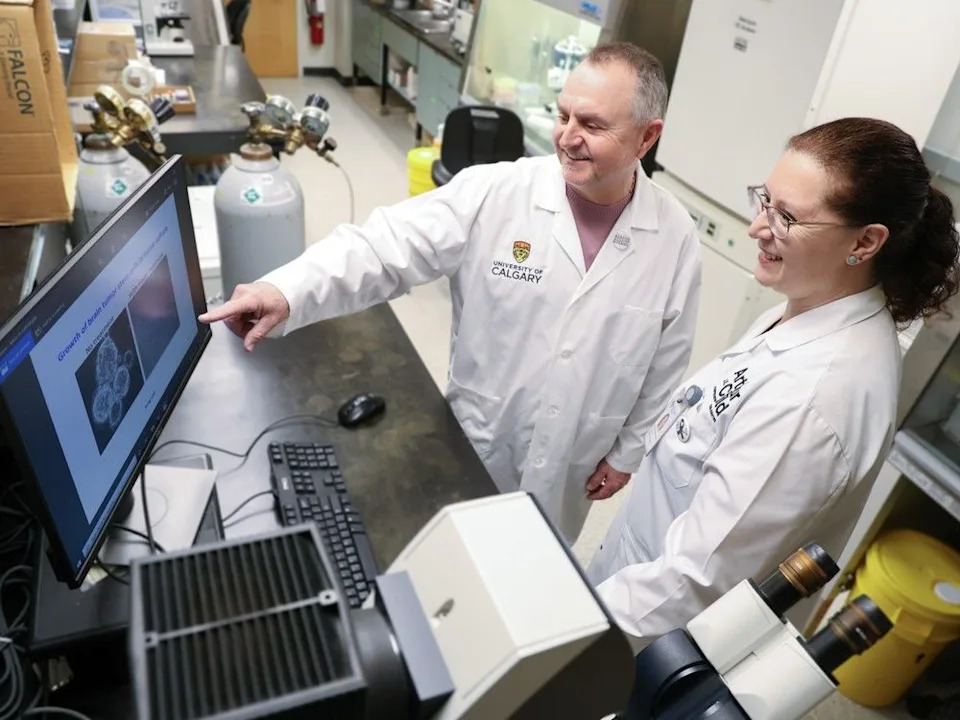
Patient and study participant Ed Waldner looks over scans with Dr. Gloria Roldan Urgoiti in a University of Calgary lab on Monday, February 9, 2026.
Before that, the team led by Yong and U of C oncologist Gloria Roldan Urgoiti had vetted 1,040 drugs for the study with one of the few remaining niacin, which is normally used to improve metabolism and the immune system.
It showed considerable results in a study using mice, enough so that the process evolved to clinical trials involving humans.
Glioblastoma, said Yong, is notorious for its ability to conquer immune cells, even uses them to propel its own growth.
Niacin appears to reverse that trend, said Yong.
“We wanted to see if (niacin) is able to reboot the defeated immune system, to do what they’re supposed to do,” he said.
“Niacin was able to win this battle in the end, to regain (for immune cells) what they were.”
It does so, said Yong, by acting as a sort of key that unlocks immune cell receptors.
While a normal daily amount of vitamin B3 is 16 mg, trial participants were given doses of 500 mg that escalated to 2,000 mg – not something that should be done without strict medical supervision and monitoring, said Yong.
That size of dose brings with it symptoms of liver stress and skin flush and researchers worked to find a balance for their participants, he said.
“We had to strategically increase the dose level that was not toxic,” said Yong, who praised the work of the U of C team of oncologists and neuroscientists in what he called a uniquely, wholly Calgary effort.
“It’s a made-in-Calgary invention – it’s not very common to be brought to clinical trial (here) and it speaks to a collaborative spirit.”
The researchers hope to begin a second phase of trials about a year from now, this time employing 48 participants. The entire process is expected to take 1-1/2 years.
Waldner said he’ll be on a niacin treatment for life and says he only suffers from a flushed face, which isn’t a daily occurrence.
“I lose track of what I’m actually fighting – I don’t think about it anymore,” he said.