PARIS — The fashion revolution of 2025 — which ushered in a new era of designers at some of the most famous brands in the world — is reverberating far beyond clothes shown on the catwalks.
All eyes are on beauty, too, as the fall 2026 ready-to-wear shows kick off Wednesday in New York, with industry insiders closely watching not just the hair and makeup looks that come down the runway, but changes in the zeitgeist, as well.
“Changes in creative leadership at major fashion houses are reshaping not only fashion, but the entire aesthetic ecosystem,” said Arabella Ferrari, chief innovation officer at Intercos Group, the leading cosmetics manufacturer, “and beauty is one of the first languages through which these shifts become visible.”
Such reshaped beauty is expected to appear on the runways, impact product and image development, and influence street style and social media — high stakes at a time when beauty continues to be an accessible entry point for many brands in an ever more competitive market.
“Beauty has become one of the fastest and most expressive ways to communicate a fashion house’s creative direction,” said Michael Nolte, senior vice president creative director at BeautyStreams. “While fashion collections are seasonal and often conceptual, beauty translates a designer’s worldview into something immediate, emotional and widely accessible.
“Beauty is no longer just about supporting the runway look, it has become a primary storytelling medium that carries a designer’s vision beyond the show and into everyday life,” he said.
Over the last 12 months alone in Europe, fashion creative direction has changed at the likes of Balenciaga, Celine, Chanel, Dior, Gucci, Maison Margiela and Valentino, while this March will see runway debuts for designers at Fendi, Gucci and Marni.
That means most likely a shakeup of the roster of head makeup artists and hairstylists backstage for brands. At Chanel, for instance, following Matthieu Blazy’s arrival, Lucia Peroni spearheaded the makeup looks, while Duffy oversaw hairstyles for the recent couture, spring 2026 ready-to-wear and Métiers d’Art displays. They succeeded Lisa Butler and James Pecis, who had overseen Chanel’s runway beauty over the prior three years.

Chanel couture spring 2026
Photo by Dominique Maître/WWD
Peroni and Duffy also created the beauty look at Michael Rider’s first rtw display for Celine in October, replacing Esther Langham and Aaron de Mey, who were the choice of former designer Hedi Slimane.
“In a short time, we’ve already seen big changes with beauty direction, casting and the presentations,” said Pecis, who is founder of clean hair care brand Blu & Green. “New creative directors for established houses need to create their identity within a house that has a long history and strong design DNA. The fashion needs to be new and exciting, but consistent with the codes of the brand. New casting with the right hair and makeup is a great way to make a statement as to who the new designer sees in their new collection, their vision for the brand.”
Other designers stick with preexisting teams, as is the case at Dior, where creative director Jonathan Anderson has maintained its show beauty leads — Peter Philips, the house’s creative and image director, and hairstylist Guido Palau.
“Each designer communicates in their own way, but in essence it’s about working together as a team — hair, makeup, manicure — to complete the designer’s vision,” Philips said. “It’s about a conversation and trying out things.”
He and Palau framed models’ faces with handcrafted flowers or veiled them with lavender fringes for Dior’s recent couture collection’s show in Paris. “When we did the fittings the youthfulness of this haute couture collection stood out,” Philips said. “Haute couture often refers to haute emotions, like drama, theatrics, glamour…. But it’s seldom young, and JW’s approach is young. So for me, it was important to keep this youthfulness.”
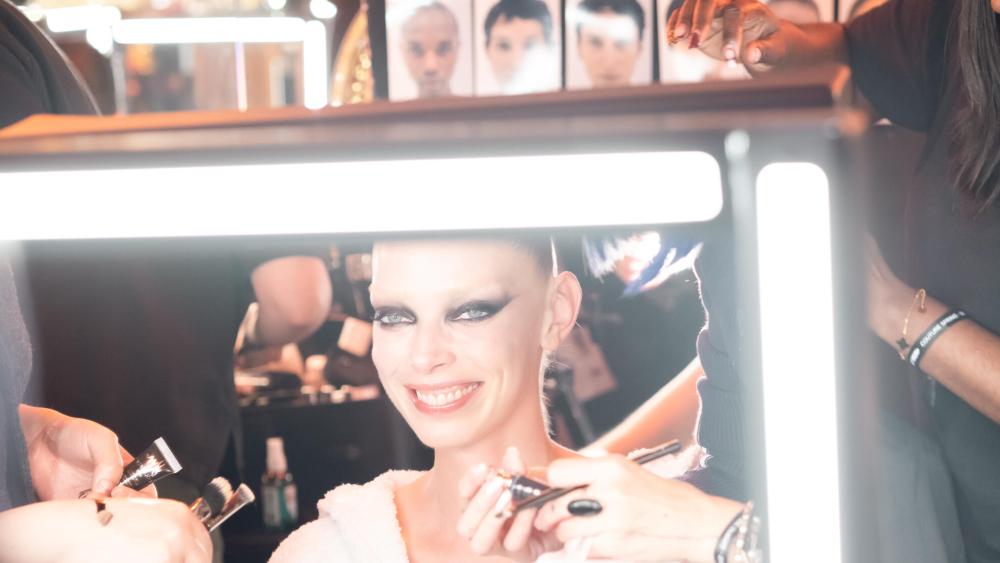
Backstage at Dior couture spring 2026.
Photo by Kuba Dabrowski/WWD
As the tenor of fashion changes, so goes beauty.
“After years of quiet luxury, the runways have felt more expressive again, more layering, embellishment, pattern-mixing and volume, with lots of experimentation in fabrics and texture: transparency, feathers and unexpected material contrasts,” Ferrari said. “Designers are pushing back against homogenized aesthetics, using maximalism to express individuality, cultural storytelling and emotional richness, while reconnecting us to the real-life sensorial experiences.”
This new era of maximalism is having a direct impact on beauty, “influencing [it] to think beyond color alone and focus on texture, finish and sensorial experience,” she continued, noting products, as well, are becoming more about expressive storytelling through modular textures, customizable intensities and formulas that invite play and personalization.
Product development timelines have been impacted, too. “Beauty brands are also trying to mirror fashion development timelines more closely, entering the creative process earlier to ensure stronger consistency between fashion and beauty narratives,” Ferrari said. “Rather than reacting to trends once they are already visible, product development is becoming more anticipatory.”
Nolte agreed there’s less of a trend-led aesthetic today, positing that beauty lines are often built around a designer’s attitude. “This is evident in how brands approach shade ranges, packaging design and campaign imagery,” he said. “Beauty products are increasingly treated as designed objects and cultural heritage, rather than simply cosmetics.”
An example is Louis Vuitton’s move into beauty with makeup artist Pat McGrath as its creative director of cosmetics last August, while another is Prada Beauty, created in partnership with L’Oréal. “The line translates the brand’s fashion-forward aesthetic into makeup and skin care, drawing heavily on the runway codes established by Miuccia Prada and Raf Simons,” Nolte said. “Hermès Beauty, meanwhile, channels over 180 years of craftsmanship into makeup, with packaging designed by Pierre Hardy that reflects the same material rigor and understated luxury found in its leather goods.”
Ferrari believes the shift in fashion direction could offer a new creative momentum for beauty, revving up the conversation around color and finishes, with lips and eyes coming more to the fore again. “But it’s not just about going bold, it’s about creativity through lightness and comfort,” she said. “There’s a fundamental shift from makeup that delivers an immediate, perfect look to life-proof makeup that follows the rhythm of your life.”
“When fashion pivots toward sharper, more cerebral aesthetics, we can expect to see growth in skin-first routines, neutral palettes and refined textures,” Nolte said. “When fashion becomes more emotional or fantastical, color and placement experimentation re-emerge in social media and indie beauty. Over time, these mood shifts influence what consumers consider ‘modern’ or ‘outdated,’ which shapes both purchasing behavior and trend cycles.”
Every so often beauty on the catwalks — such as McGrath’s “glass skin” look for the Maison Margiela Artisanal 2024 collection — can swiftly go viral and create an immediate consumer demand for related beauty products, generally in the makeup or styling categories. Nolte said street-level beauty isn’t copying runway looks, but about absorbing their underlying mood.
Two models at Maison Margiela’s couture 2024 show with glass skin makeup looks by Pat McGrath.
Courtesy of Pat McGrath Labs
“This underscores the importance of close alignment between runway makeup teams and product developers to fully capitalize on market potential,” he said.
That’s becoming easier than in the past, since brands’ fashion and beauty divisions are more and more structurally and strategically aligned, often with a unified aesthetic vision. At Dior, it’s called “One Dior,” for example. There, Anderson’s impact will be less on product formulas or colors than on packaging.
Similarly, when Dior’s prior designer Maria Grazia Chiuri was in-house, her summer fashion collection with toile de Jouy — which then became her signature — was integrated into a summer makeup collection with a Riviera theme. That infused product packaging as well as, in fashion, the styling of the models and merchandising units, allowing for a visual link.
Philips teased that new, “collectible” color cosmetics packaging will be out for summer that reflects Dior through Anderson’s lens.
Another important element of show time is front-row beauty.
Tyla sat front row at the Valentino spring 2026 couture show.
Stephane Feugere/WWD
“For us it’s an amazing platform,” Philips said. “Because we’ve got all our celebrities, all our faces that come and see the show, and they are made up by our teams and with our products. So it gives us multiple looks, in a way, and [the ability] to talk about novelties and new products. That’s a very strong extra asset on working together hand-in-hand in this One Dior context.”
Valentino, where Alessandro Michele was named the creative director in April 2024, does “Get Ready With Me” social shorts with celebrities attending its shows.
“A change in designers also brings new fresh air, new people and new tribes to the brand,” said Claudia Marcocci, Valentino Beauty brand president at L’Oréal, which holds Valentino’s fragrance and beauty license.
These days, the coherence between a brand’s fashion and beauty can reverberate through products and campaigns.
“Luxury fashion brands have been in this strategic reframing of their beauty categories, where they are trying to move away from the licensee model — even if it still is a licensee model — to verticalize and elevate beauty,” said Lucie Greene, founder and chief executive officer at consultancy Light Years. That associates beauty as a category with artistry, extremely high quality and provenance.
“Therefore, the design direction of beauty on runways takes on more importance,” she said. “It’s more of a statement.”
Still, beauty and fashion are very different businesses with very different clientele. Marcocci said that for most luxury brands, there is about a 5 percent overlap between those who buy fashion and those who purchase beauty, with the latter providing accessibility. “The reality is that we have a role which is to be the guardian of everything which is timeless,” she said. “That’s why we always go back to heritage, in a way.”
“I always keep in mind that not every woman wants to be fashionable, but every woman wants to be beautiful,” Philips said. “And that’s a different thing.”