Artificial intelligence is no longer optional in modern product innovation, which stands on non-negotiable grounds for competitive advantage. New product ranges and iterations continuously evolve through cycles of improvement, and each cycle brings both opportunities and challenges. To keep pace in this competitive landscape, it is essential to understand new methods, tools and techniques to lead the game.
If Albert Einstein had access to today’s speed of information, it might not have taken him 10 years to develop the theory of relativity. Similarly, for current R&D teams, the key is integrating AI to create pathways for innovative products with maximum market success and novel ingredients that address real problems.
AI can support and provide deep insights, but its effectiveness depends on precision prompts. AI cannot replace strategic thinking or structured execution; rather, it should be a tool to make innovation pathways more coherent and targeted.
In nutraceuticals, balancing competitive speed with scientific integrity is challenging, but the right framework and tools can enable compliant, timely delivery.
How AI helps supplement development research
If there were no problems in the world, there would be no scope for improvement or growth. When a problem arises, it signals progress and something is not aligned as per expectations or needs are not fulfilled. Now, the drill begins recognizing unmet market needs and gaps. Passion for science can spark ideas and investigate solutions never attempted before, but those ideas must ultimately serve their purpose to the marketplace.
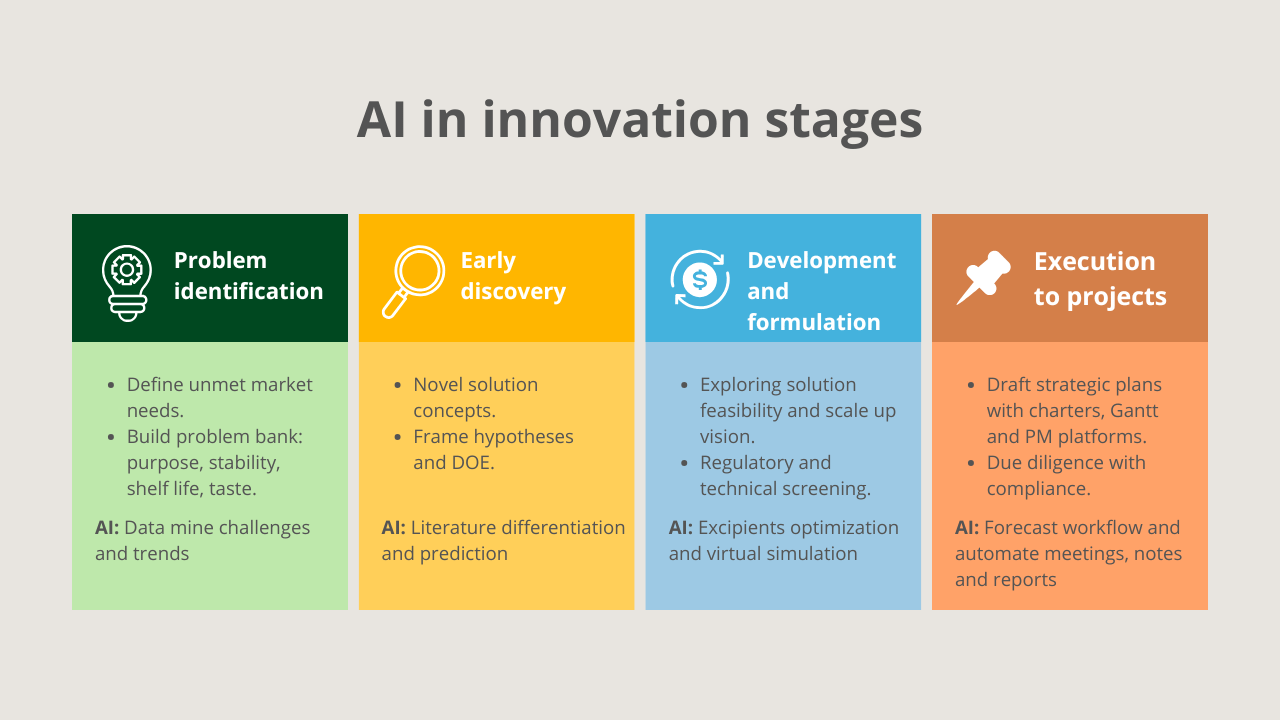
Research speed. Data mining becomes the starting point for uncovering the root causes of issues, which begins with ingredient of choice, usage or intended purpose of it and then expands to concerns such as stability, shelf-life, taste, dosage and more. The procedure would take significant time to gather and analyze all the data. AI, however, can accelerate this by scanning large datasets, identifying patterns and predicting potential challenges early in the process.
Product ideation. While AI provides support to identify challenges, word-of-mouth remains prevalent in nutraceuticals. Feedback from conferences, seminars and customer meetings may seem stereotypical, but they have proven their worth as invaluable experiences to uncover the supplement industry’s hot ingredients and trends that AI is adapting within the supplementation domain.
Literature review. Historically, early-stage ideation involved painstaking literature reviews and manual data collection that consumed weeks to months.
Today, this process is far more efficient thanks to AI-driven literature mining, which synthesizes research findings, identifies design of experiments (DOE) and surfaces novel ingredient formulations in some clicks. Filtering and ideating through AI platforms make identification significantly easier and strategic.
Patent analysis. In addition to literature mining, AI has assisted patent analysis by leveraging databases to uncover prior discoveries, helping avoid duplication and identify opportunities to differentiate formulations. This is especially valuable when aiming for product exclusivity or premium positioning, as patents and copyrights play a critical role in protecting innovation and securing competitive advantage.
Market validation. At the heart of this process lies hypothesis generation, which is the foundation for predictive modeling within an innovation portfolio, guiding the journey toward a validated proof of concept. There could be countless ideas, many might hit the bin if they fail to satisfy market needs.
To avoid this trap, successful innovators combine scientific curiosity with market intelligence, ensuring that creativity aligns with consumer demand.
Regulatory review. Another advantage to AI integration is its ability to highlight red flags in terms of potential regulatory issues associated with the selected ingredient, helping teams navigate complex regulatory landscapes before investing heavily in development.
This proactive approach reduces risk and accelerates decision-making. AI transforms early innovation from a slow, manual process into a dynamic, data-driven strategy to faster idea execution, precision in risk management and a clearer path to successful product development.
 How AI helps supplement development and formulation
Once a problem is defined through initial screening, the next step is to move into the development and formulation stage. At this point, it’s still too early to confirm product feasibility, so the focus is on ingredient selection, regulatory screening and preliminary technical assessments.
Lab simulation. Before getting your hands dirty in the lab, it’s worth leveraging virtually designed simulations. These can help predict bioavailability, stability and ingredient behavior under different conditions, saving significant time and resources. Additionally, AI-driven excipient optimization simplifies the “jungle gym” of ingredient combinations, formulating strategic designs and being less reliant on trial-and-error.
This technology serves as a resourceful tool for aspiring talents in nutraceuticals, offering guidance and confidence, while also serving as a quick vibe check for experienced chemists to validate their formulation approach before committing to physical testing by subtracting uncertainty at an early stage with mindful use of resources.
Experimentation design. When it’s time to run experiments in the lab, prompting AI to draft a comprehensive Design of Experiment (DOE) can be a game-changer. AI can outline experimental variables, controls and statistical models, ensuring efficiency and accuracy from the start. It can recommend instrumentation requirements based on formulation anticipated, whether to use an appropriate spray dryer, encapsulation system or type of ethoxylates, minimizing costly trial-and-error.
AI transforms formulation development from a labor-intensive guessing game into a data-driven, predictive process that empowers teams to innovate faster, smarter and with greater confidence.
Project planning. Projects come to life through execution, and this responsibility often falls on project managers (PMs). Organizations rely on various methodologies and software tools to draft charters, create Gantt charts and manage tasks, along with laying out the groundwork to keep teams aligned. PMs act as servant leaders, removing roadblocks and enabling stakeholders to grow while maintaining momentum.
When innovation moves from idea to execution, resource allocation, strategic mindset and financial constraints take center stage, and this is the point at which AI assistance is needed. AI can assist with cost modeling, operational planning and equipment recommendations, while integrating seamlessly with project management platforms to optimize timelines.
Some of the most generic tasks, such as real-time notetaking, workload tracking, and chatbot-driven problem-solving, can enhance collaboration and communication across functions. One personal favorite feature is how a chatbot can help troubleshoot issues, provide quick answers and facilitate cross-functional communication, reducing delays and improving decision-making.
AI as a partnership tool, not people replacement
AI is a supportive tool and not a substitute for leadership judgment. PMs still set direction, plan team meetings, make trade-offs and uphold scientific rigor.
Before scale-up, due diligence is non-negotiable: compliance checks on GRAS/NDI and global regulations, validation of scientific claims, and patent landscape reviews to avoid surprises. AI is a pal with resource allocation, cost modeling and timeline optimization while leadership steers the ship and ensures the project stays compliant, feasible and strategically sound. In essence, AI transforms project execution from a manual, fragmented process into a dynamic, data-driven workflow, empowering teams to deliver innovation faster, smarter and with greater confidence. AI is a catalyst for efficiency and innovation in nutraceutical R&D, accelerating discovery, sharpening formulation decisions and minimizing execution risks.
However, success ultimately depends on pairing AI-driven insights with human expertise, strategic judgment and scientific rigor. When project managers, scientists and regulatory teams use AI as a support tool, and not a substitute, they unlock its true potential.
AI has not yet reached full maturity, and its limitations, including sustainability concerns and the depth of knowledge it carries, still need careful evaluation.
But currently, AI has unlocked faster, smarter and more compliant pathways to market. The future belongs to teams that harness AI thoughtfully and integrate information with the strengths of AI and human expertise, while staying grounded in real-world needs and sound science. By doing so, organizations can transform innovation from a slow, uncertain process into a dynamic, data-driven journey toward meaningful breakthroughs.