
The nutraceutical excipients market is set for steady long-term growth, driven by clean-label innovation, personalized nutrition trends, and rising demand for enhanced bioavailability solutions.
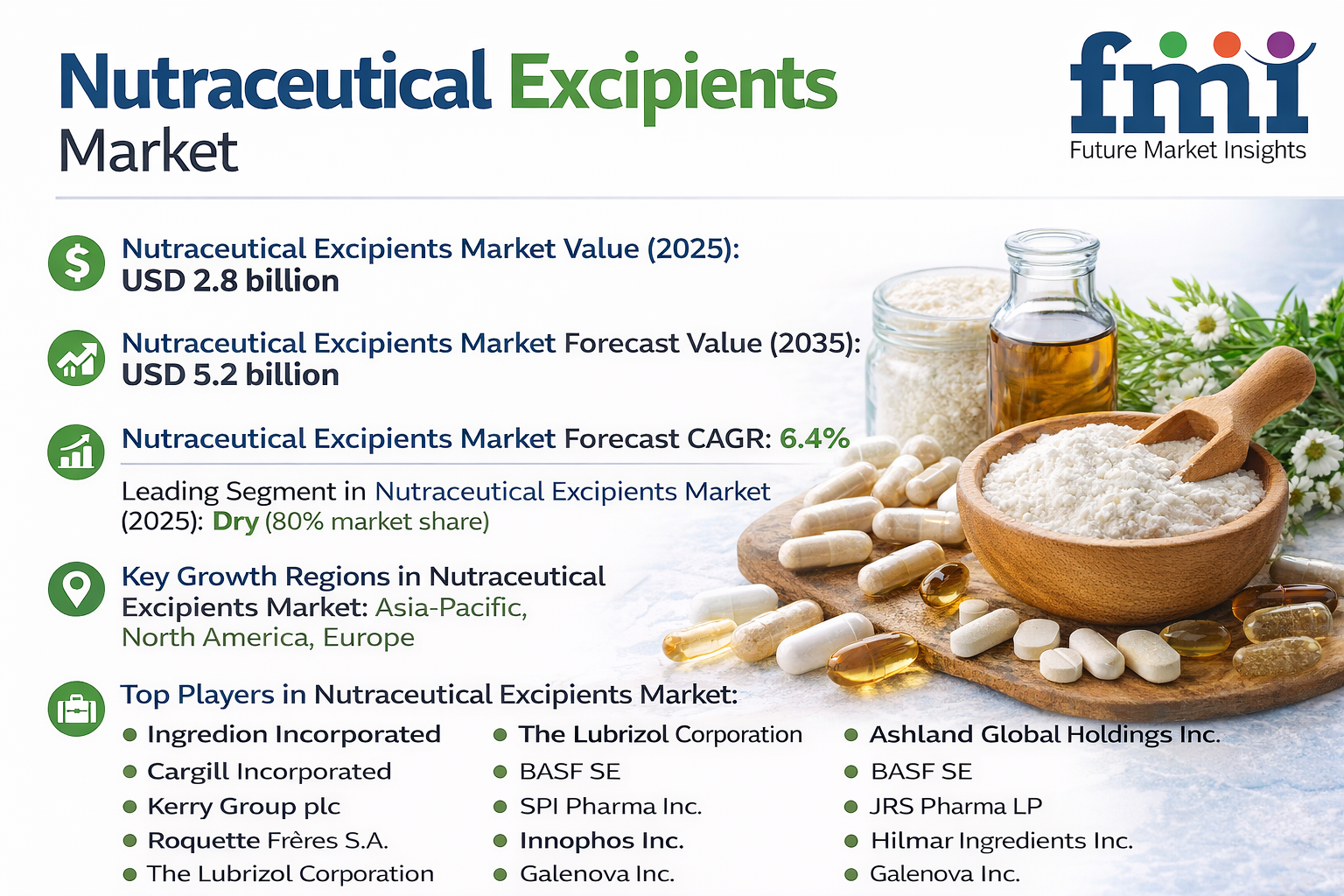
NEWARK, DELAWARE / ACCESS Newswire / February 13, 2026 / The global nutraceutical excipients market is entering a new growth phase, projected to expand from USD 2.8 billion in 2025 to USD 5.2 billion by 2035, according to the latest analysis by Future Market Insights (FMI). This expansion represents a steady CAGR of 6.4% over the forecast period, translating into an absolute dollar opportunity of USD 2.4 billion.
The market is expected to witness 1.9 times growth over the next decade, driven by rising health consciousness, increasing adoption of personalized nutrition, and growing demand for clean-label and natural excipients that enhance bioavailability and formulation stability.
By 2030, the industry is anticipated to reach USD 3.8 billion, adding nearly USD 1.0 billion in incremental value during the first half of the decade. The remaining USD 1.4 billion is projected to be realized between 2030 and 2035, reflecting moderately accelerated momentum supported by product innovation and sustainable manufacturing practices.
Functional Formulation: The Backbone of Nutraceutical Performance
Nutraceutical excipients play a critical role in ensuring dosage accuracy, product stability, solubility, and controlled release of active ingredients. As functional foods, dietary supplements, and personalized health solutions gain popularity, manufacturers are investing in multifunctional excipients that go beyond traditional formulation support.
The market is undergoing a strategic transformation driven by:
Rising demand for fillers & diluents with enhanced flowability
Clean-label and plant-based sourcing requirements
Bioavailability enhancement technologies
Intelligent delivery systems for targeted health outcomes
Advanced excipient systems are improving solubility and stability by up to 30-40% in certain applications, enabling more effective absorption of vitamins, minerals, omega-3 fatty acids, and probiotics.
Market Share Across Parent Industries
The nutraceutical excipients segment holds a significant and expanding position across multiple parent markets:
12% share of the global excipients market
25% share within dietary supplement ingredients
18% contribution to functional food ingredients
14% share in pharmaceutical excipient crossover applications
20% presence in clean-label ingredients
15% participation in personalized nutrition ingredients
This multi-market integration highlights the growing strategic importance of excipients as enablers of advanced health formulations.
Segmental Leadership: Fillers & Diluents Dominate
By Product, Fillers & Diluents Account for 50% Market Share
Fillers & diluents dominate the product category, holding approximately 50% of total market share in 2025. Their widespread adoption is driven by their essential role in:
Ensuring consistent dosages
Improving powder flowability
Enhancing manufacturing efficiency
Supporting long shelf life stability
As demand for standardized supplement formulations grows, manufacturers are investing in natural and sustainable filler technologies that align with clean-label positioning.
By Form, Dry Segment Leads with 80% Share
Dry excipients account for nearly 80% of the market in 2025, due to superior stability, extended shelf life, and ease of handling in large-scale production environments.
Dry formats support tablets, capsules, sachets, and powdered supplements, offering reduced formulation complexity and cost-effective scalability. Their continued dominance reflects the industry’s focus on stability, convenience, and regulatory compliance.
Drivers, Restraints, and Key Trends
In 2024, global adoption of nutraceutical excipients increased by 12% year-on-year, with North America and Asia-Pacific capturing significant shares.
Primary Growth Drivers
Rising preventive healthcare adoption
Expanding personalized nutrition applications
Aging population demographics
Increased consumer demand for natural and sustainable ingredients
Growth of e-commerce distribution channels
Clean-label innovation is significantly accelerating demand. Natural excipients demonstrate up to 85% higher consumer acceptance compared to synthetic variants in certain market surveys, while offering improved transparency and regulatory alignment.
However, market expansion faces certain constraints:
Natural excipient costs can range 20-150% higher than synthetic alternatives
Regulatory approval timelines for novel excipients may extend 40-60% longer
Agricultural supply chain volatility impacts sourcing stability
Despite these challenges, manufacturers are prioritizing vertical integration and advanced quality control to maintain compliance and competitive positioning.
Regional Outlook: China and USA Lead Growth Momentum
The global landscape reflects varied maturity levels and adoption patterns.
Country
CAGR (2025-2035)
China
7.8%
USA
7.2%
Japan
7.0%
Brazil
6.5%
Germany
5.5%
UK
4.3%
France
3.2%
China is projected to lead with a CAGR of 7.8%, supported by rising health awareness and expanding middle-class demographics. The United States follows closely at 7.2%, driven by regulatory stability and advanced preventive healthcare trends.
Japan’s aging population continues to support steady growth, while European markets emphasize quality standards, organic certification, and pharmaceutical crossover applications.
Competitive Landscape: Innovation and Technical Differentiation
The competitive environment is moderately consolidated, with leading players focusing on clean-label development, biotechnology integration, and multifunctional excipient systems.
Key companies shaping the market include:
Industry leaders are investing heavily in R&D to enhance solubility, stability, and controlled-release performance. Strategic collaborations between excipient manufacturers and nutraceutical companies are accelerating innovation in bioavailability enhancement and personalized health solutions.
Outlook: A Decade of Functional Evolution
As global consumers prioritize transparency, efficacy, and preventive healthcare, nutraceutical excipients are transitioning from supportive ingredients to critical formulation enablers.
With rising clean-label adoption, technological innovation, and expanding personalized nutrition platforms, the nutraceutical excipients market is poised for sustained and resilient growth through 2035.
For an in-depth analysis of evolving formulation trends and to access the complete strategic outlook for the Nutraceutical Excipients Market through 2035, visit the official report page at: https://www.futuremarketinsights.com/reports/nutraceutical-excipients-market
Explore More Related Studies Published by FMI Research:
About Future Market Insights (FMI)
Future Market Insights (FMI) is a leading provider of market intelligence and consulting services, serving clients in over 150 countries. Headquartered in Delaware, USA, with a global delivery center in India and offices in the UK and UAE, FMI delivers actionable insights to businesses across industries including automotive, technology, consumer products, manufacturing, energy, and chemicals.
An ESOMAR-certified research organization, FMI provides custom and syndicated market reports and consulting services, supporting both Fortune 1,000 companies and SMEs. Its team of 300+ experienced analysts ensures credible, data-driven insights to help clients navigate global markets and identify growth opportunities.
For Press & Corporate Inquiries
Rahul Singh
AVP – Marketing and Growth Strategy
Future Market Insights, Inc.
+91 8600020075
For Sales – sales@futuremarketinsights.com
For Media – Rahul.singh@futuremarketinsights.com
For web – https://www.futuremarketinsights.com/
SOURCE: Future Market Insights, Inc.
View the original press release on ACCESS Newswire