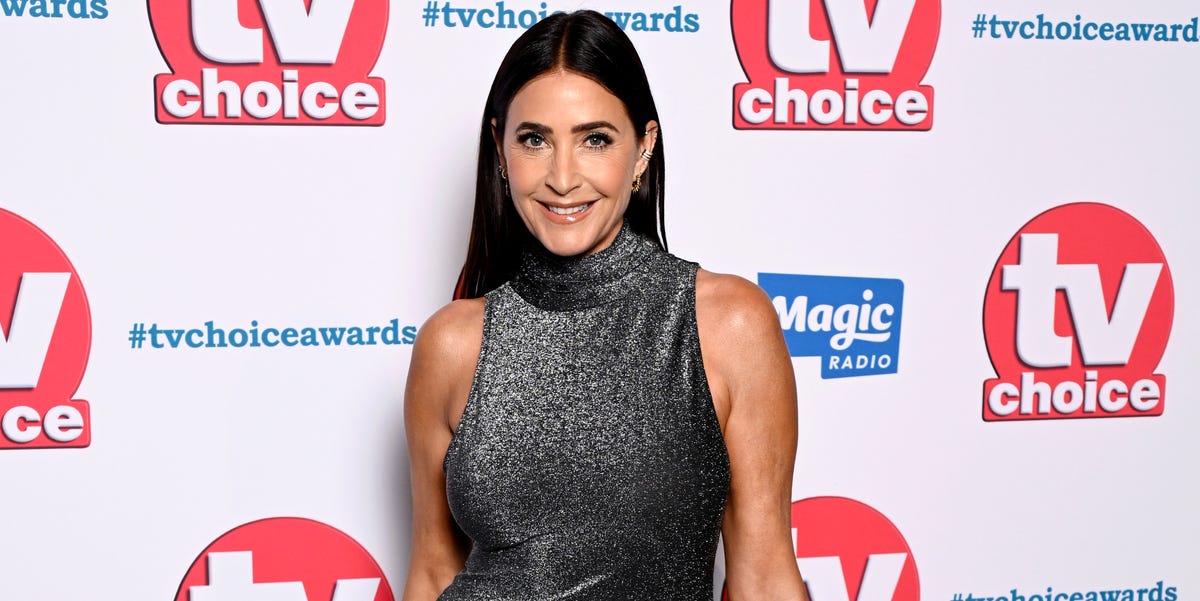
TV presenter, radio host, podcaster, author, model: Lisa Snowdon has and continues to have a very busy schedule – but she hasn’t let that get in the way of making time for her health and wellness. In fact, she does more than make time for wellness – it’s a priority. Lisa also often posts science-led videos on social media, interviewing experts in the field to help equip midlife women with the tools and confidence to navigate menopause and break taboos around the topic.
Just a few weeks ago, Lisa turned 54. How did she celebrate? A birthday workout, of course. Clad in some groovy leopard print leggings, Lisa gave us a sneak peek into some of the strength-based training that she has been doing in the gym.
‘One of the biggest shifts that Lisa has made in her training was to trade lots of cardio training for a more strength-based system,’ Lisa’s personal trainer Rev Paul Webb tells WH. ‘This was – and really is – very beneficial for Lisa and for women as they approach and go through menopause.’
‘As we get older, we naturally lose muscle mass and bone density plus other attributes such as power, strength and conditioning,’ adds Webb. ‘A well-constructed strength programme, such as Lisa follows, has incredible benefits, and research carried out over decades now clearly shows that strength training will have a positive effect on all-cause mortality, lowering the risk factors of heart disease, cancer, dementia, diabetes and many more.’
Social media trends – which often have a habit of putting certain workouts on a pedestal – can often mean women feel they must approach fitness in a certain way. The reality? There’s no one-size-fits-all approach and one of the core elements of a great workout programme is not sheer volume, but, rather, functional, full-body fitness.
‘Lisa doesn’t swear by one exercise but rather we make sure that we cover all movement patterns in her programme,’ says Webb. ‘So, for example, we cover a squat pattern, a hinge or bend pattern, a push and pull pattern, a single-leg lunge pattern and a rotational or anti-rotational (plank) pattern.’
Related Story
‘By splitting Lisa’s three weekly programmes into an upper, lower and full-body split, we can make sure that Lisa gets at least two exposures to each movement via different exercises across a training week,’ Webb explains.
So, for those of you who assume that you need to be in the gym five days a week for hours on end to see results, think again. In fact, research suggests that just two 30-minute workouts per week can build strength, power and muscle.
The workout
As Webb mentioned, part of Lisa’s weekly split involves a full-body workout. Below, he shows us exactly what that looks like.
Warm-up
Webb says Lisa will first complete a dynamic warm-up with drills. Such a warm-up usually involves movement-based mobility work (eg, leg swings, arm circles, glute activation, light lunges), which is designed to get the heart rate up and prepare your joints and muscles for the types of movement they are about to do.
Main session The session is split into three blocks. Where two exercises are listed together, perform them back-to-back before resting. Where one exercise is listed on its own, complete all reps, then rest. Rest 45-60 seconds after each set (or pairing). Complete all sets of one exercise (or pairing) before moving to the next.Short on time? To help speed up the session, Webb adds that you can perform all exercises in a block as a circuit-style session.
Block one
1A Cable squat and rows – 4 x 10-12 reps
1B High incline single-arm press and single-leg calf raises – 4 x 10-12 of each
Block two
2A Dumbbell pullover and hip extensions – 3 x 12
2B Neutral grip pulldowns – 3 x 12-15
2C Pallof rotations – 3 x 10-12 each
Block three
3A Landmine squat and press – 3 x 10-12
3B Incline Y raises with Blackburns – 3 x 8-10 each
3C Lateral lunges and cable row – 3 x 6-8 each
3D Walking lunges and plate rotation – 3 x 6-8 each
Related Stories
Hannah Bradfield is a Senior Health and Fitness Writer for Women’s Health UK. An NCTJ-accredited journalist, Hannah graduated from Loughborough University with a BA in English and Sport Science and an MA in Media and Cultural Analysis. She has been covering sports, health and fitness for the last five years and has created content for outlets including BBC Sport, BBC Sounds, Runner’s World and Stylist. She especially enjoys interviewing those working within the community to improve access to sport, exercise and wellness. Hannah is a 2024 John Schofield Trust Fellow and was also named a 2022 Rising Star in Journalism by The Printing Charity. A keen runner, Hannah was firmly a sprinter growing up (also dabbling in long jump) but has since transitioned to longer-distance running. While 10K is her favoured race distance, she loves running or volunteering at parkrun every Saturday, followed, of course, by pastries. She’s always looking for fun new runs and races to do and brunch spots to try.