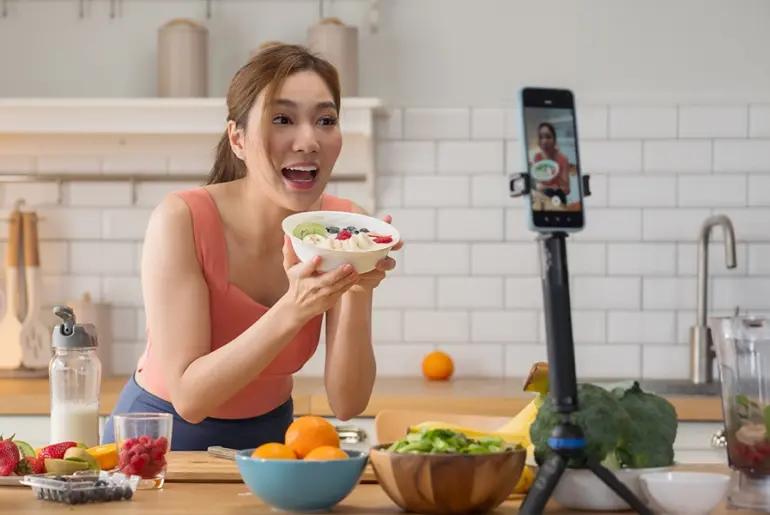
A few years ago I was on a podcast and the host asked me how I felt social media had changed our relationships with food. My answer was that in all the years I had worked in the area of nutrition, never before had food been so closely linked to our identity. Over that time, I’ve witnessed a complete shift in perspective about what individuals deem to be healthy – not necessarily on nutrient value or how it might benefit their body, but based on what it looks like and whether it fits a certain aesthetic or lifestyle. Long gone are the days when you asked someone about healthy eating and they would refer to the ‘eat well plate’ – now it’s all pretty pictures of green smoothies, Buddha bowls and energy balls.
What’s wrong with this, you might ask? Absolutely nothing, as long as they’re something you actually want to consume and are going to help you meet your nutritional needs, especially if you are physically active.
I will never forget a male runner I worked with. He turned up to his first appointment and said, ‘Here’s my food diary, I think you will be really pleased.’ What I actually read horrified me. For someone who was running 60km a week, he was hardly consuming any carbohydrates – he wondered why he was so tired but also why his performance wasn’t progressing. He started every morning with a kale smoothie that someone at his gym had sworn by to help ‘boost his metabolism’. I asked him if he liked drinking it and he said,
‘No, it’s awful!’
Needless to say, we had to start from scratch, but months later when he came back for his final session with me he was so grateful that he was finally eating food he actually liked the taste of, with the added bonus that he had shaved five minutes off his half marathon PB.
What is healthy eating?
Healthy eating means having a healthy relationship with food, where no one food is demonised or heralded a hero but where all food is accepted without positive or negative judgement. In fact, I have previously defined healthy eating as ‘unrestrained eating’, where you have choice over what you eat and are not being controlled by your beliefs relating to food.
It is about appreciating that there are certain nutrients we need to consume for our overall health, where health is not the size of your body but related to key metrics that reduce your risk of certain diseases. This is something I think gets overlooked. Human bodies are meant to come in different shapes and sizes – there is no ‘one size fits all’.
This means some people will have a larger frame and bone structure, while others are smaller and more petite. It also means some people will naturally need a higher body fat percentage in order to be healthy for them, but no size or shape is intrinsically superior to another.
In fact, our uniqueness is also what makes us special. And yet so few people appear able to embrace and accept their normal body size. Too many pursue body aesthetics that are just not suitable or supportive of health or even performance, and it is this that also often skews their relationship with food.
Indeed, a meta-analysis1 in the journal Medicine & Science in Sports & Exercise that being in a bigger body with a higher body fat percentage but being active was healthier than being so-called ‘normal size’, with a lower fat body percentage, but sedentary.
Healthy eating is not depriving our body of any food groups – and I mean any. So while many health influencers, celebrities and even lifestyle nutritionists demonise sugar, small amounts are not an issue. In fact, I would argue that spending time with loved ones, over the dinner table, chewing the fat, breaking bread or enjoying a slice of your favourite cake (my preferred), is probably more beneficial to your mental health than avoiding social situations as a result of strict food rules.
In fact, research has proven that social connection should be top of your list when it comes to overall mental and physical wellbeing, because when we spend time with others it releases the hormone oxytocin, which brings about positive emotions and a sense of belonging.
When healthy eating goes bad
A few years ago I wrote a book called ‘Orthorexia – when healthy eating goes bad‘. Orthorexia is defined as the obsession with eating correctly or purely. It had gained momentum due to the #cleaneating trend doing the rounds at the time. Orthorexia was first identified by Dr Steven Bratman in 1997, after some patients were presenting with nutrient deficiencies, low mood and high anxiety as a result of choosing to eat in a particular way that avoided foods they deemed as ‘bad or unclean’.
In orthorexia, individuals become evangelistic about the way they eat, often avoiding whole food groups such as carbs or dairy, sometimes under the guise of wellness or following an eating approach such as veganism. And while there is nothing wrong with this per se, in these individuals the avoidance is psychological – there is anxiety about eating certain foods due to rules and beliefs they have created, rather than it being for ethical or environmental reasons. This means that often their diet is devoid of essential nutrients, leaving them malnourished.
In runners, orthorexia can also lead to low energy availability, which in turn can result in RED-S (relative energy deficiency in sport), a condition that has huge physiological and psychological implications to both performance and health.
Healthy eating is not celebrity-endorsed recipes that might look pretty but are often devoid of one or more food groups. It’s a balanced approach to eating, one that provides the body and brain with all the nutrients necessary not just to maintain its function, but to allow it to thrive.
Renee McGregor is a leading sports dietitian with over 20 years’ experience. reneemcgregor.com
Source: 1 https://pubmed.ncbi.nlm.nih.gov/10593541/
ENDS