DES MOINES, Iowa (ICD) – A bill proposed by Gov. Kim Reynolds and advanced from a House subcommittee Thursday would perpetuate the state’s restrictions on food items that can be purchased with federal nutrition assistance.
Anti-hunger advocates opposed House Study Bill 694 because it would tie the state’s participation in the Supplemental Nutrition Assistance Program , or SNAP, to the governor’s waivers aimed at eliminating junk food from the program.
The bill would also tackle some of the governor’s and Republicans’ other priorities, like making ivermectin more accessible and removing food dyes from Iowa school meals.
Molly Severn, speaking as a liaison from the governor’s office, explained that the bill would:
require licensed physicians to take a nutrition and metabolic health course every four years require the “continuous implementation” of the governor’s SNAP and summer feeding program waiverseliminate food dyes and additives from school meal programs and vending machines“improve access” to ivermectin, a drug typically used for parasitic infections that some have linked to treating COVID-19 and other illnessesallow psychologists licensed in other states to practice in Iowa eliminate certificate of need requirements at certain facilities, including outpatient behavioral health facilities
Severn said the governor has “long prioritized policies that improve health care for Iowans of all ages and in every community” which she said has contributed to Iowa’s top ranking in health care affordability.
As it was originally written, the bill would have also increased taxes on tobacco products, vape products and consumable hemp products, but Rep. Austin Harris, R-Moulton, who chaired the committee, said his intention is to remove that section of the bill in committee. Harris said a separate bill has been introduced in the House to address the governor’s requested tax hike on tobacco, vape and hemp products.
SNAP Healthy Foods waiver
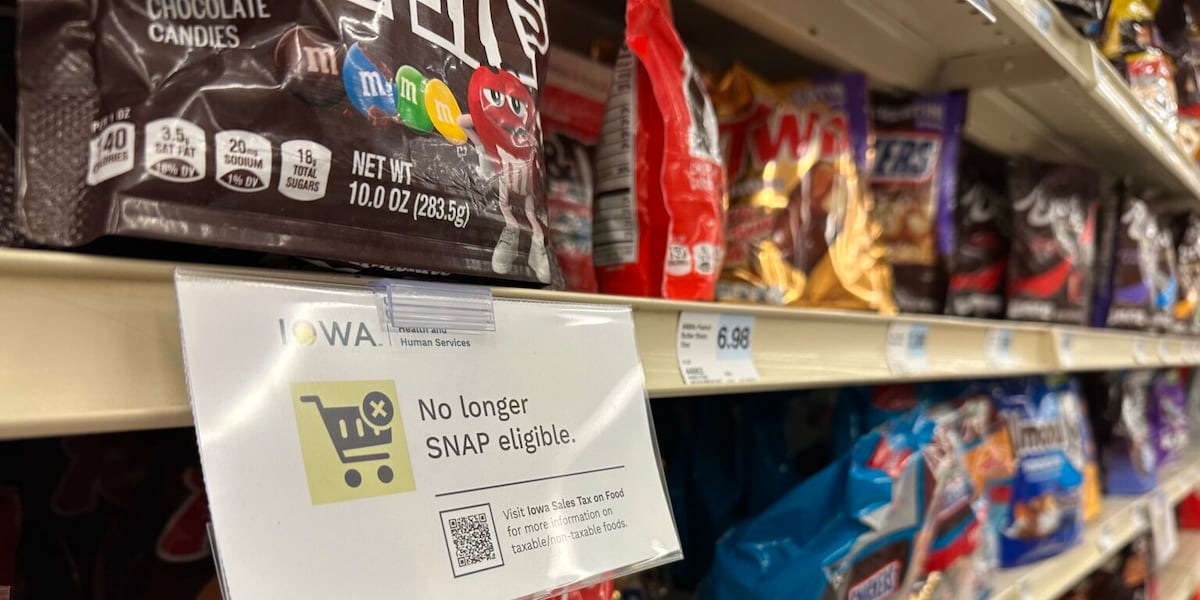
In May 2025, the U.S. Department of Agriculture approved a waiver, submitted by Reynolds, that would prohibit SNAP recipients from using the funds on food items eligible for sales tax, like soda, candy and sugary snacks.
The intent of the waiver was to ensure SNAP benefits were used for healthy foods, but anti-hunger advocates have found the restrictions to be far reaching and confusing for retailers and program participants.
Marc Craig, a SNAP recipient from Des Moines, spoke against the bill in subcommittee Thursday and described the difficulty of using his benefits since the waiver went into effect at the start of the year.
A sub sandwich with a sauce packet is allowed at one store, but a ham and cheese sandwich at another grocery store is excluded. He can’t buy a Snickers candy bar, but could purchase a Snickers ice cream bar.
Craig said a shopping trip that used to take him several minutes, now takes an hour as he works to decipher what is eligible and not.
“To me this is not an attack on obesity,” Craig said. “I’m not obese because I want to be unhealthy, it’s because my options are limited.”
The bill requires the state to “continuously maintain” participation in the SNAP program “in accordance” with the federally approved guidelines that “specify that eligible foods are healthy foods as defined by the director or the director’s designee.”
Craig said it seemed like a “bad precedent” to task just one person with the distinction of healthy foods.
“I would like to see maybe a committee with like doctors, pediatricians or world experience, so we can kind of negate some of the negative impact that the waivers had,” Craig said.
The waiver, as granted by USDA, lasts for two years and is set to conclude with an evaluation from the federal Food and Nutrition Service on the impact the project had on participants and retailers.
Luke Elzinga, speaking on behalf of the Des Moines Area Religious Council and the Iowa Hunger Coalition, pointed out to lawmakers that the study of the waiver’s impact has “obviously not been completed.”
“The fact that our governor is already trying to make this permanent before any sort of evaluation occurs, tells me this is not about health, it’s not about nutrition, it’s just about ideology,” Elzinga said.
Elzinga also said the bill is like a “blank check” to the state health and human services department director as they will determine what constitutes “healthy.”
“Do you as state legislators really want to cede this authority to the director of HHS, regardless of who they may be, whether or not they have any formal nutrition education and what governor they serve?” Elzinga asked.
Dustin Miller, speaking on behalf of the Iowa Grocery Industry Association which registered as undecided on the bill, said the SNAP waiver in Iowa has been “much easier” to implement, compared to other states with waivers, because eligible items are tied to sales tax.
“If you talk to our retailers who are implementing these in other states, we are the enviable position because of that clarity,” Miller said.
He requested the bill language reflect the same distinction, related to sales tax, rather than broadly state healthy food.
After initially opting out of a federally funded summer feeding program for low-income students, Reynolds decided to participate in the program after the state was granted a waiver from USDA allowing the application of the same food restrictions.
The bill allows the state to participate in the summer program for school-aged children, so long as eligible foods are also consistent with what is determined to be healthy foods.
Paige Chickering, the Iowa state manager for Save the Children Action Network, spoke against the bill and asked lawmakers to remove the language related to the summer program.
Chickering also argued the bill makes it appear that Iowa would be unable to participate in SNAP if a federal waiver is not granted.
“Washington, D.C., and administrations change – these waivers weren’t always approved by USDA in the past, and if we see changes at the federal level, we don’t want that to mean that Iowa no longer participates in SNAP in the future,” Chickering said.
Ivermectin and food dyes
The bill stipulates that food served in school lunches, breakfasts and sold on school campuses cannot contain: blue dye 1, blue dye 2, green dye 3, potassium bromate, propylparaben, red dye 40, yellow dye 5, or yellow dye 6.
The Iowa Beverage Association registered against the bill and Jon Murphy, speaking on behalf of the association, expressed concerns with the SNAP provisions of the bill, and suggested alternative language for lawmakers in the section pertaining to food dyes in schools.
Murphy suggested that rather than list out specifically outlawed food dyes, the language should specify that school districts can only serve foods that contain ingredients that have “undergone a rigorous scientific review and approval process” by the U.S. Food and Drug Administration.
“All of the ingredients and dyes on this list have been approved by the FDA,” Murphy said. “There’s been rigorous scientific study done on all these things, and so we don’t think that it’s appropriate to go through what the FDA has already done and say that they got it wrong.”
As part of the ongoing “make America healthy again” objective from the Trump administration, the FDA has approved several plant derived, rather than synthetically derived, food dyes and has urged companies to phase out certain synthetic food dyes.
A different portion of the bill would allow for the over-the-counter availability of ivermectin, and would remove penalties for pharmacists or pharmacies that distribute the medication.
Similar language has advanced in the House in a separate bill, House Study Bill 2056. Proponents of that bill argued there are emerging uses for the medication and that dispensing the medication should not be delayed. Opponents, including medical professionals and pharmacists, argued the legislation would require them to administer something that they know could be harmful to an individual.
Rep. Austin Baeth, D-Des Moines, sat on the subcommittee for the governor’s bill Thursday and said he was concerned by both the section on SNAP and the one related to ivermectin.
Baeth, who is an internal medicine physician, said the section about ivermectin “reduces the seriousness” of the bill aimed at making Iowa healthy.
“There is no FDA approved reason for ivermectin unless you have parasites, and I think giving the weight of state government behind that drug to be used over the counter is misguided and is going to hurt a lot of people,” Baeth said.
Baeth also said the SNAP section should be removed from the bill and said “feeding hungry people should never be political.”
“It appears that the current bill as written, has less to do with actually helping people be healthier and have a healthier diet, more to do with creating political talking points,” Baeth said.
The governor’s office and the Iowa Department of Health and Human Services were the only groups registered in favor of the bill.
Harris advanced the bill and said there will be a “large amendment” coming to the bill the following week.
Other big policy bill would restrict access to WIC program, expand disabilities programs
Harris also chaired a subcommittee that advanced another controversial bill on Wednesday.
House Study Bill 696 would restrict access to public assistance programs, including the federal food assistance program for women, infants and children, require assessments of the SNAP program in the state and increase the Medicaid income limits for working Iowans with disabilities.
The bill would restrict Iowa participation in the Special Supplemental Nutrition Program for Women, Infants, and Children, or WIC, to “citizens and qualified aliens.”
HSB 696 would also allow the state to require applicants to show proof of at least 12 months of continuous residency in Iowa to be approved for public assistance programs, including SNAP and WIC.
Kathy Underhill, the CEO of the Des Moines Area Religious Council, or DMARC, a nonprofit organization with more than a dozen food pantries in the Des Moines area, said the bill would create a “vast moat” around the public health goals of food assistance programs.
Underhill said the legislation will lead to malnourished babies and she asked lawmakers to pray for her and the frontline workers that would be face to face with mothers who could not feed their babies.
The bill would also require a quarterly report on payment error rates associated with the Supplemental Nutrition Assistance Program. Iowa’s payment error rate for 2024 was 6.1%, but the state health and human services department estimated 2025 rates would be below 6%. A provision in the federal One Big Beautiful law would hold states responsible for a greater share of the SNAP program costs if its error rates exceed 6%.
Harris said part of the intent of the bill is to bring Iowa in line with provisions in the massive, federal spending bill enacted over the summer.
The bill also requires the Iowa Department of Health and Human Services to submit various waivers to the U.S. Department of Agriculture. The waivers pertain to the calculation of the payment error rate, the citizenship status of SNAP households, earned household income and the expungement of benefits.
The Iowa Hunger Coalition, in an analysis of the bill, concluded that some of the requested waivers would be beneficial, while others could lead to some SNAP recipients losing access to benefits.
While the nutrition elements of the bill were opposed in the subcommittee, provisions relating to Iowans with disabilities were supported by attendees, though many were still opposed to the bill as a whole.
The bill would increase the income limit from 250% of the federal poverty level to 300% of the federal poverty level for Iowans with disabilities who are eligible for medical assistance.
Zach Mecham, the chair of Allies in Advocacy, said the provision was a “step in the right direction” though he said a limit at 400% of the poverty level would allow Iowans with disabilities to work as much as they can without losing benefits.
Regardless, Mecham opposed the other sections of the bill.
“There is no policy, regarding income … that would make me be OK with taking away food assistance from children,” Mecham said.
Harris said the bill aims to protect the “integrity and stability” of public assistance programs in the state.
“Iowa is not going to be a sanctuary state for waste, fraud and abuse, and we are going to move this bill forward today,” Harris said.
Iowa Capital Dispatch is part of States Newsroom, the nation’s largest state-focused nonprofit news organization.
Copyright 2026 KWQC. All rights reserved.