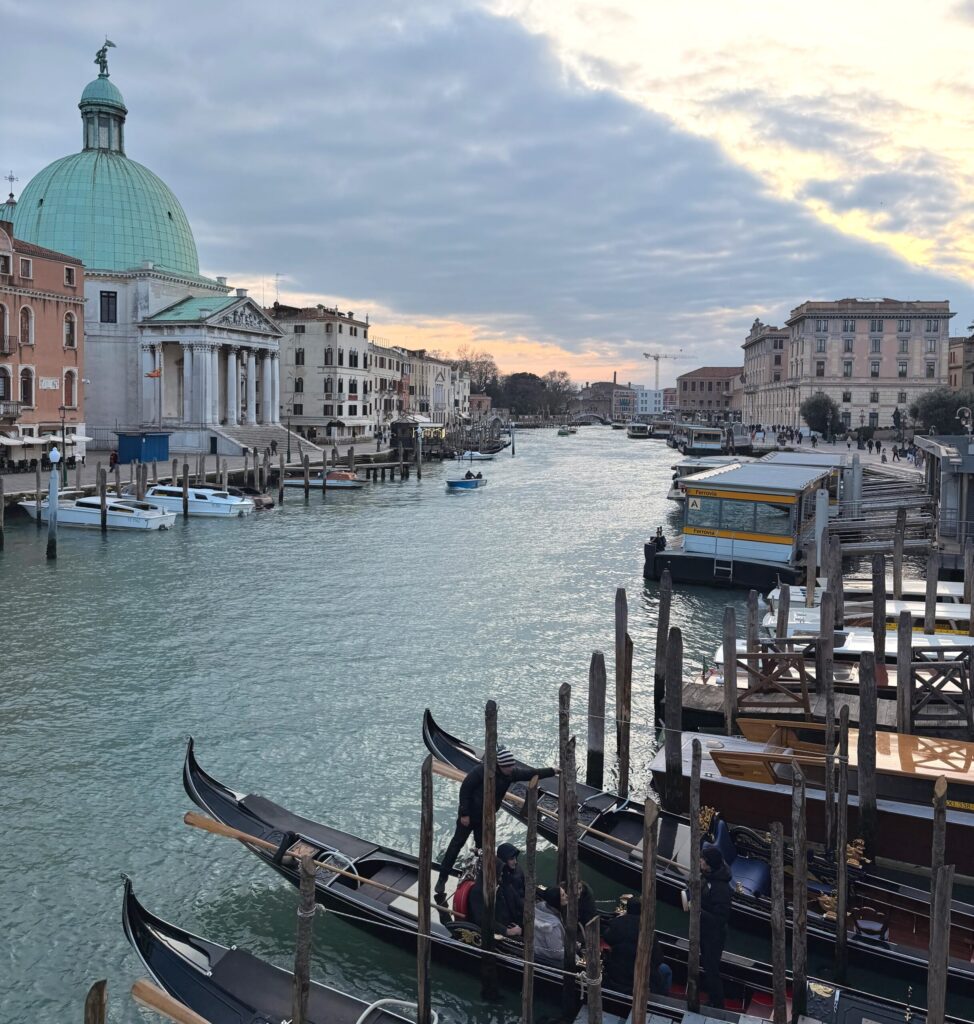
 Rialto Bridge, Grand Canal, Venice
During Yeshiva Week in January 2026, we spent 28 hours in Venice as part of a broader trip through Italy. Venice stands apart from virtually every other major European destination. Built entirely on water, with no cars and no traditional road infrastructure, the city is navigated exclusively on foot or by boat. Despite our short stay and winter temperatures in the 30s Fahrenheit, Venice proved to be remarkably accessible, especially for kosher travelers, thanks to the centralized Jewish infrastructure located within the historic Jewish Ghetto. Our stay was made seamless by the Rimon Hotel, a newly renovated kosher hotel located directly in the heart of the Ghetto.

Venice is Sinking
Venice is also a city facing a very real long-term environmental challenge. Built on wooden pilings driven into the muddy floor of the Venetian Lagoon over 1,000 years ago, Venice has been gradually sinking while sea levels continue to rise. The city subsides at a slow rate of approximately 1 to 2 millimeters per year, while rising sea levels and periodic flooding events, known locally as acqua alta, increasingly threaten low-lying areas such as Piazza San Marco. In response, Italy has invested billions of euros into the MOSE flood barrier system, a series of mobile gates designed to temporarily isolate the lagoon from the Adriatic Sea during high tide events. While these protections have significantly reduced major flooding in recent years, Venice’s long-term future remains uncertain, making visits today feel especially meaningful, as travelers experience one of the world’s most historically significant and physically fragile cities firsthand.
This is why we chose to include Venice in our trip, even if it was a short one.

Arriving in Venice by Private Boat
After landing in Rome around 11am and transferring to a 1pm domestic flight, we arrived at Venice Marco Polo Airport shortly before 3pm. Unlike most cities, arriving in Venice requires crossing water to reach the historic center. While shared water buses and land transfers are available, we chose to enter the city by private boat taxi.
Private water taxis depart directly from the airport docks and transport passengers across the Venetian Lagoon into the canals of the city. The ride takes approximately 30 minutes and provides a memorable introduction to Venice. As the boat approaches the island, church towers, historic buildings, and narrow canals gradually come into view. It is a uniquely Venetian arrival experience that reinforces the city’s identity as a place defined entirely by water.
Our boat dropped us within walking distance of the Jewish Ghetto, where we would be staying.
 Rimon Place Hotel, Jewish Ghetto, Venice
Staying at the Rimon Place Hotel in the Jewish Ghetto
We stayed at the Rimon Place Hotel, a newly refurbished kosher hotel located directly in the heart of Venice’s Jewish Ghetto, the only kosher hotel in the city. The hotel underwent a complete renovation approximately a year and a half prior to our visit, transforming a historic Venetian building into a modern, comfortable accommodation designed to serve kosher travelers. Note: Rimon Place Hotel sponsored our visit to Venice and hosted us for our short time in the city.
The rooms feature updated furnishings, modern bathrooms, comfortable bedding, and views overlooking narrow Venetian canals and pedestrian pathways. Visiting in January made the hotel’s heating and insulation especially valuable, providing a warm and comfortable retreat after long days spent walking outdoors.
The hotel’s location is one of its greatest strengths. It sits directly next to Ba’Ghetto, one of Italy’s most established kosher restaurant brands, and is approximately a 30-second walk from the Chabad synagogue, which holds daily morning services.
Each morning, the hotel serves a full kosher breakfast that includes freshly prepared eggs, pancakes, breads, pastries, cheeses, spreads, and coffee drinks. Having a reliable kosher breakfast on-site allowed us to start each day efficiently without needing to search for food elsewhere.
For kosher travelers visiting Venice, the Rimon Hotel offers one of the most convenient and strategically located accommodations in the city.
Delicious breakfast at Rimon Place Hotel
Exploring Venice on Foot and Visiting Piazza San Marco
After checking in around 4pm, we spent the afternoon exploring Venice on foot. Venice is built across more than 100 small islands connected by over 400 bridges, and with no cars anywhere in the historic center, walking is the primary mode of transportation.
We headed toward Piazza San Marco, the historic and symbolic center of Venice. The square is surrounded by some of the city’s most important landmarks.
The Campanile di San Marco, the tall bell tower overlooking the square, provides panoramic views of the city for those who choose to ascend it.

Next to it stands St. Mark’s Basilica, one of Venice’s most famous landmarks. Originally constructed in the 11th century, the basilica features Byzantine architectural influences, domes, and elaborate exterior detailing. We admired the basilica from the outside, but did not enter, as it remains an active church used for Christian religious services.
Adjacent to the basilica is the Doge’s Palace, which served as the political and administrative center of the Republic of Venice for centuries. It housed the Doge, Venice’s elected leader, along with government offices and judicial chambers.
Across the square is the Museo Correr, which houses artwork, Murano glass, and historical artifacts reflecting Venice’s centuries of political and economic influence.
Walking through Venice also highlights its historic identity as a commercial center. The city is filled with shops selling artisan goods, clothing, Murano glass, and handmade products. Visiting in January, during post-holiday sales, provided opportunities to purchase items at significant discounts.

 Gam Gam Kosher Venice
Dinner at Gam Gam and First Night in Venice
We returned to the Jewish Ghetto for dinner at Gam Gam, the long-standing kosher meat restaurant operated by Chabad of Venice. Gam Gam has served kosher travelers for decades and offers a menu combining traditional Italian cuisine with Israeli and Middle Eastern dishes.
Menu offerings include pasta dishes, grilled meats, schnitzel, shawarma, falafel, and traditional Jewish comfort foods. We enjoyed a delicous meal here, and reservations are recommended year round.
After dinner, we returned to the Rimon Hotel for a comfortable night’s rest.
Breakfast at the Hotel and Touring Doge’s Palace

The next morning began with kosher breakfast at the hotel. The spread included fresh eggs, pancakes, pastries, breads, cheeses, spreads, and coffee drinks, providing a full and satisfying start to the day. (see images above)
We then walked back to Piazza San Marco to tour Doge’s Palace. Touring the palace provides insight into Venice’s governmental structure, including its council chambers, administrative offices, and prison areas. The experience highlights Venice’s role as a powerful and independent republic for centuries.
We then visited the Museo Correr, where exhibits include Murano glass chandeliers, artwork, sculptures, and historical artifacts reflecting Venice’s cultural and economic history.
Vaporetto Ride, Lunch at Gam Gam Goodies, and Local Kosher Pastries

On our return toward the Jewish Ghetto, we rode the vaporetto, Venice’s public water bus system, along the Grand Canal starting at the famous Rialto bridge. The vaporetto provides scenic views of Venice’s palaces, bridges, and waterfront architecture.
For lunch, we visited Gam Gam Goodies, the dairy counterpart to Gam Gam. This takeaway-focused location specializes in Neapolitan-style pizza prepared by a chef from Naples, as well as falafel options. The doughy crust and traditional preparation methods provide an authentic kosher Italian pizza experience. Definitely recommend trying.
Another important stop within Venice’s Jewish Ghetto is Volpe Kosher Bakery, just across from Gam Gam Goodies, one of the few dedicated kosher bakeries serving both locals and visitors. Located within the Ghetto area and just a short walk from the synagogues, restaurants, and the Rimon Hotel, Volpe offers a wide selection of freshly baked breads, pastries, cakes, and traditional Italian baked goods. Visitors can find items such as fresh rolls, croissants, cookies, and packaged cakes that are ideal for breakfast, snacks, or taking along for day trips. The bakery also provides convenient grab-and-go options for travelers heading out early in the morning or catching trains to other cities, but don’t expect to grab a full meal here.
Touring the Historic Synagogues of Venice
After lunch, we toured the historic synagogues located within the Jewish Ghetto. Established in 1516, the Venetian Ghetto was the first officially designated Jewish ghetto in the world. Jews were required to live within its gates, which were locked each night, until 1797, when Napoleon conquered Venice and granted Jews full civil rights.
The synagogues, built within upper floors of residential buildings, feature beautifully preserved interiors reflecting centuries of Jewish life. These synagogues remain active today for services and special occasions.
We also visited Judaica shops within the Ghetto, which offer handcrafted Jewish art, ceremonial objects, and unique items reflecting Venice’s Jewish heritage.
Exploring Dorsoduro and Artisan Venice
Later in the afternoon, we walked to the Dorsoduro neighborhood, a quieter area known for its canals, artisan workshops, and historic streets. We passed traditional Venetian mask shops offering handmade masks and workshops where visitors can create their own.
We also passed the Leonardo da Vinci Museum and explored smaller canals and bridges that highlight Venice’s architectural and cultural history.
Walking through Venice truly feels like walking through a living museum.

Final Evening and Departure to Florence
We returned to the Jewish Ghetto for dinner. After a scheduling conflict prevented us from dining at Ba’Ghetto that evening, we returned to Gam Gam, where we enjoyed additional dishes, including traditional Jewish fried artichokes, a classic Roman Jewish specialty.
Dinner at Gam Gam
After dinner, we met with the Chabad rebbetzin, who shared insight into Jewish life in Venice, particularly during busy travel periods such as Yeshiva Week and warmer seasons, when Shabbat meals attract large numbers of Jewish visitors.
She then walked us to Venice’s Santa Lucia Train Station, approximately 10 minutes from the Ghetto. From there, we boarded our two-hour train to Florence.
Why Venice Is an Ideal Destination for Kosher Travelers
In just 28 hours during Yeshiva Week, we experienced Venice’s historic landmarks, Jewish heritage sites, kosher restaurants, and neighborhoods.
We walked approximately 15,000 to 20,000 steps per day, demonstrating how accessible Venice is on foot.
Staying at the Rimon Hotel made the experience seamless. Its location in the Jewish Ghetto, kosher breakfast, and proximity to synagogues and restaurants provided an ideal base.
If you have more time to spend in Venice, I would include exploring Murano’s glassmaking island, participating in a mask-making workshop, and spending Shabbat in the Jewish Ghetto.
Venice offers a rare combination of historic Jewish heritage, centralized kosher infrastructure, and a physical environment unlike any other city in the world. Even within just 28 hours, it proved to be one of Europe’s most distinctive and rewarding destinations for kosher travelers.