This week Colorado-based Natural Grocers by Vitamin Cottage NGVC 0.00%↑ is hosting a series of community events in Lake Geneva, WI.
These include a community meet-and-greet and several hiring events in advance of the chain’s first Wisconsin store set to open later this year.
When Natural Grocers opens the Wisconsin store, it will be its first in a state east of the Mississippi River for the specialty grocer that primarily sells organic food and produce, vitamins and dietary supplements.
Natural Grocers currently operates ~170 stores in all 21 states west of the Mississippi except California.
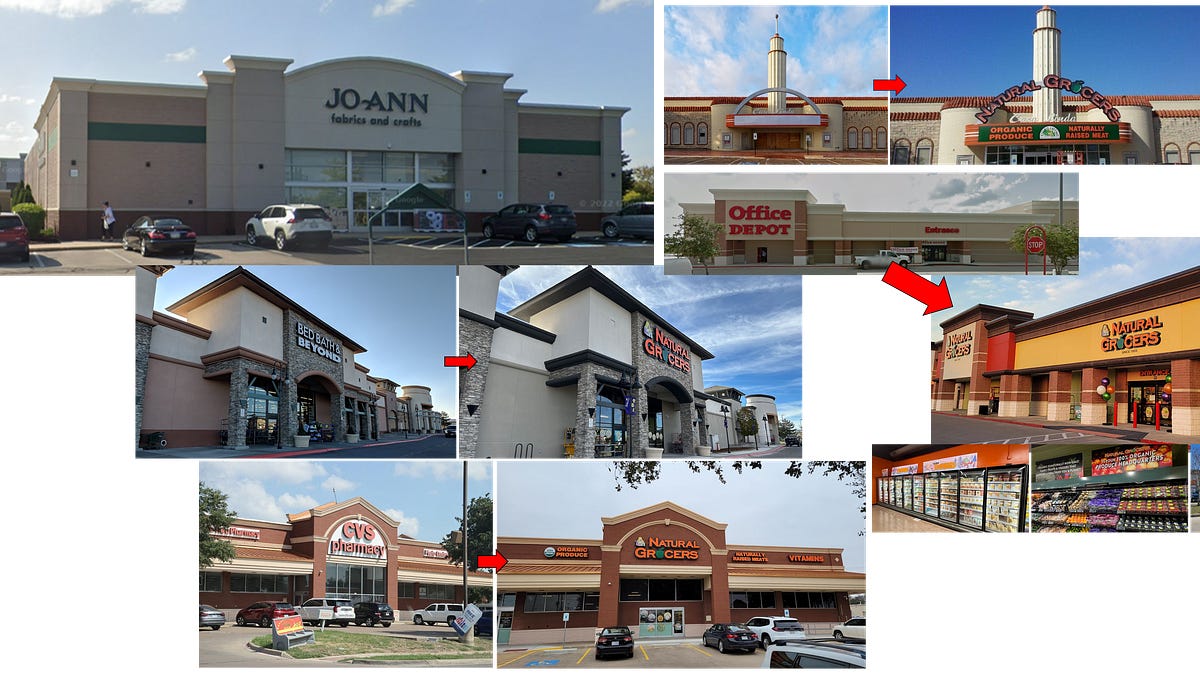
The new Natural Grocers store—which will be located in Lake Geneva’s Geneva Commons shopping center—will be in a familiar space to locals:
A repurposed 15,000 square foot building formerly occupied by craft retailer Joann Fabrics.
Natural Grocers aggressively pursued the former Joann space in Lake Geneva.
In fact the Company did not even wait to negotiate a lease with the shopping center’s landlord for the building.
Instead it acquired the Joann lease in an auction held last April during the craft retailer’s bankruptcy.
This meant that Natural Grocers assumed all obligations of the lease—including to pay rent immediately despite the fact that it would likely take a year to open in the space.
Additionally, it also obligated Natural Grocers to take on the cost of the adaptive reuse without a contribution from the landlord.
But the Company has plenty of experience with repurposing buildings that had once been occupied by other retailers.
Natural Grocers has repurposed dozens of Big Box retail sites, former drugstores and vacant grocery stores.
It has even completed an adaptive reuse of a former theater into a grocery store!
These projects are all part of Natural Grocers’ real estate strategy to upgrade and add to its store base in a cost effective—and sustainable—way.

Natural Grocers by Vitamin Cottage is not a high flying unit grower.
The specialty grocer—which primarily sells organic food and produce, vitamins and dietary supplements—was founded by Margaret and Philip Isely in 1955 and had just 11 stores when the Iselys’ children acquired it in the late 1990s.
Even though Natural Grocers has added ~160 stores over the past 25 years, the Company is still managed by members of the Isely Family and opens new units at a careful and methodical pace.
In fact Natural Grocers added a total of just 7 net new stores over the past 5 years.
However, during that same time period the Company has also relocated many of its existing stores into higher quality real estate.
In the past three years alone Natural Grocers relocated at least 10 stores.
But 2026 is expected to be a more active year for the Company.
Natural Grocers’ CFO Richard Halle noted on last week’s Q4 2025 earnings call that the grocer plans to open 6 to 8 new stores in 2026 as well as relocate or remodel 2 to 3 of its existing stores.
Many of these new stores and relocations will be in repurposed real estate.
In fact the adaptive reuse of the former Joann Fabrics store in Wisconsin will be a familiar project for Natural Grocers.
The Company has opened several new stores in “2nd generation” suites formerly home to Joann as well as other Big Box retailers like TJ Maxx and Bed Bath & Beyond.

Another recent Natural Grocers’store opening in 2025 was also in a converted Big Box retail store:
A former Office Depot in Brownsville, Texas.

But there is one type of property that Natural Grocers has repurposed even more regularly:
Former drugstores.
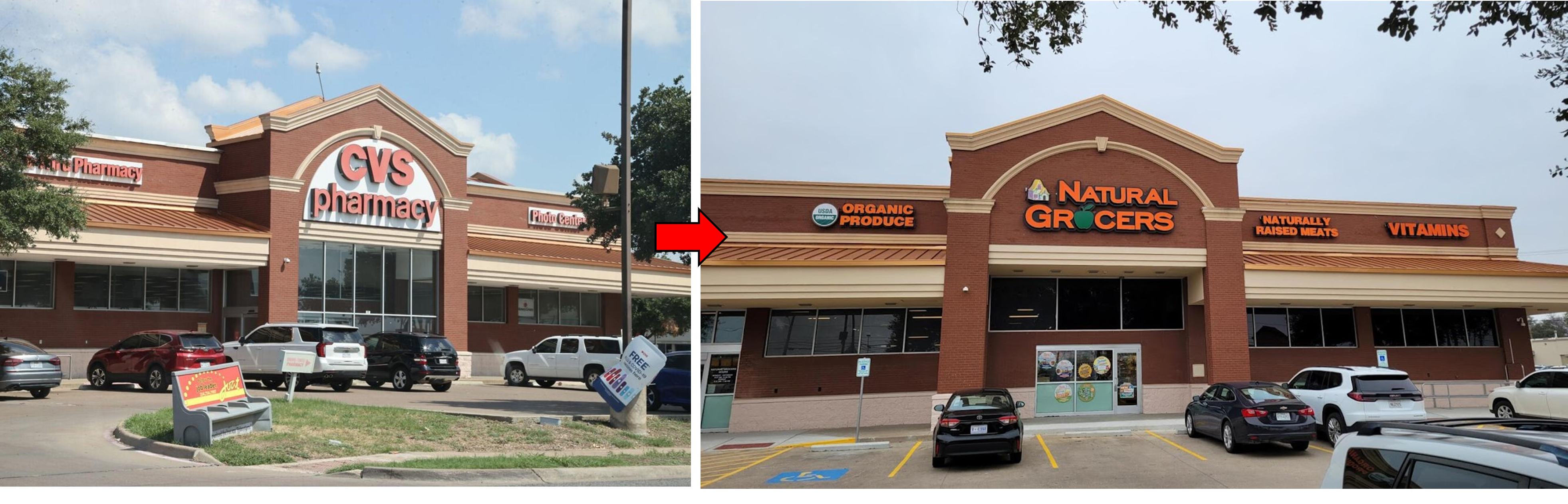
Natural Grocers has opened multiple stores in former drugstore real estate.
Like this adaptive reuse of a former CVS building in Waco, Texas—one of the two stores the Company opened in 2025.
Natural Grocers has even pursued adaptive reuse in smaller towns where former drugstores and Big Box buildings are not widely available.
For instance, in 2024 Natural Grocers opened a new store in the town of Gunnison, Colorado (population ~6,800).
It was a repurpose of locally owned Darnell True Value Hardware, a 16,000 square foot hardware store that had recently closed after ~30 years of operation.

Sometimes Natural Grocers pursues even more creative adaptive reuse projects.
Like its repurpose of The Casa Linda Theater in Dallas, Texas.
The Casa Linda Theater opened as a single screen theater in 1945.
A second screen was added in the early 1970s and a few years later the Casa Linda expanded to four screens in a little over 12,000 square feet.
It operated until 1999.
While a few chains considered taking over the classic theater to continue operating it as a cinema, the space sat vacant for about a decade.
Until Natural Grocers by Vitamin Cottage completed an adaptive reuse of the former theater into a grocery store.
Quite a bit of work was necessary to convert the space—including a roof replacement, leveling of the floor and removal of load-bearing walls.
Inside the classic theater-turned-grocery store looks like a typical Natural Grocers site.

But Natural Grocers preserved the exterior and facade of the building — and put its own twist on the original art-deco marquee.

Adaptive reuse of existing commercial real estate will likely remain a key strategy for Natural Grocers by Vitamin Cottage as it grows.
After all the repurpose and reuse of vacant buildings not only offers Natural Grocers an attractive opportunity to upgrade its real estate, but it also resonates with the Company’s foundational support for practices that promote sustainability.
Natural Grocers has historically prioritized offering products produced via regenerative and sustainable agricultural practices.
The Company has also touted its work to reduce its environmental impact by preventing food waste and restricting the single-use plastic bags.
Perhaps Natural Grocers will even begin to measure the (lack of) impact from its adaptive re-use projects and building conversions — like U-Haul UHAL 0.00%↑ which has incorporated its sustainability focus into its real estate development and site selection.
In any event, Natural Grocers is likely to rely on adaptive reuse as a means to both upgrade its real estate and enhance its sustainability efforts.
Especially as the Company moves eastward in expansion—into a part of the country where bankrupt retailers like Joann, Rite Aid and Party City have vacated several thousand (!) sites over just the past couple of years.