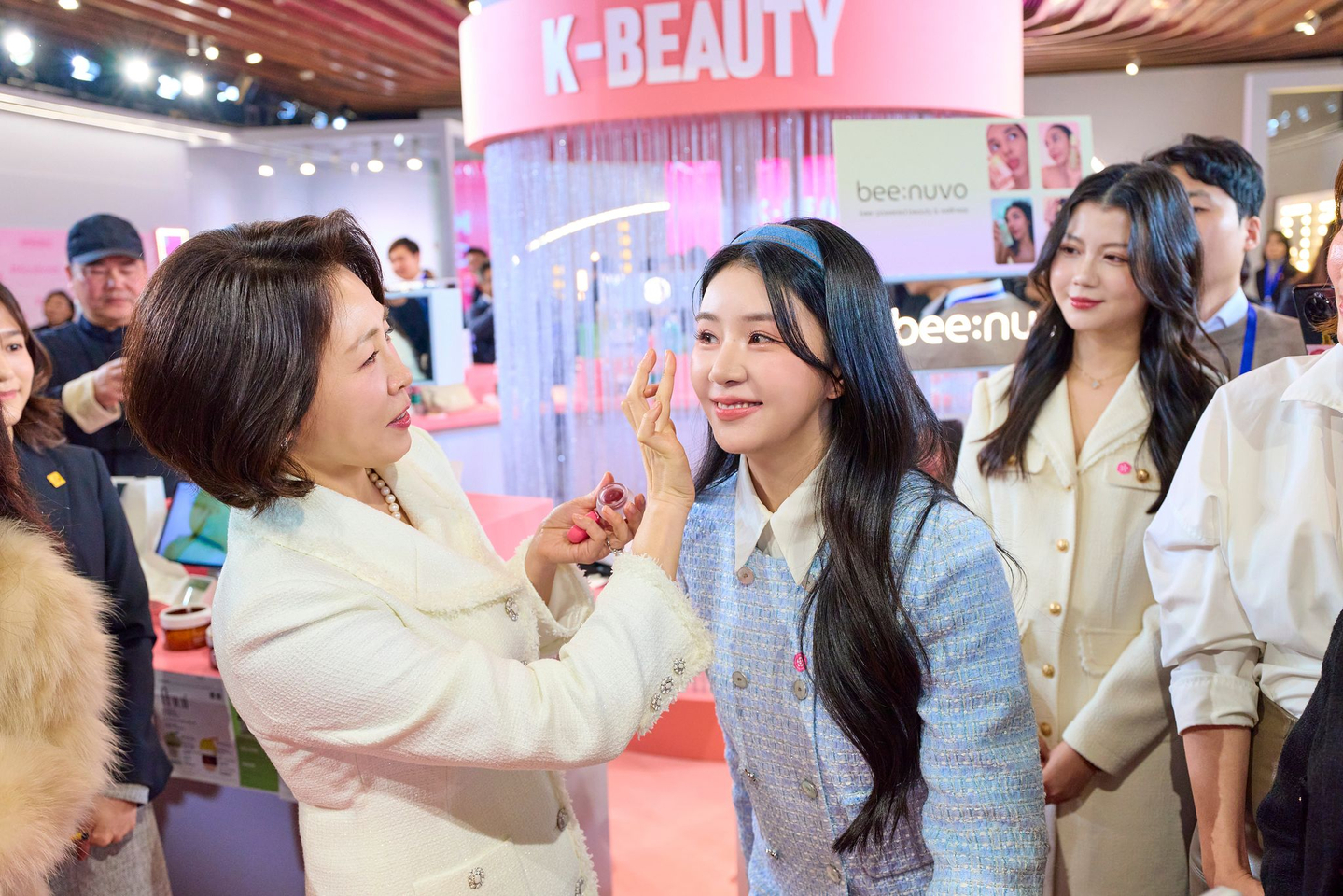
![First Lady Kim Hea Kyung, left, applies cosmetics to an attendee's face during a Korean beauty event held at the Fuxing Art Center in Shanghai on Jan. 7. [JOINT PRESS CORPS]](https://www.vitaminrush.com/wp-content/uploads/2026/02/f8f32554-4f6c-4cb3-bd53-d9da8fce23aa.jpg)
First Lady Kim Hea Kyung, left, applies cosmetics to an attendee’s face during a Korean beauty event held at the Fuxing Art Center in Shanghai on Jan. 7. [JOINT PRESS CORPS]
Emerging Korean beauty companies posted their best-ever results in 2025 on the back of growing overseas demand.
With exports rising, however, counterfeit goods and intellectual property infringements have also increased, prompting calls for institutional support from the government to sustain the sector’s growth.
Local cosmetics brand d’Alba Global said Friday that it posted sales of 519.8 billion won ($359.4 million) and operating profit of 101.1 billion won in 2025. Sales rose 68 percent, and operating profit climbed 69 percent from a year earlier, with annual sales topping 500 billion won for the first time. Overseas sales jumped 131 percent from 141 billion won in 2024 to 326.1 billion won, accounting for 62.7 percent of total sales.
“Starting late December, we began selling our flagship products at 150 Costco stores in North America and 1,500 Ulta Beauty stores in the United States,” said a d’Alba Global spokesperson. “This year, we plan to expand the number of offline stores in North America to about 3,000 and raise the share of offline sales in the region to 25 percent.”
APR and Goodai Global, also considered among the leading trio of fast-rising K-beauty players alongside d’Alba Global, continued to post strong growth in 2025. Despite being founded only about a decade ago, all three companies have expanded rapidly, led by overseas markets.
APR recorded sales of 1.53 trillion won and an operating profit of 365.4 billion won in 2025, up 111 percent and 198 percent, respectively, from 2024. Goodai Global has not yet disclosed official earnings, but industry sources estimate it generated about 1.7 trillion won in sales in 2025, following a reported surpassing of 1 trillion won in consolidated sales in 2024.
K-beauty’s growth is also reflected in export performance. The Ministry of Trade, Industry and Resources and the Korea International Trade Association said cosmetics exports rose 11.8 percent from 2024 to $11.4 billion in 2025, marking a record high. After exceeding $10 billion for the first time in 2024, exports remained above the $10 billion level for a second straight year.
![A citizen browses cosmetics at a beauty store in Seoul on Feb. 11. [YONHAP]](https://www.vitaminrush.com/wp-content/uploads/2026/02/4b51c881-1e84-42c3-9e4e-d4beb872cff0.jpg)
A citizen browses cosmetics at a beauty store in Seoul on Feb. 11. [YONHAP]
Counterfeits, however, also increased alongside growth. The Korea Customs Service seized 117,000 counterfeit items of Korean-brand goods in 2025, with cosmetics accounting for 41,903 items, or 35.9 percent, the largest share among all categories. Seized goods included products imitating Beauty of Joseon sunscreen, a cosmetics brand owned by Goodai Global.
The government has begun strengthening its response system to support K-beauty’s growth and protect brands. The Ministry of Food and Drug Safety launched a consultative body with the Ministry of Intellectual Property and the Korea Customs Service on Jan. 23 to assess the distribution of counterfeit cosmetics and step up enforcement.
The National Assembly has also begun discussing related measures. Liberal Democratic Party Rep. Kim Won-i held a policy seminar on Feb. 10, bringing together K-beauty and platform companies to discuss countermeasures.
“The scale of intellectual property damage suffered by K-beauty companies has exceeded 1 trillion won,” Kim said. “To maintain competitiveness in global markets, institutional and policy backing is needed.”
Calls for policy improvements also came from the private sector. “K-beauty has been growing so fast in the U.S. market that it has overtaken France to rank first in the share of cosmetics imports,” said Hannah Shin, head of Amazon Global Selling Korea. “We need policies that strengthen structural competitiveness, not one off support.”
“To ensure K-beauty’s sustainable growth, institutional measures such as tougher penalties for counterfeit goods must be put in place,” said Shin Jae-ha, a vice president at APR.
This article was originally written in Korean and translated by a bilingual reporter with the help of generative AI tools. It was then edited by a native English-speaking editor. All AI-assisted translations are reviewed and refined by our newsroom.
BY NOH YU-RIM [[email protected]]