A USU nursing professor explores how natural fruit compounds can protect the cardiovascular health of service members.
Dr. Mary Engler’s research at USU explores how the antioxidant power of dark-pigmented fruits, such as
black currants and tart cherries, can provide “nutritional armor” to protect a warfighter’s cardiovascular system
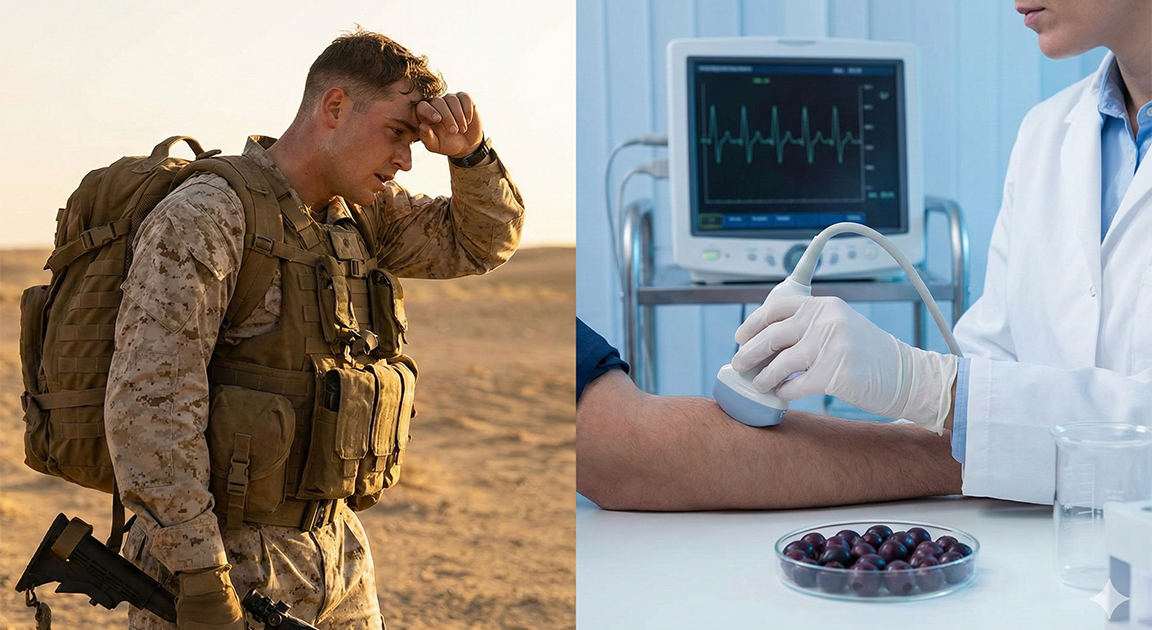
against the intense physical strain of the battlefield. (AI image created by Google Gemini)
February 20, 2026 by Hadiyah Brendel
Inside the labs of the Uniformed Services University’s (USU) Daniel K. Inouye Graduate School of Nursing (GSN), military readiness takes the form of deep purple fruit extracts.

Dr. Mary Engler, a professor and director of
the GSN Ph.D. in Nursing Science program.
(Photo credit: Tom Balfour, USU)
Leading this charge is Dr. Mary Engler, a professor and director of the GSN Ph.D. in Nursing Science program. Engler is conducting clinical trials to explore how specific natural compounds can shield the cardiovascular systems of military personnel.
For Engler, this work is deeply personal and driven by a powerful legacy. She is continuing the scientific work of her late twin sister, Dr. Marguerite Engler, by researching how plant flavonoids can improve vascular health and mission performance.
The Power of Flavonoids
Picture a warfighter hauling a 60-pound rucksack through 100-degree desert heat. Their heart races to pump oxygen, blood vessels strain under the pressure, and oxidative stress floods their cellular system.
Engler aims to counter this battlefield damage using black currants, aronia berries, and tart cherries. The rich, dark pigments in these fruits come from anthocyanins, flavonoids armed with potent antioxidant and anti-inflammatory properties.
“Our goal is to protect the heart now,” Engler says.
She envisions these natural extracts acting as nutritional armor. By taking them proactively, service members can keep their blood vessels flexible and resilient before irreversible damage occurs.
Measuring Readiness: FMD and CAVI
To see this vascular armor in action, Engler’s team watches the blood flow in real time. They use ultrasound technology to perform Flow-Mediated Dilation (FMD), watching a monitor as a brachial artery in the arm opens up after a brief constriction.
A swift, wide dilation on the screen reveals a healthy, responsive heart ready for deployment. A sluggish response, however, flashes an early warning sign of future cardiovascular disease.
The team also maps arterial stiffness using the Cardio Ankle Vascular Index (CAVI). microphones placed on the body listen to the heart’s rhythm while cuffs measure pressure, translating the pulse into a tangible score.
A CAVI score creeping above nine indicates stiffening arteries. Engler’s nutritional interventions aim to drive that number down, restoring youthful elasticity to the vascular system.
Precision Health and the “Omics” Frontier
The research goes far deeper than a standard ultrasound, zooming down to the microscopic level of DNA and RNA. Her multi-omics approach analyzes frozen genetic samples alongside a panel of 100 different proteins.
This biological fingerprint reveals precisely how a service member’s unique genetics interact with the berry supplements.
“We are looking at the molecular level to see how these nutrients change the environment of the blood vessels,” Engler notes.
The ultimate goal is hyper-personalized medicine for the military. Tomorrow’s warfighters might receive custom prescriptions of tart cherry or black currant extract tailored strictly to their DNA to speed up their recovery.
Impact on the Force
By cooling the inflammatory fire after grueling training, these plant-based shields help service members bounce back faster. Flexible, relaxed arteries reduce the heart’s overall workload during high-stakes missions.
Military personnel are already leaning into this proactive approach to longevity. Engler’s social media recruitment continually draws a surge of volunteers, proving that today’s force wants active control over their long-term health.