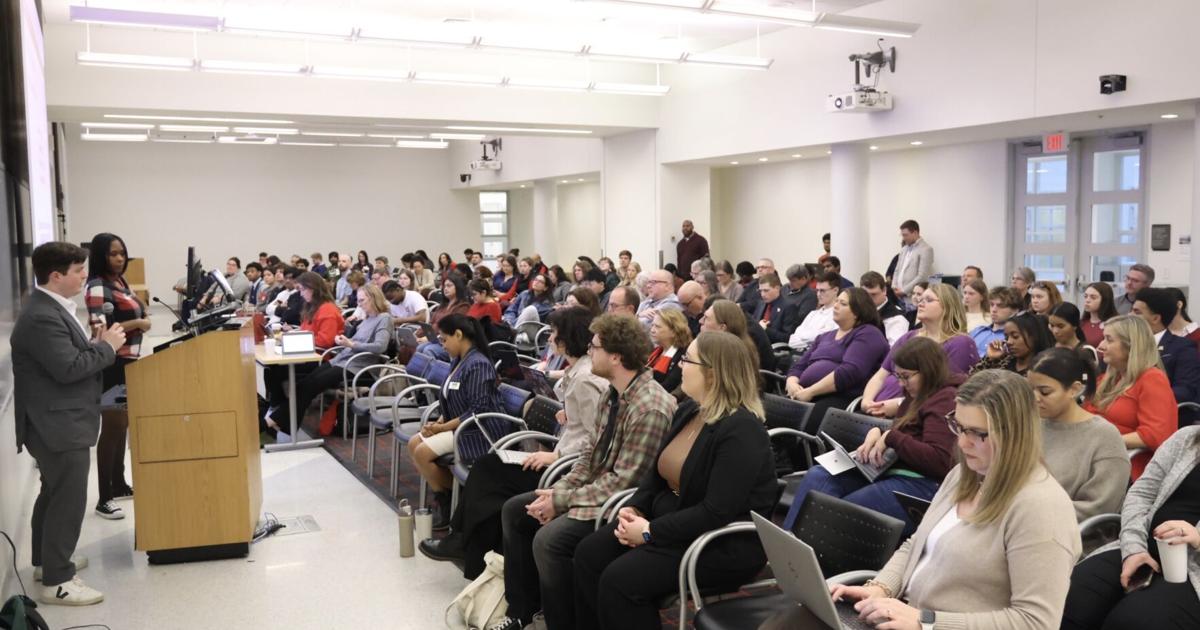

Undergraduate Student Body President Joshua Copley addresses a joint senate meeting in room 400 of Tangeman University Center (TUC) at the University of Cincinnati on Feb. 17, 2026.
Joe Carey | News Editor
Four campus governing bodies at the University of Cincinnati (UC) convened for an annual joint senate meeting in Tangeman University Center on Feb. 17, 2026. The general assembly included members from UC’s Undergraduate Student Government (USG), Graduate Student Government, Faculty Senate and Staff Senate.
The combined senate voted in favor of an instructional calendar proposal for the 2027-2028 and 2028-2029 academic years. The bill’s provisions included the following:
A two-day Fall Break.No instruction the Wednesday before Thanksgiving.A four-day final exam schedule.No standalone reading days.
The bill’s proponents claimed the proposed changes would promote student wellbeing while aligning UC’s calendar with peer institutions in Ohio and the Big 12 Conference.
“As a professor, I voted for it because having just isolated days off all through the semester is kind of chaotic from a pedagogical point of view,” said Gregory Loving, a professor of philosophy and vice chair of UC’s Faculty Senate. “I would rather have one longer break that you can actually use rather than kind of one day off here, one day off there.”
The proposal would eliminate Election Day as a reading day for UC students. Proponents said UC faculty would be encouraged under the new calendar to hold asynchronous instruction during presidential election years.
“We are outside of the norm in Ohio and nationally with having Election Day as a reading day,” said Molly McDermott-Fallon, assistant vice provost and chair of UC’s Calendar and Examinations Committee. “The compromise suggested was to have presidential election years have asynchronous instruction, which would be consistent with peer practice.”
Jesse White IV, a second-year political science major and USG senator for the College of Arts and Sciences, was one of five senators to vote “no” on the calendar bill. White said mandating instruction on election day could hinder students from getting to the polls.
“I feel that getting rid of the reading day on Election Day would disenfranchise student voters from going out and taking part in their civic duty and engaging in democracy,” White said. “I know there are other avenues to vote, such as early voting and absentee ballot voting, but with Ohio law changing it to where there’s no grace period for absentee ballots anymore it makes it a little harder.”
Ohio lawmakers passed a bill that eliminates the four-day grace period for absentee ballots to arrive at the state board of elections on Nov. 19, 2025. The bill was signed by Ohio Gov. Mike DeWine on Dec. 20, 2025.
The UC assembly also passed a joint resolution titled “Improving Bearcat Wellbeing,” by unanimous vote.
The act requests the creation of a “Wellness Policy Group,” a board of representatives from each governing body tasked with advising UC administrators on matters of public wellness.
The text also calls for “more frequent and explicit messaging” from the President’s Office to the campus community.
“The idea behind this wellness bill was that there seemed to be a disconnect or mistrust between the administration and different populations of the Bearcat community,” Neelakshi Chatterjee, UC graduate student government president said, “We are working to bridge that gap.”
Joshua Copley, undergraduate student body president said the wellness bill is an important step towards shared governance at UC and proactive conversation between higher administration and the campus community.
“Our goal with all our governing bodies coming together is that if we agree on something, then the university administration cannot ignore that,” Copley said. “We are coming out and showing that when every aspect of campus is passionate about something, you have to come listen to us and we have to open that dialogue with senior administration.”
Despite a unanimous vote, the measure carries no force of law and can only take effect following approval from UC President Neville Pinto.