The wellness industry has boomed in recent years, begetting a sea of trendy wellness-focused restaurants that brand healthy eating as a luxury experience. But what does it mean for a restaurant to be healthy?
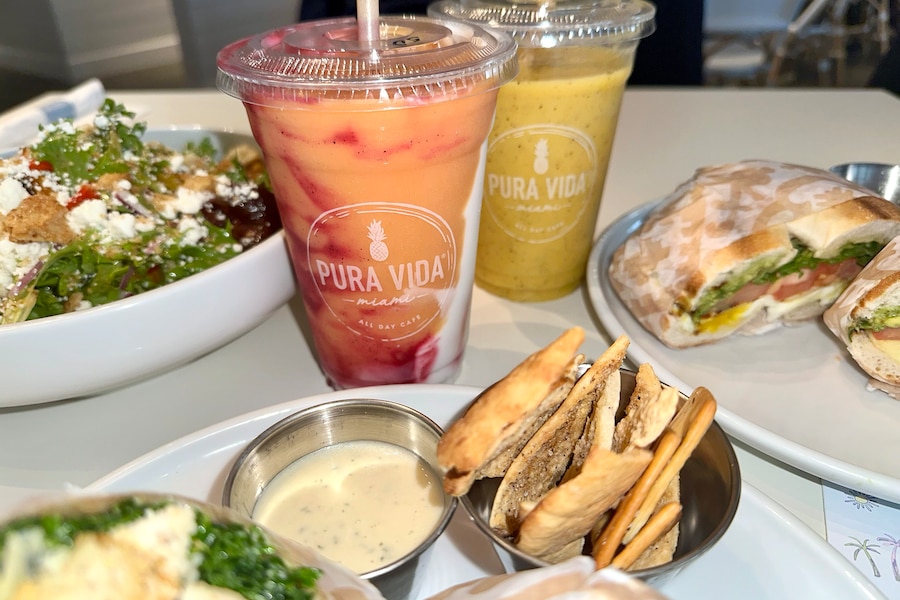
Pura Vida Miami just landed its first DMV location in Potomac, with future locations in the Mosaic District in Virginia and Logan Circle in D.C. slated to open this spring and summer.
The restaurant chain offers tasty and Instagrammable breakfast sandwiches, salads, acai bowls and coffee. The menu boasts that they’re “proud to cook without seed oils.” It sells bottled wellness shots and limited-edition “functional” smoothies with fancy-sounding supplements and a $20 price tag.
Restaurants marketed as “clean” are rising in popularity as consumers grow more health-conscious. But “clean” isn’t the signifier you might think it is, because restaurant marketing doesn’t adhere to formal nutrition definitions, registered dietitian nutritionist Andrea Whitley told The Banner.
“It’s understandable that restaurants want to use language that resonates with the current wellness trend,” Whitley said. “But … when they’re saying things like, ‘This is clean,’ sometimes it can imply that other foods are dirty. And then the conversation goes from ‘I just want to be well’ to a morality thing.”
Seed oils, beef tallow and the MAHA influence
Pura Vida Miami joins a growing list of area restaurants — including True Food Kitchen in Bethesda, Gaithersburg and Annapolis; Sweetgreen in Baltimore and Towson; and D.C.’s popular new Eebee’s Corner Bar — that are ditching seed oils in favor of olive oil, avocado oil, coconut oil and beef tallow.
Seed oils, such as canola, grapeseed and vegetable oils, have been vilified in recent years, with some health non-experts claiming that they’re “toxic” and cause several health problems. Dietitians and nutrition researchers maintain that seed oils are not only safe to consume, but actually contain fatty acids associated with a lower risk of diabetes, stroke and serious heart problems.
“There’s no large-scale evidence that supports that they’re inherently harmful,” Whitley said.
 Eebee’s Corner Bar, located in D.C.’s Shaw neighborhood, serves its popular burger with a side of beef tallow fries. (Hannah Yasharoff/The Banner)
Beef tallow is the cooking oil of choice for Robert F. Kennedy Jr., the U.S. health secretary. He recently declared that his “Make America Healthy Again” campaign was “ending the war on saturated fats.” Research shows that saturated fats, including beef tallow, are detrimental to heart health.
“A lot of people like it because they are trying to go more toward a whole-foods diet,” Whitley said. “It’s not inherently bad, but you have to take into consideration that it’s higher in saturated fat, and if you have high cholesterol, hypertension or risk for heart disease, it can be a concern.”
The rise of the super-expensive ‘functional’ smoothie
Remember that $20 functional smoothie? Pura Vida Miami isn’t alone in offering pricey “functional” smoothies with purported benefits beyond adding more fruit to your daily diet.
Erewhon — a trendy Los Angeles-based grocery famous for charging $50 for a Mason jar of bone broth and $19 for a single strawberry — kick-started a luxury wellness smoothie movement in 2022. It partnered with model Hailey Bieber to make the Strawberry Glaze Skin Smoothie: a pink-and-white-swirled drink that supposedly improves your skin with collagen peptides and sea moss gel.
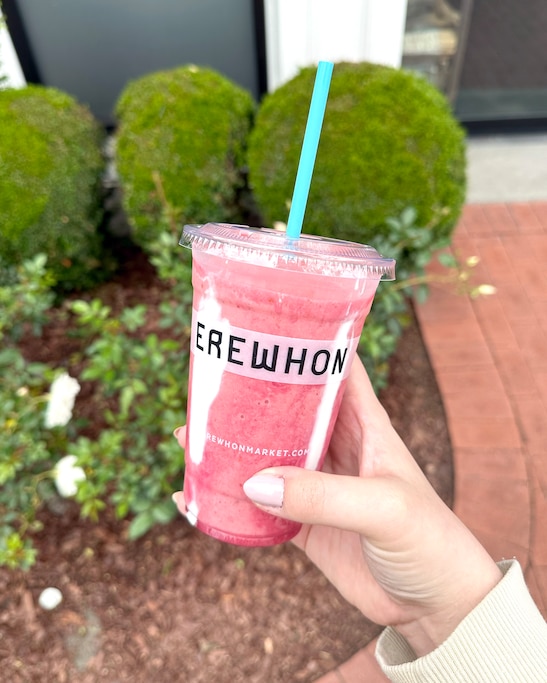 Los Angeles grocery store Erewhon’s Hailey Bieber Strawberry Glaze Skin Smoothie went viral. (Hannah Yasharoff/The Banner)
Similarly colorful copycats have since popped up in and around Montgomery County, including the Ode to LA/Strawberry Fields smoothie (a “superfood smoothie” with strawberry, banana and coconut) from Rooted3 in Bethesda; the Glow Time smoothie (a magenta-and-baby-blue drink with tremella mushroom powder and blue spirulina) from Life Alive in D.C.; and the Strawberry Cloud Smoothie (featuring sea moss and collagen) from South Block in North Bethesda.
Whitley argues that high prices aren’t necessarily a bad thing from a health standpoint: Quality supplements can get pretty expensive, and if you’re going to consume them, it’s better to avoid the cheaper ones, which often include fillers.
These smoothies are largely very tasty. Adding more fruits and vegetables to your diet is never a bad idea. But branding a pricey smoothie as a pillar of health can mislead consumers to believe that that’s the only solution to getting healthier.
Supplements such as creatine and collagen offer important benefits such as supporting muscle, skin, bone and joint health, but they can also be found naturally in animal-based proteins.
“Is it necessary you buy [functional smoothies] from that store? If that’s what you’re into, yes. There’s nothing wrong with it,” Whitley said. “But it may not be in everyone’s budget. That doesn’t mean they can’t get what they need in other ways. … I’m a fan of [eating] food first and then filling in the gaps with supplements.”
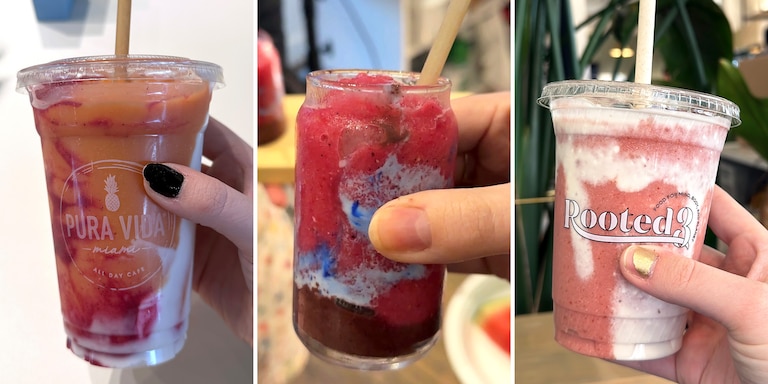 From left, Pura Vida Miami in Potomac, Life Alive in D.C., and Rooted3 in Bethesda now offer colorful and supplement-filled smoothies similar to Erewhon’s. (Hannah Yasharoff/The Banner)Protein is king. Should it be?
Protein is the macronutrient du jour. While dietitians concur that it’s an important part of everyone’s daily diet, some people may be overemphasizing it.
The recently opened Springbone Kitchen in D.C. offers hot chocolate made with bone broth, which adds roughly 10 grams of protein to an otherwise nearly proteinless beverage. Many national chains, including Starbucks, Chipotle and Cava, have introduced protein-centric menus that offer anywhere from 27 to 81 grams of protein in a serving.
The United States Department of Agriculture recently released its new Dietary Guidelines for Americans, which include a recommendation to consume 1.2 to 1.6 grams of protein per kilogram of body weight daily — a stark increase from the guidelines’ previous recommendation of about 0.8 grams of protein per kilogram. (That’s the difference between a 150-pound person consuming 54 grams of protein and a range of 82 to 109 grams.)
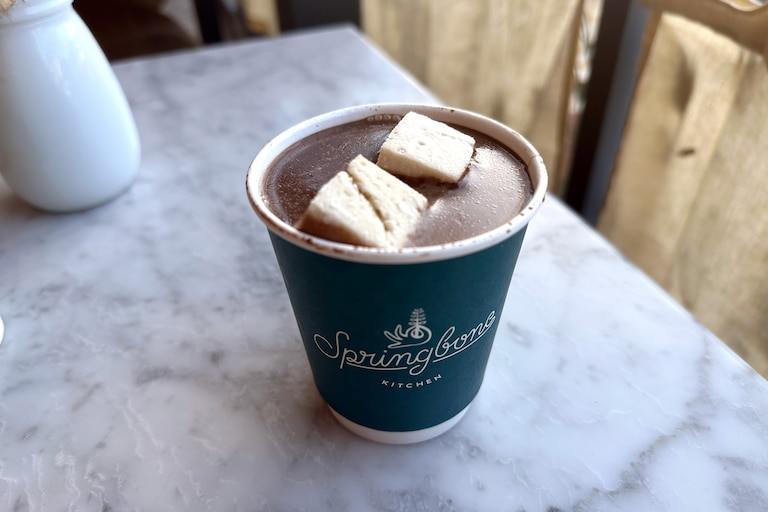 Springbone Kitchen, a New York chain that recently landed in D.C., offers a bone broth hot chocolate that’s surprisingly tasty. (Hannah Yasharoff/The Banner)
The Academy of Nutrition and Dietetics still recommends numbers closer to the previous guidelines. Whitley said protein should usually be 20% to 25% of a person’s diet, depending on calorie intake.
As with all other nutrition advice, however, the right approach varies by person and is best determined by a qualified dietitian.
“I don’t want people to think that they can’t enjoy food,” Whitley said. “Food is social, it’s cultural and you really want to enjoy it. But marketing terms like ‘clean’ don’t automatically make a food healthier. We have to look at your overall dietary patterns. That matters more than any individual green ingredient or buzzword.”