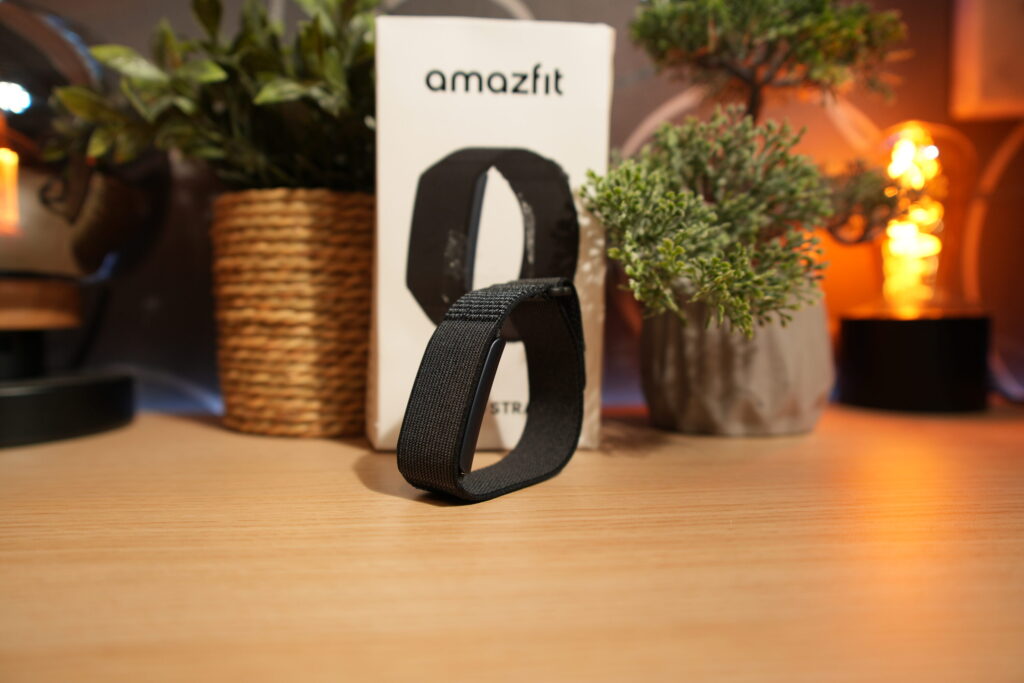

Amazfit Helio Strap review: Fitness tracking without a display, without monthly costs and for less than 100 euros: does that sound too good to be true? Alongside smartwatches and smart rings, a whole new category is emerging on the wearable market: fitness wristbands with no display at all. The best-known representative of this category is Whoop. However, its subscription model costs several hundred euros a year. The Amazfit Helio Strap positions itself as an affordable but convincing alternative: for a one-off fee of 99.90 euros, you get comprehensive health analysis without any hidden subscription costs. The compact wearable deliberately focuses on the essential functions and offers precise monitoring of health, activity and sleep. But in our test, we find out whether it’s really worth buying.
Technical data of the Amazfit Helio Strap
Strap size
33.97 x 24.3 x 10.59 mm
weight
20 grams
Housing
Fiber-reinforced plastic
Display
not available
Battery capacity
232 mAh
Charging time
approx. 2 hours
Maximum battery life
10 days
sensors
BioTracker 6.0 PPG biometric sensor (5PD + 2LED), acceleration, gyroscope, temperature
Wireless connection
Bluetooth 5.2 BLE
Price (RRP)
€ 99.90 *

€ 99.90
Gewöhnlich versandfertig in 1 bis 2 Monaten
Amazfit Helio Strap Review: design and workmanship
The first impression of the Amazfit Helio Strap is simple and functional. No display, no buttons. Just a functional design. The heart of the Helio Strap is a small plastic puck without any metal elements, which houses the sensors. However, it is precisely this concept that is the main reason for the exceptionally low weight of just 20 grams including the strap. A value that makes a considerable difference in everyday use.
The wristband itself is made of nylon with a simple plastic buckle and a Velcro fastener. It is attached via a standard 22 mm connection, which theoretically makes many third-party straps compatible and enables individual customization.

The Helio Strap is surprisingly comfortable to wear on a daily basis. I often forgot to wear it on my wrist because it’s just so light and hardly noticeable. That’s a real compliment for a wearable. However, there is one important caveat: although the strap is so light, it builds up relatively high on the wrist. So if you wear the strap far forward, the angular design might make it a little uncomfortable. But that’s no different with Whoop and the like.
The PPG biometric sensor and two pogo pins for charging are located on the underside. As there is no display, the device communicates exclusively via a vibration motor. And this is responsible for alarms, reminders and notifications, for example.

However, the motor is rather weak, so if you are a heavy sleeper, you should not rely on it alone. The water resistance of 5 ATM (up to 50 meters deep) is sufficient for showering, swimming and snow. However, you should avoid saunas or hot showers, as steam can damage the inner seals in the long term.
Strong features in the Amazfit Helio Strap
The Amazfit Helio Strap lives up to its name “fitness tracker” in terms of functionality: the sensor setup is pretty impressive for this price and leaves little to be desired. Inside, there is a PPG sensor with five photodiodes and two LEDs, an acceleration sensor, a gyroscope and a temperature sensor. The multi-photodiode system improves measurement accuracy and allows more versatile health measurements.


However, you won’t find an integrated GPS chip, so you always have to have your smartphone with you for tracking. In everyday training, you have the option of starting an activity manually via the Zepp app on your smartphone, although the Helio Strap can also recognize and track activities automatically.
At least if you have previously activated this function in the app… which I unfortunately had to painfully discover after a 90-minute workout. The Helio Strap then transmits real-time heart rate data to compatible devices via Bluetooth.
Automatic activity detection is available, but unfortunately only moderately reliable: it recognizes that movement is taking place, but often only names the activity as a generic activity instead of identifying the specific workout. According to the Amazfit, 25 strength training exercises are supposed to be recognized automatically (including squats, dumbbell flyes and pull-ups), but unfortunately this was not the case in my gym test.
The heart of the wearable is of course the Zepp app, which provides a solid basis for health and sleep tracking. The sleep tab provides a clear overview of night data including HRV, deep sleep percentage and skin temperature


Everything is provided with a clearly understandable traffic light system that shows at a glance what is OK and where action is needed. I really like the tidy app. It is intuitive to use and clearly laid out. The BioCharge concept, which shows the daily energy balance, is a central feature that I find very interesting. Based on your recovery and exertion, it shows how fit you are for the day and whether you can go full throttle or should take it easy.

An optional Aura subscription (approx. 70 US dollars per year) expands the range of functions to include AI-based wellness advice and audio relaxation content, but I couldn’t find any real added value in the subscription. On the plus side, unlike WHOOP, basic use is completely free.
10 days battery life
The battery life is one of the strongest arguments in favor of the Helio Strap and the Amazfit’s promise actually holds true in practice. According to the manufacturer, the built-in 232 mAh battery should last up to 10 days. After a week of continuous use, with daily monitoring, three intensive training sessions and all active measurements, the battery was still 35 percent charged. This is an impressive performance for a device that weighs just 20 grams.

By comparison, even GPS sports watches with a much larger battery and screen often last less than two weeks. According to the Amazfit, a full charge takes less than two hours. As the device is only plugged in every ten days, this value is hardly significant.
One real point of criticism is the charging accessory supplied. The Amazfit Helio Strap is charged with a small magnetic charging puck that connects via two metal contacts on the back. The puck itself is tiny, proprietary and does not come with a USB-C cable. If you lose it, you have to buy a replacement.
Performance and accuracy of the Helio Strap
The Amazfit Helio Strap performs remarkably well in its core competence, reliable biometric measurement. The PPG sensor with five photodiodes delivers very stable heart rate values in everyday use without the wild outliers that often occur with cheaper trackers. Measured values and training data are at a very precise level. The latter in particular corresponds almost 1:1 with the data provided by the devices in my gym. Chapeau, Amazfit.

On the other hand, irregularities and inaccuracies can be seen during high-intensity activities as far as heart rate measurement is concerned. Here, the Amazfit Helio Strap sometimes overestimates the heart rate by around 10 bpm, which of course has a noticeable effect on the calories burned.
This is perfectly adequate for determining heart rate zones, but it is not the best choice for precision athletes who rely on every pulse beat. Step counting, on the other hand, is very accurate, although the fitness tracker takes a while to record movements in the first place. However, it quickly catches up and then provides an accurate measurement of steps.
Sleep tracking is one of the most impressive features of the Helio Strap. The total sleep score is reliable and is a good subjective reflection of how rested you feel in the morning. However, there is still room for improvement when it comes to detailed metrics such as sleep phases or sleep onset latency. Short waking phases of less than five minutes are often not recognized, but a change in sleep stage and a change in heart rate are at least registered.
Amazfit Helio Strap Review: Conclusion
The Amazfit Helio Strap is a convincing and affordable fitness tracker that performs well above its price range of around 100 euros in the core areas of heart rate tracking, sleep monitoring and battery life. Anyone looking for a screenless everyday companion that is lightweight, waterproof and can be used without ongoing subscription costs will find a convincing overall package here.
However, anyone dreaming of a real WHOOP replacement will be disappointed: The Zepp app does lack depth and the precision that athletes expect cannot always be achieved. Particularly annoying is the automatic activity detection, which doesn’t always live up to its name and sometimes doesn’t even recognize when you’re active.
For whom is the Helio Strap worthwhile? For fitness beginners, budget-conscious tracker fans and anyone looking for a reliable, lightweight and subscription-free companion for everyday life and sport, it is worth its 100 euros. However, those who train at a professional level and expect precise training control will only be happy to a limited extent.
PRO
No subscription obligation
Attractive price
Many health insights
Good sleep tracking
Accurate heart rate
Long battery life
CONTRA
Limited app features
Inaccurate automatic detection
No GPS
Design & Workmanship
Features
Sensors & accuracy
Value For Money
84/100
Convincing fitness tracker with accurate sensors, attractive price and long battery life. However, the automatic detection could be better.
€ 99.90
Gewöhnlich versandfertig in 1 bis 2 Monaten