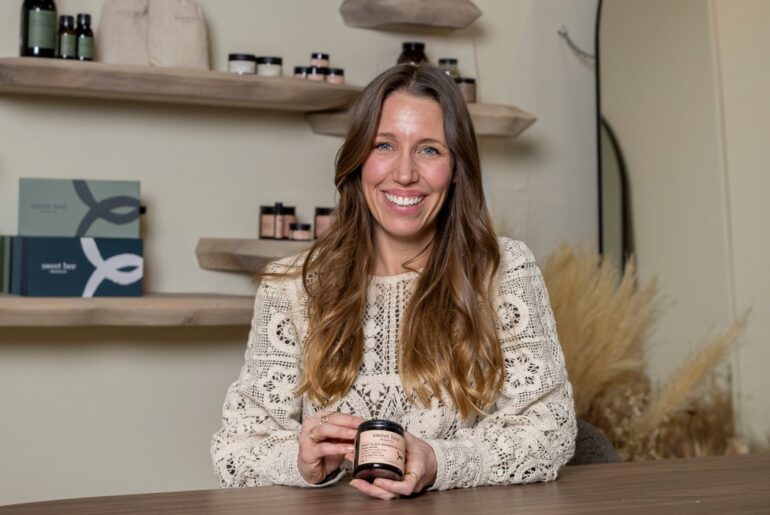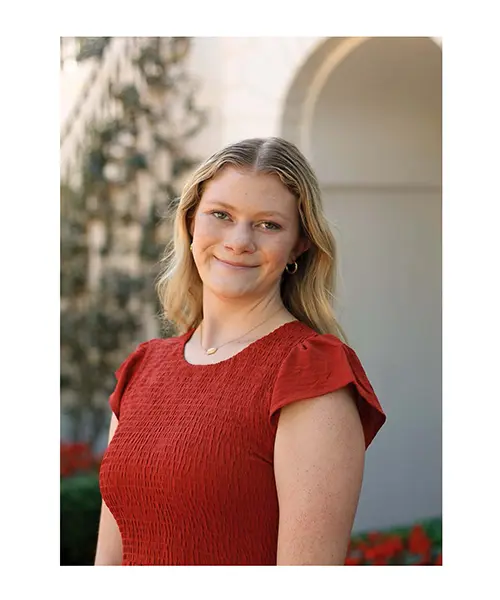
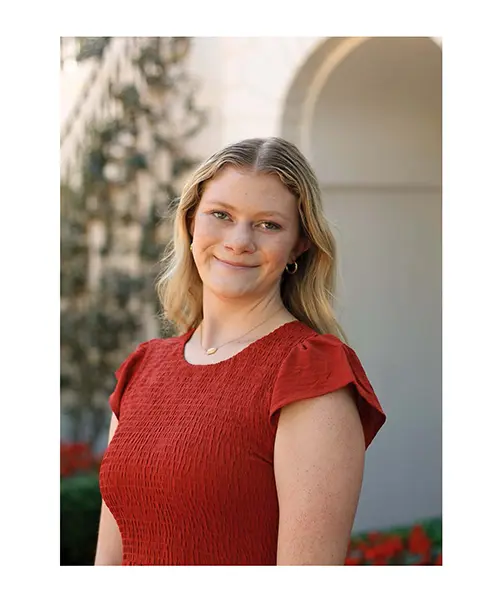
Emma Honer is a junior majoring in public health and social work running for SGA vice president for belonging and wellness.
Q: Why is it that you’re running for vice president of belonging and wellness?
A: I am running for the vice president of belonging and wellness, because I believe that it is a student’s responsibility to help other students, you know, make sure they’re aware of resources, and are making sure that students and staff are aware of resources that are on campus. And if we notice that there are barriers to these resources, or barriers to getting the help that they need and that they deserve, it should be our responsibility to help them, because we are our fellow students, so we understand what they are going through, and we should have the knowledge to be able to help them. And I believe that no matter a student’s background, major organization or experience a student may have, I believe that they have a place on campus, and they deserve to be respected and to feel as though they have a place here.
Q: Why do you think you’re the best candidate for this position?
A: I believe that I am the best fit for this position, because I do have experience with the Student Government Association.
I have served on both the belonging and wellness committee as well as the student affairs committee, and then this year, I served on the Board of Governors for the Student Government Association. And through this I had the opportunity to advocate for equitable outcomes for all the organizations that applied for block seating. And I also was able to provide full transparency through the process as well.
And I think that is something that is incredibly important for the vice president of belonging and wellness position, because we need to be transparent and we need to be consistent, and we make people informed of everything that is happening in the Student Government Association, and make them aware of resources that we have and understanding why that we make the decisions that we need to make.
And I also believe that I am the best fit for this position, because outside the Student Government Association, I have other relevant experience as well with both health and wellness, and another part of health and wellness is being able to foster a strong sense of community.
And I have held roles in the First Year Experience Office where I’ve provided mentorship and been leaders to incoming freshmen and transfer students. Because to me, personally, one thing I want to expand on as the vice president of belonging and wellness is making sure that transfer students have a place on campus. And as a counselor for Camp 1831 there were transfer students at that camp who were really nervous about making these relationships, and I don’t want them to have to feel as though they are out of place for maybe coming to the Capstone after coming from another institution.
And I also believe that I am the best fit for this position because I am familiar with the needs of students on campus as a member of multiple organizations, and I have held internships to where I have had to talk to other professionals for help. And in this position, this is not a position that you can just do inside the box. One would say sometimes you’re going to have to think outside the box to help the students on campus.
Q: What are your campaign’s key platforms?
A: This is a wonderful question. So one thing I want to clarify is when I submitted a proposal to run for the vice president of belonging and wellness, I originally only had three pillars. However, after learning about students’ experiences on campus and doing more research about the needs of students on campus, my pillars changed, my ideas changed, and I think that it’s really important that I address this change now so that people can make an informed decision when it’s time to vote.
My first pillar is about belonging and wellness without the barriers. I believe that belonging and wellness should never feel out of reach, and that they should be accessible, visible and built into the student experience. So I have a few ideas that I want to implement if I am selected to be the vice president of belonging and wellness.
The first one would be the one stop wellness hub, which is a quick quiz that students could take, and we could refer them to resources on campus or other resources that would be available off campus.
And then I also want to provide wellness grants, because The University of Alabama has many wonderful resources. However, sometimes a student might need very specific help that The University of Alabama might not be able to provide right now. And with these wellness grants, we can help cover counseling, co-pays, emergency prescriptions, rec center memberships or classes, transportation to appointments or even help students who are experiencing financial stress, because that is also another part of wellness.
And then I also want to have midterm and final reset weeks so that students can have the opportunity to relax during very stressful times during the academic semester or year.
And then finally, for the first pillar, when I have the find your people initiative, so that people can find other individuals who might have similar interests to them or have similar experiences to them as well. And then my second pillar is about belonging and wellness and making sure that belonging and wellness lasts a lifetime, because belonging and wellness doesn’t end after your time at the Capstone. Your wellness and belonging doesn’t end after college. It lasts a lifetime, and your needs change as you go through hard times.
So how I want to help with this is I want to make mentorship circles, small groups that meet once a month. They are very low stress. They meet all four years at the Capstone. You’ll have the same group that you’ll meet with for all four years. And then I want to provide wellness skills for the rest of your life. I want to teach people about coping skills and how to navigate situations that are very stressful.
And then I also want to create Campus Connection grants. And these are separate grants than the other wellness grants, because these grants would be meant to host intentional, inclusive community events that bring together students who might not otherwise be able to cross paths.
And then I also want to have alumni to student belonging network. Like I said, belonging doesn’t end after your time at the Capstone ends. It keeps continuing. And it’s really important to have connections to alumni, not only for professional purposes, but it can also provide strong companionship as well, and then belonging in the classroom initiative, I also want to encourage faculty and staff to incorporate activities to foster belonging in the classroom.
And then for my third pillar, I understand that mental health is an essential part of belonging and wellness, because mental health is health to me. And one thing I want to implement is mental health ambassadors for every college. So every college would have a certain amount of mental health ambassadors, and they would be trained through the Camellia Center, and they would host conversations and be a good resource to students who are in need of maybe assistance they would not be to be a therapist, but it would be somebody who could help them navigate resources on campus.
And then I also want to create liaisons across student organizations. And I want to understand gaps that maybe are happening on campus and reporting concerns if they have any. And I also want to bring events to students so that they can be aware of resources on campus. And then I also want to have resident hall wellness captains so every residential hall would have a representative. They’d be similar to the mental health ambassadors, but they would be representing the dormitory instead.
And then for my last pillar, I’m actually going to have five pillars instead of four, because as this campaign has gone on, I continue to notice more gaps. So for my fourth gap, that gap would be belonging and wellness that works for you. So essentially, what this would be is finding programs that fit your specific needs and understanding why you have these needs and continuing to connect you to resources on campus, and continuing to expand leadership experiences in the SGA so that you can understand how belonging and wellness works for you, and how you can help others learn how it can work for them as well.
And then finally, after I submitted, I learned about these four pillars. I have structured a fifth pillar because, as this campaign has gone on, I’ve continued to notice major gaps on campus, and some people have come forward about concerns that they have on campus. For example, student veterans are currently facing a lot of concerns. Right now, The University of Alabama ranks No. 5 in the most amount of student veterans on campus, but they don’t always have access to resources on campus, and for people who have served our country. Why are we not providing the resources that they need?
And then also for individuals who have disabilities, sometimes the doors on campus can’t properly open if they are in need of a door to be opened in a specific way. It’s already hard enough maybe as a student to be carrying a handful of books and you have a hard time pulling open a door, but imagine you’re a wheelchair user and you can’t open the door. And I want to make sure that everybody who has a disability on campus is able to easily be accommodated on campus without any concerns. I also want them to have the resources that they need to thrive inside the classroom and outside the classroom, and I’m continuing to understand the needs of disabled students on campus, and by understanding their needs, I can implement resources or collaborate with professionals to accommodate their needs. And as this campaign has gone on, this pillar is currently still being developed, because I’m still understanding the needs of people on campus.
Q: What two specific initiatives do you want to accomplish, and what time frames do you hope to accomplish them in?
A: I think that my biggest goal that I want to accomplish right away, the first day that I step into office- I want to accomplish this by the beginning of the next school year, which would be fall of 2026- would be access to these grants, the wellness grants and the student collaboration grants I want the students to be able to hit the ground running right away in August or September, and be able to be involved on campus and get other people connected to their organization.
And then I believe that the second most important goal I want to accomplish would be, I believe the cross-community collaborations will be my second goal. I want to accomplish this right away in August, because I want those individuals to be interacting all four years of college or for the remainder of their college experience, and that way they can be connected to individuals who have similar interests to themselves, and maybe some people that they wouldn’t get to know otherwise. One of my biggest goals as the VP of belonging and wellness is for people to interact with each other. I want this community to truly feel like a family.
Q: How do you plan to adapt if your initial plan for achieving these goals doesn’t go how you hope?
A: That’s a wonderful question. I believe that adaptability is one of the most important skill sets that you can have as a leader. And I already have plan B’s in place for every initiative that I have. If the grant does not work the way that I would hope I would still plan on creating a program to make sure that students can get access to resources, both on and off campus, by reaching out to local partners on campus and maybe expanding connections that the SGA currently has so that students can still access these resources for a reduced cost, and then if the student collaborations does not work, I will still find ways to create groups for students to feel connected and engaged on campus.
Q: Due to the ongoing issues regarding DEI and other diversity related legal issues in the state, how do you plan to ensure students feel welcomed and represented at the university?
A: Absolutely, I am personally very disappointed that DEI has been facing some legal issues recently, and I understand that this has had a major impact on multicultural groups and students from different social and cultural backgrounds, and I want to help them with these grants. I’d be able to provide organizations the opportunity to receive financial resources for their organization, so that they don’t have to worry about potential financial stressors to continue their community.
And I also believe that as the vice president of belonging and wellness, we need to understand that social and cultural wellness is essential. If I am elected for the vice president of belonging and wellness, I cannot promise that DEI will come back. However, I want to find ways to make sure that multicultural communities can continue, and for the cross community collaborations, a couple of those groups will be focused on people of cultural backgrounds. For example, if people want to continue to be connected with people of similar social and cultural backgrounds, I want for them to have the opportunity to do that, and I will absolutely allow that.
And as somebody who is not a person of color, I don’t fully understand how DEI would impact them, because I don’t have that experience, but I want to have that humility to understand, and if I am to be picked, I will absolutely have my doors open, and I want to listen. I want to understand how this is impacting you, and I want to understand how the Student Government Association can help them, and how it could impact organizations that they are currently involved in.
Q: The current administration of the SGA has not publicly commented on the highly controversial closure of student magazine’s Alice in 1956 but the Faculty Senate recently put out a statement in support of these students affected by the closure. Will you commit to speaking publicly about issues such as this that spark such intense criticism of the university?
A: I will absolutely advocate for student voices such as the Alice Magazine and the Nineteen Fifty-Six magazine, because not only is that a right of students at The University of Alabama, it’s a constitutional right every person that is a US citizen has the right to say what they want to say, share what needs to be shared. And I will not only defend that as a fellow student, I will defend that as a fellow American as well, because that’s a constitutional right, and I believe that everybody deserves to have their voices heard on campus and beyond. And there will be grants put in place for multicultural organizations and social groups, and I hope that somehow we can make sure that all students’ voices are heard regardless of their backgrounds.
Q: What is one last thing you want voters to know about you?
A: I want the voters to know that I care about all of them as people, and I want them to know that I am going to listen, even though I might not always understand what people might be going through. I want to understand, and I’m always open to learning about new experiences, new ideas, because I have that humility, and I want to be able to learn, and I want to serve students the best that I can.
And if I am not willing to listen, then I don’t think I can do that job, but I know that I can do this job, because I will listen to you.