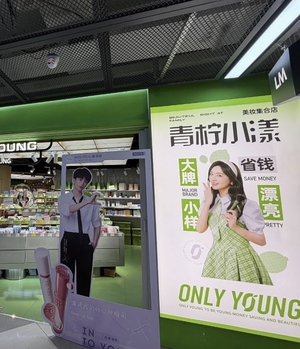
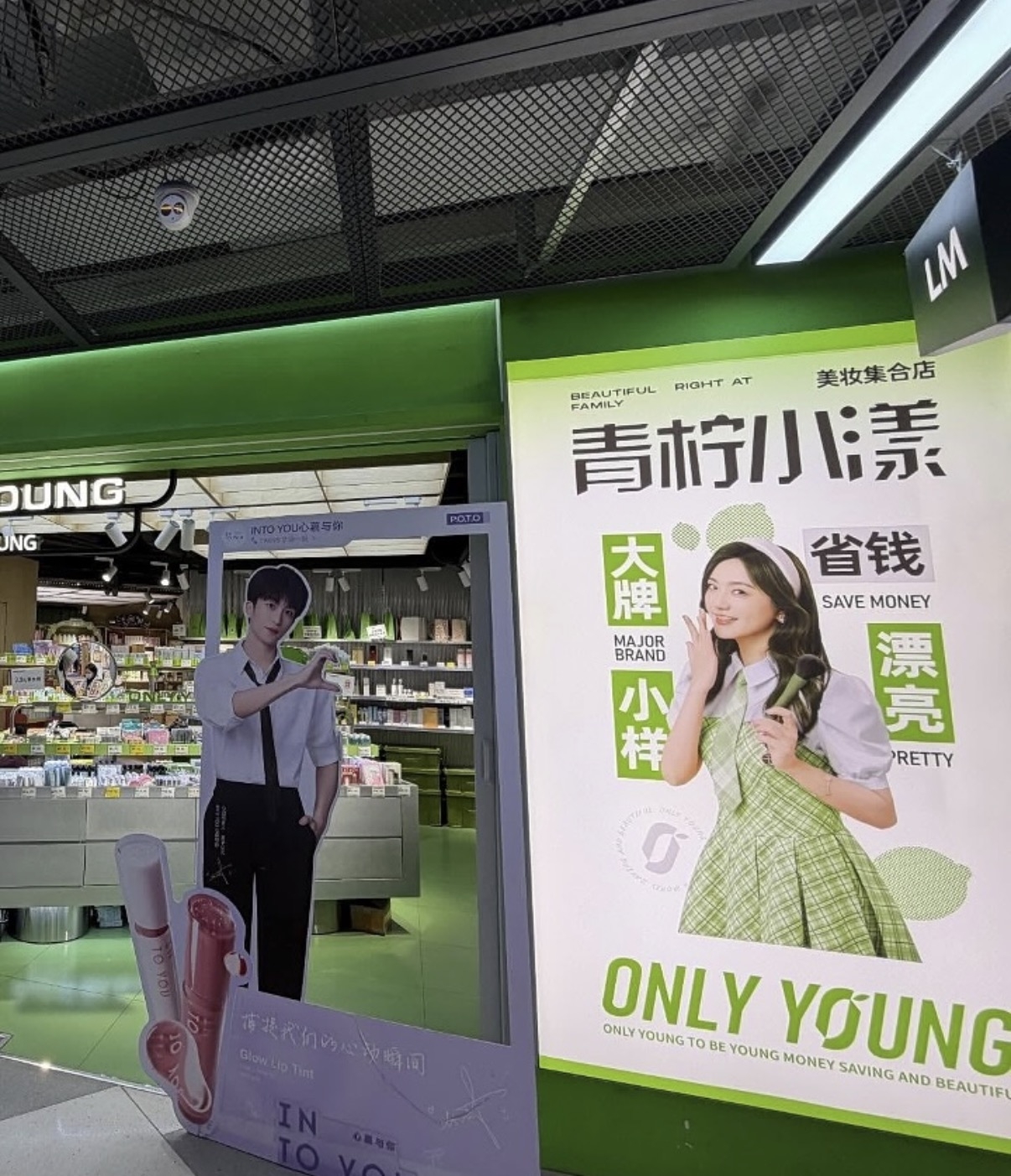
 In Changsha, Hunan Province, a beauty store named “Only Young” has drawn criticism for closely resembling Korea’s leading beauty retailer CJ Olive Young, widely regarded by foreign tourists as a K-beauty shopping destination. (Instagram)
As K-beauty’s global popularity continues to climb, counterfeit and copycat products targeting Korean cosmetics brands are spreading rapidly overseas, raising concerns over intellectual property violations and consumer safety.
South Korea’s cosmetics exports surpassed $11.4 billion last year, ranking the country second worldwide. As brand recognition and consumer trust grow, so does the proliferation of so-called “dupes” seeking to capitalize on the K-beauty boom. The expansion of e-commerce and overseas distribution networks has accelerated the spread of products that closely mimic Korean brands across foreign online platforms and local retail channels.
These counterfeits often go beyond simply copying trademarks. In many cases, they replicate package designs, colors, product names and even distribution concepts. The Ministry of Food and Drug Safety estimates that intellectual property infringements caused about 1.1 trillion won ($825 million) in damages to K-beauty companies last year.
According to the Korea Customs Service, cosmetics accounted for 41,903 cases, or 35.9 percent, of the 117,000 counterfeit K-brand items seized last year — the largest share among all categories. Seized goods included imitations of Goodai Global’s beauty brand Skin1004 and Beauty of Joseon.
Data from the Ministry of Intellectual Property show that reported cases of counterfeit Korean cosmetics circulating in overseas online markets rose from 16,774 in 2023 to 23,494 in 2024, before surging to 36,116 last year. Copying has been concentrated in color cosmetics, skin care and functional products, where brand awareness has risen rapidly. Authorities warn that counterfeit cosmetics, whose ingredients and manufacturing processes are unverified, may pose serious safety risks to consumers.
Blatant brand imitation has also sparked controversy. In Changsha, Hunan Province, a beauty store named “Only Young” has drawn criticism for closely resembling Korea’s leading beauty retailer CJ Olive Young, widely regarded by foreign tourists as a K-beauty shopping destination. The store’s name, logo, signature green color and shopping bag design bear striking similarities, raising concerns that consumers unfamiliar with the brands could be misled.
The store has expanded quickly, offering nationwide free shipping and operating additional branches in nearby Liuyang. Its marketing heavily emphasizes Korean imagery, including the use of K-pop background music in promotional videos posted on China’s short-form platform Douyin.
“A typical trick to lure consumers is pretending to be a Korean-related store as Korea’s brand value rises globally. Corporate responses alone have limitations. Government-level cooperation on intellectual property protection and coordination with local law enforcement is urgently needed,” said Seo Kyung-duk, a professor at Sungshin Women’s University.
yoohong@heraldcorp.com
![A screenshot shows the Instagram account of a suspect identified only by the surname Kim in the Gangbuk motel murder case, as shared on an online community. [SCREEN CAPTURE]](https://www.vitaminrush.com/wp-content/uploads/2026/02/1771918772_627ad02f-6ea4-4485-bf95-5cb72a6039a6-432x515.jpg "Online frenzy over suspected motel killer turns Instagram account into twisted beauty pageant")