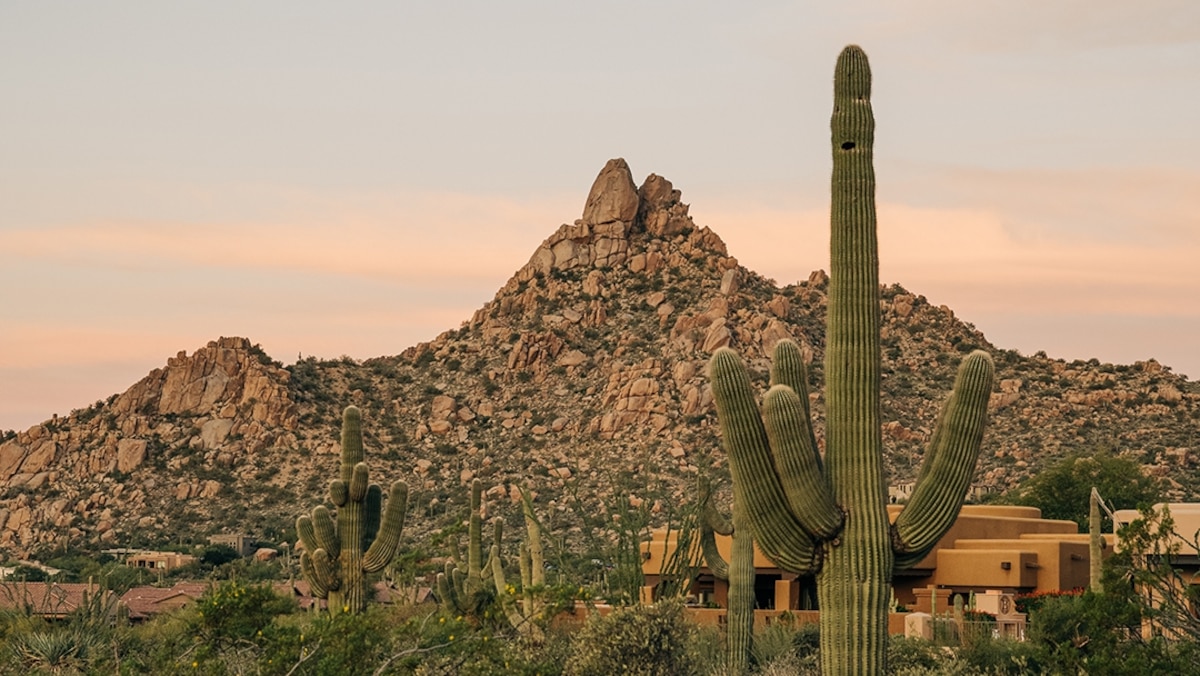
“Welcome to ‘Hotel Saguaro’,” says my guide Mary Hovden, pointing not to a building but to a tall cactus, freckled with neat, round holes. With its long, upstretched arms, it stands almost humanlike against the sky. “Those are bird condos,” she adds with a smile, tugging the rim of her ivory-brimmed hat to shield the sun’s glare. Inside its spiny walls, the saguaro’s soft inner flesh keeps its rooms cool in summer and warm in winter, making it a popular year-round residence for Gila woodpeckers, pygmy owls and gilded flickers. A few steps on, Mary pauses by a creosote bush. “I call this the tough guy of the desert,” she says. “It can go two years without water and live for 200.”
The late-morning Arizona heat presses in — dry and still. It seems to chase away any trace of moisture, softened only by the faint, resinous scent of the creosote, a signature fragrance here. We’re wandering through the Desert Botanical Garden on Scottsdale’s southern edge, home to more than 50,000 arid-adapted plants. The city sits where the Sonoran Desert meets the McDowell Mountains and the Salt River Basin, and this vast natural landscape shapes everything. It’s the driver behind the city’s reputation for holistic wellness — something I’ve come to explore through its restorative spas, cactus-dotted open spaces and red-rock trails.
Naturalist Jeffrey Lazos Ferns, of Pascua Yaqui and Cora (Nayarit, Mexico) descent, joins us on the green-laden path. His dark hair is slicked back into a plait, silver jewellery glinting as he moves between agaves and mesquite trees. His voice is calm as he speaks about the region’s recent floods that followed months of drought, and how the sudden shift caught many people off guard. He says the natural world has a memory, with waterways and land rembering how to adapt to sudden changes like these. Humans have lost that connection; the desert hasn’t.
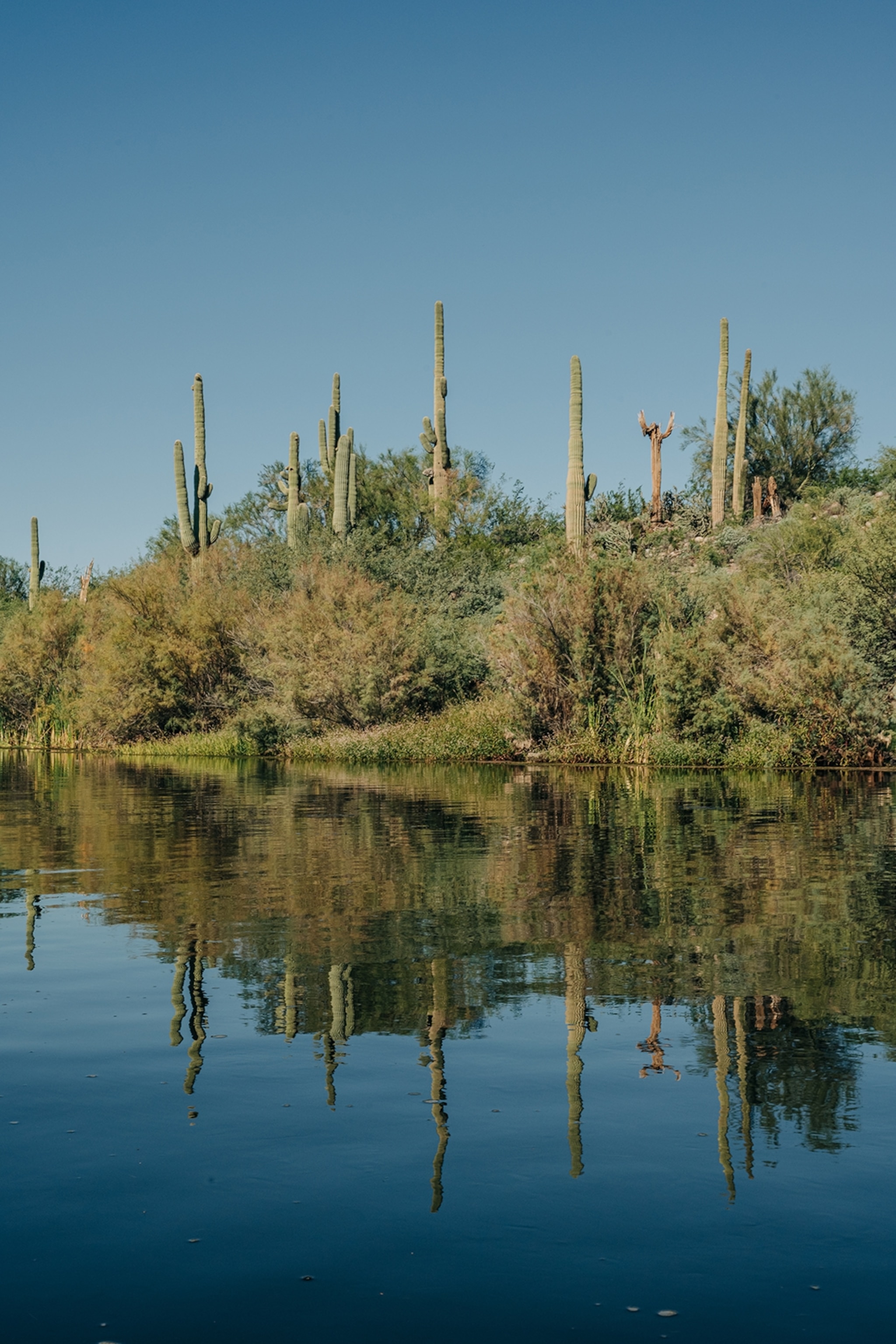
The Salt River is a popular kayaking spot, with saguaros lining the riverbanks.
Photograph by Teal Thomsen
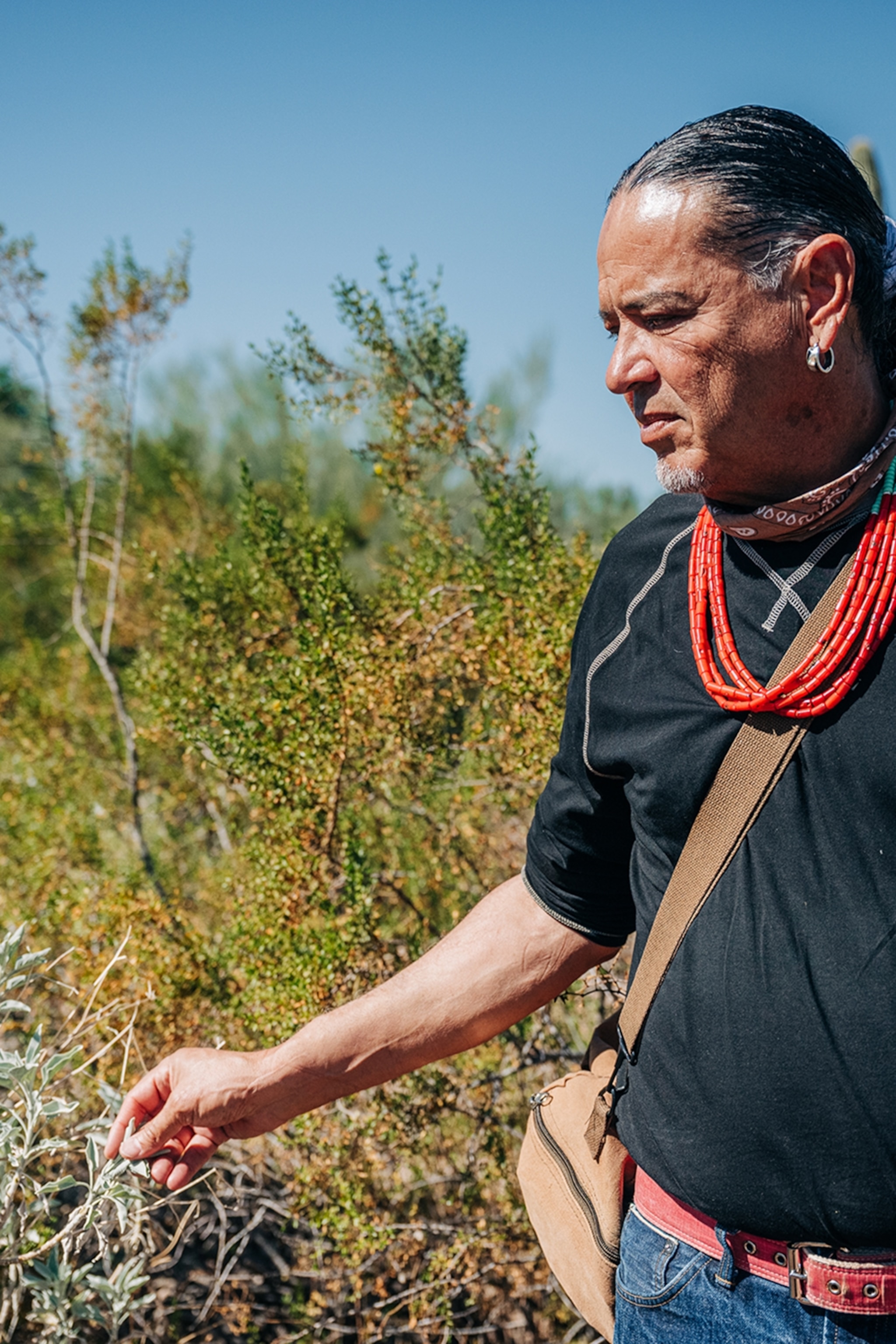
Jeffrey Lazos Ferns shares insights into the healing powers of plants at the Desert Botanical Garden.
Photograph by Teal Thomsen
As we walk, Jeffrey gazes towards the earthy outcrops in the distance. The floods, he explains, were a reminder that people must learn to live with the land again. He taps the lime-hued branch of a palo verde tree, then gestures to a cluster of prickly pear cactuses nearby, pointing out that both the pads and fruit are used in food and traditional medicine. “We call plants our teachers,” he says. “Most people just drive through this desert. But as an elder once taught me, when you stop to pause and watch, you start to see how nature interacts with itself — and you realise everything here is in motion.”
The water flows
Later that day, I push a kayak into the cool, olive-green water of the Lower Salt River alongside Daniel Konves, my guide from Cliff Creek Outfitters. Saguaros tower along the red clay banks, offering their winged guests waterside views. As we paddle, our oars slice rhythmically through the water’s calm surface. Three bald eagles glide overhead while a pair of herons patrol the shallows, their beaks darting at the surface in search of flashes of silver. We keep a lookout for the wild horses that sometimes come to graze along the riverbanks, though Daniel says the recent rain means more grass is available inland, making sightings rarer.
Flowing from the mountains east of Scottsdale, the Salt River keeps both people and wildlife alive. Daniel explains that less than 1% of Arizona is riparian land — the lush vegetation that borders rivers — yet it’s the lifeblood of almost all desert life, including within the city. “Everything comes down to the water,” he says — mountain lions, bobcats, even bighorn sheep. As he speaks, I dip my fingers into the cold river, a brief relief from the afternoon sun. We go on to discuss the resilience of the animals and Indigenous communities that have adapted to the heat and drought, their survival tied to the river’s quiet consistency. Like Jeffrey, Daniel sees water as the thread that connects life here — a message he passes on to clients who come here to reconnect with nature.
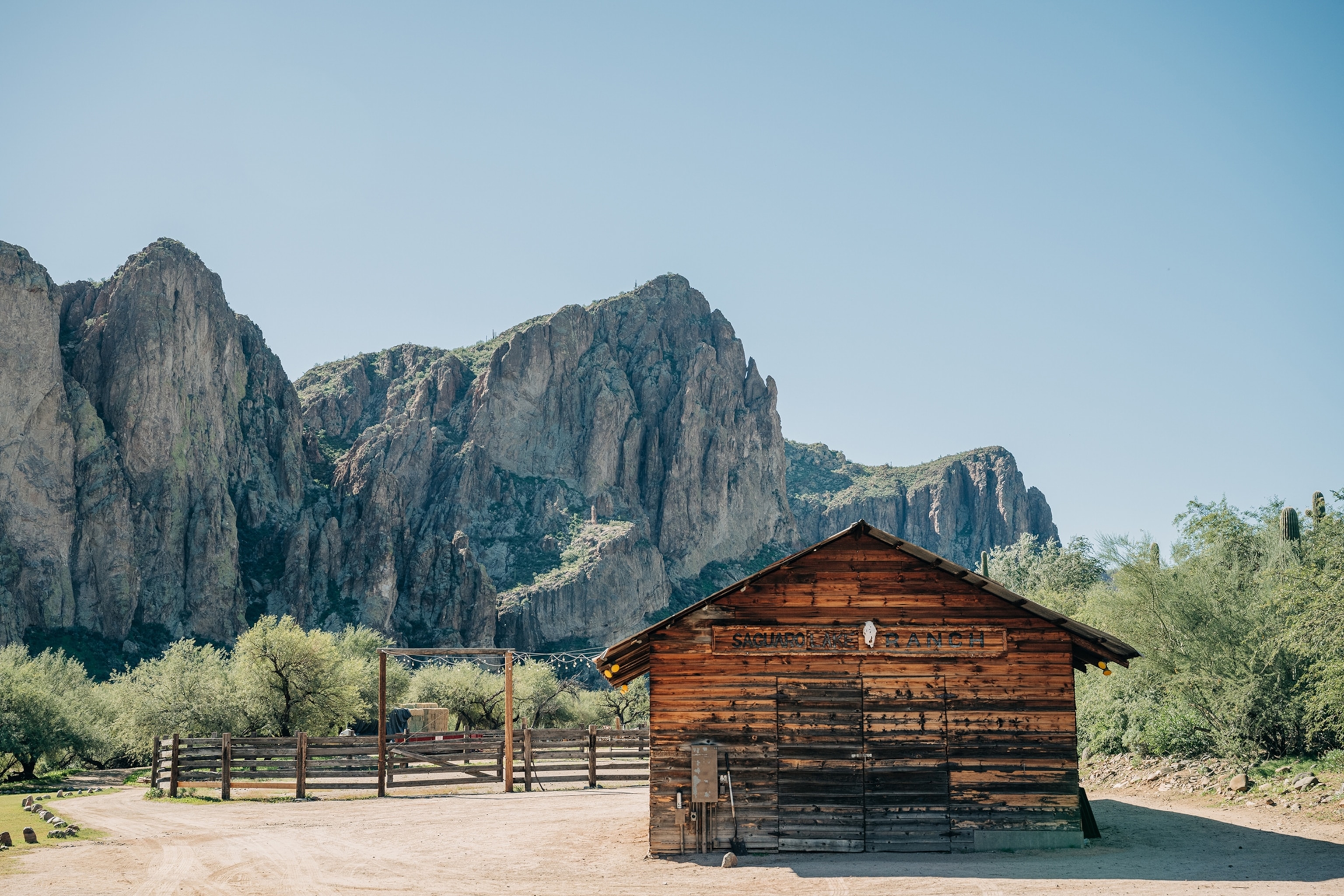
Visitors can experience Scottsdale’s “Old West” at Saguaro Lake Ranch Stable.
Photograph by Teal Thomsen
Tracing landscapes
The next morning, we drive 30 miles east of Scottsdale, following the Salt River through cliffs and open desert, arriving at Saguaro Lake Ranch Stable ahead of a morning horse-ride in Tonto National Forest. Leaving the city behind, I think about the long American tradition of heading west — a pull that’s drawn people for generations and still does, reflected in Scottsdale’s storied Old Town and the surrounding historic ranches.
At the entrance, horses are gathered, padding softly in the dust and flicking their tails as wranglers tighten saddles and check reins. The air carries the sweet, earthy scent of hay and sun-warmed wood. My horse, Hammer, has a steady, patient demeanour — a good match for my nerves.
Lottie Connolly, the head wrangler, leads a small group of us through the mesquite and saguaros along a narrow trail that snakes towards the river. Small but assured, she rides ahead, her voice bright above the creak of leather and the shuffle of hooves, guiding the group with ease. The air is thick and still as we approach sheer cliffs jutting from the water’s edge. She points to dark smudges on the rock face, just below the peaks — marks left by temporary waterfalls that poured down during the recent heavy rains.
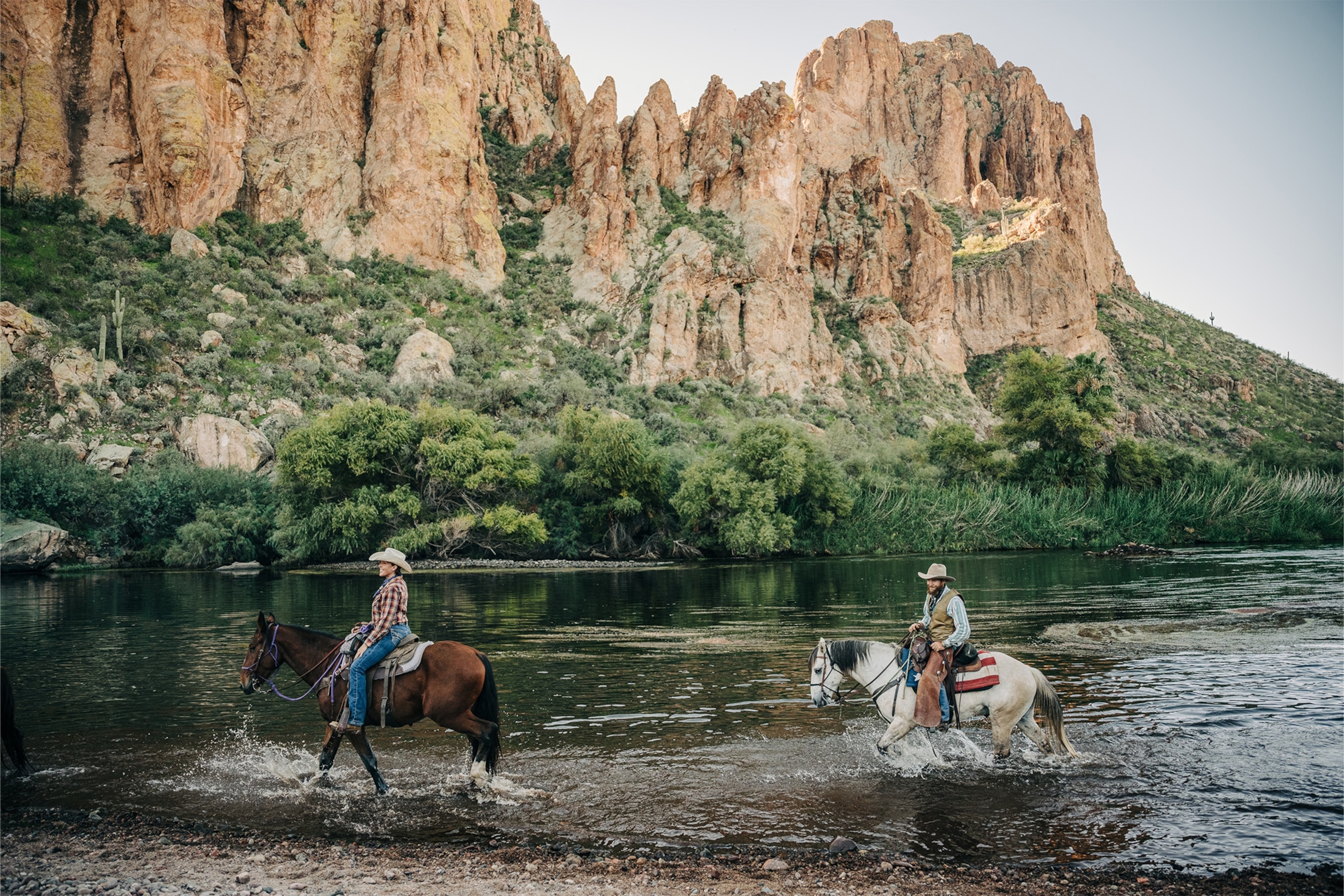
Saguaro Lake Ranch Stable offers rides through Tonto National Forest, passing through dramatic scenery alongside the Salt River.
Photograph by Teal Thomsen
I strike up a conversation with Judy Newton, who’s riding just behind me. She tells me she’s been coming here since childhood — more than 70 years now. “It was my cousin Stephen’s ranch,” she says warmly. “I grew up riding these trails.” Her love for the place is infectious, her gaze tracing the landscape like someone reading a familiar page. The ranch — which includes the stable as well guest cabins — has been in her cousin’s family, the Durands, since 1948.
After the ride, John Bevell — the ranch’s manager — greets us with a broad smile. “It’s not for everyone,” he laughs, “but for the ones who get it, it’s perfect.” He tells me his father moved west from Tennessee before he was born. “I didn’t enjoy living in Arizona as a child,” he admits, “but my dad told me, ‘No humidity, no chiggers [mites] — if you’ve ever been bitten by one, you’d understand!’” Looking towards the cliffs, his voice softens as he speaks about the spirit of this place — a spot that, he says, lets him feel like a lost boy in Neverland. “Stephen [Durand]’s mother used to pray for protection over this ranch,” he adds, “and I think it’s still working — I’ve seen storms turn away before they reach us.”
Inside the ranch’s main lodge, wooden walls are lined with paintings and mounted elk heads, with a central fireplace I imagine crackling on a cosy evening. Outside, chairs circle a lawn primed for late-night s’mores and ‘cowboy cookouts’, where guests can unwind after a day of riding.
Grounded by stillness
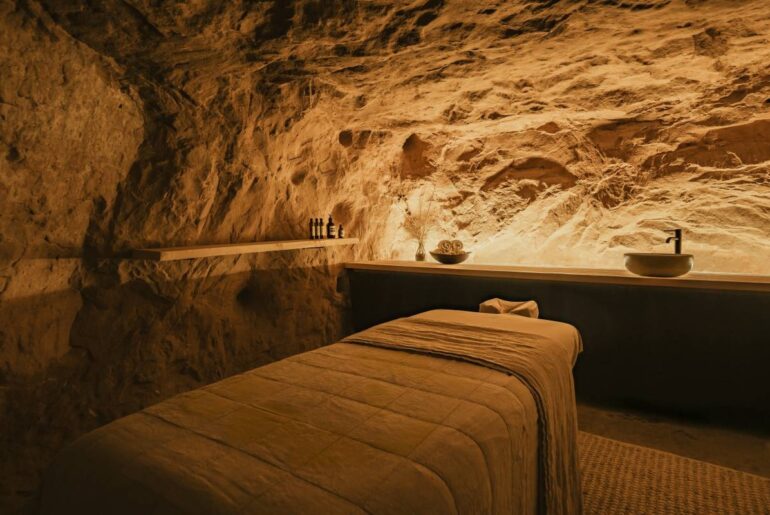
“We try to emulate all aspects of Arizona — the five Cs: copper, cattle, cotton, citrus and climate,” my massage therapist says the following day, scooping a handful of burnt-orange desert clay into her palm. After so much movement, it feels right to see what stillness can offer. Lying in a golden-hued treatment room at the Grand Hyatt Scottsdale Resort, I’m experiencing the Arizona Sanded Group Wrap. Using elements drawn directly from the surrounding landscape, it aims to exfoliate and clarify.
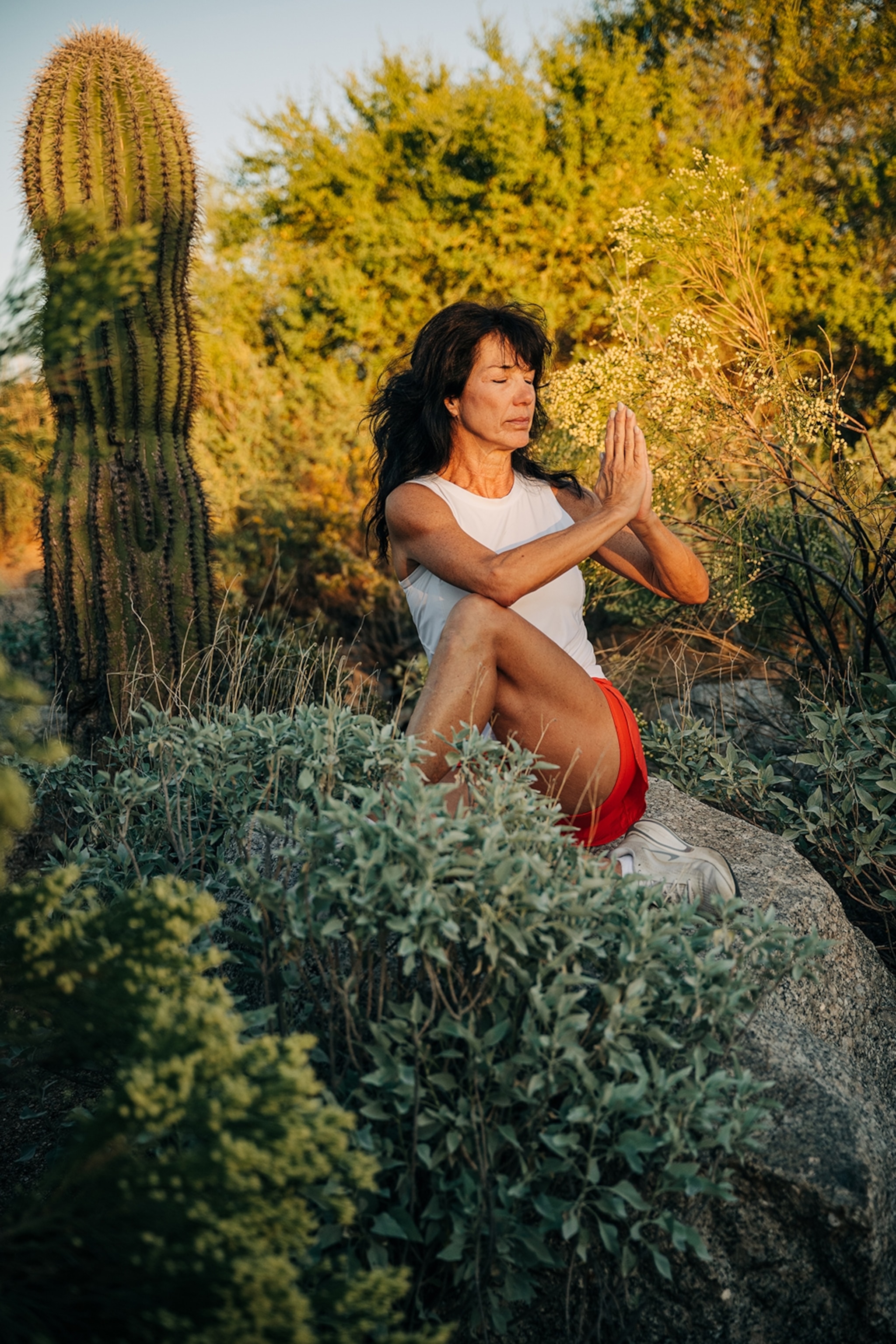
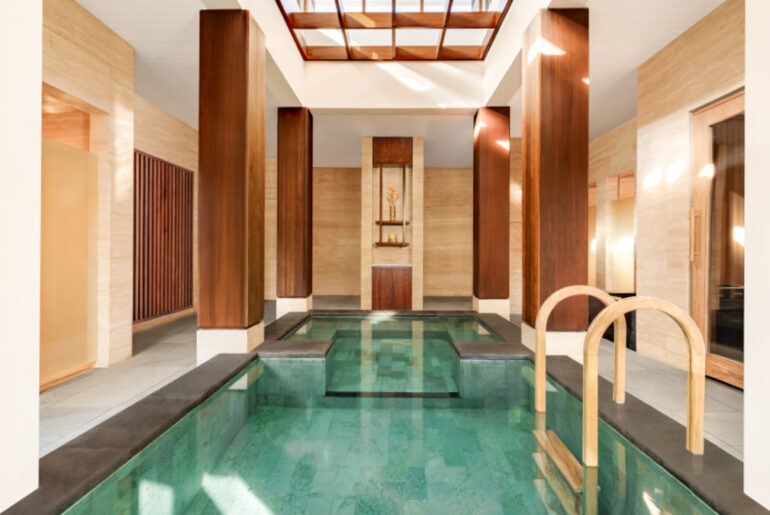
During Desert Bathing sessions at the Four Seasons Resort Scottsdale, guests are guided through mindfulness practices in nature.
Photograph by Teal Thomsen
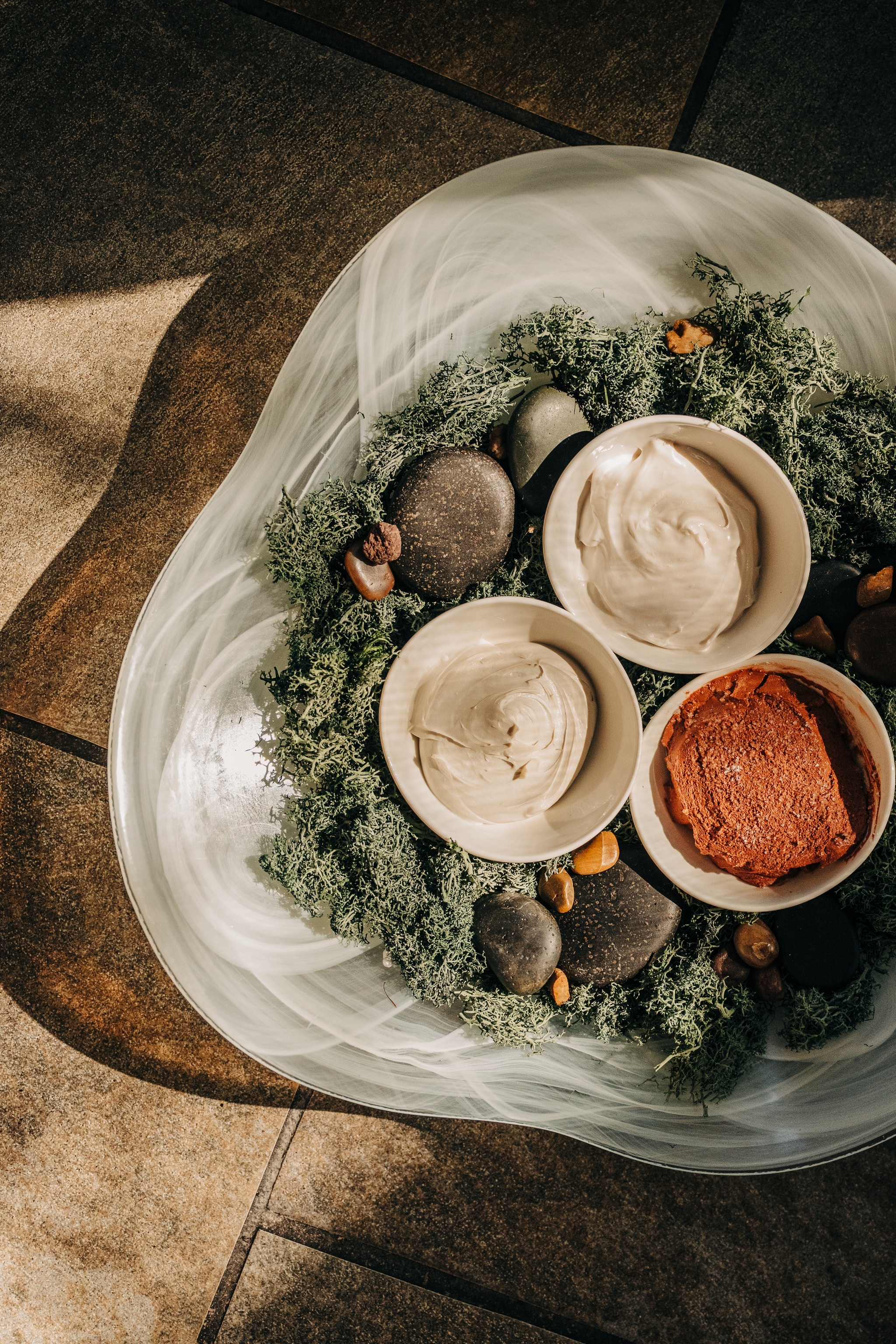
The Sanded Ground Wrap at the Grand Hyatt Scottsdale Resort draws on natural clay from the desert.
Photograph by Teal Thomsen
As the mineral-rich clay dries on my skin, the air fills with the scent of warm earth. I’m wrapped in foil before it’s rinsed away, then a buttery cream is massaged in with slow, purposeful strokes. “This is grounding,” she tells me. “You can’t get much closer to the desert than this.”
This is just one of many wellness rituals across Scottsdale inspired by the desert, drawing on its healing natural elements. A couple of days later, at Four Seasons Resort Scottsdale at Troon North, therapists use the paddles of the prickly pear cactus — the plant which Jeffrey had pointed out days earlier — to apply a warming, vitamin-rich gel. One therapist explains this cactus has been used to soothe skin for centuries. “It’s like aloe,” she says, “but less sticky.”
That evening, as the sun’s light begins to sink, I join a handful of guests at the resort for a desert-bathing session — inspired by Japan’s forest-bathing tradition. We begin with quiet intention and light movement before walking among the saguaros and silvery brittlebrush bushes. Every so often, we pause for a gentle yoga stretch as our guide encourages us to notice what’s around us: rabbits darting between shrubs; the light breeze whispering through cactus spines.
Looking up
After Scottsdale’s candyfloss-pink and violet skies fade to black, I meet a group of resort guests gathered near Pinnacle Peak Park where Mark Johnston — known as AZAstroGuy — greets us. His telescope is fitted with a high-tech camera linked to a laptop, a setup designed to reveal far more than an eyepiece ever could. “Arizona has the most certified dark-sky sites in the US,” he notes.
On the screen, the universe unfolds in swirls of orange, purple and electric blue — light from distant galaxies and supernovae. Mark speaks with the knowledge of someone who’s spent a lifetime looking up, but is able to translate the vastness into something everyone can grasp. “Earth is tiny when you think about it — 1.3 million Earths would fit inside the sun,” he says. “The Big Bang was 13.8 billion years ago — if we’re lucky, we may live for 100 of those. Just a blink.”
The desert night is calm beneath a crescent moon. A landscape so expansive by day now seems humbler under the infinite sky. My thoughts drift to the saguaros from the first morning — now dark silhouettes standing like silent sentinels against the stars, their hollow limbs storing rainwater and sheltering birds. I’ve come to see how people here connect with this landscape in their own way and how each of them depends on it to exist in this delicate ecosystem. As Jeffrey said, everything here is in motion — just like the birds checking into Hotel Saguaro.
Q&AHiking guide Armond Liebling from Cliff Creek Outfitters explains how Scottsdale’s desert trails can boost wellbeing.
1. What makes Scottsdale’s wellness offering so effective?
In this region, you’re never more than 15 minutes from incredible outdoor spaces, where everything slows. When I need to contemplate something, I get on these trails, and others do the same.
2. Are more people turning to hiking for wellbeing?
Definitely, especially since Covid. People head to trails such as the Gateway Loop or Tom’s Thumb to hike, bike, horse-ride or even meditate. In all the years I’ve guided, I can only remember one person ever getting mad — it’s just so calming here.
3. What can visitors learn from spending time here?
Mother Nature has it all figured out. Creosote, for example, is root propagated, so after wildfires it’s the first thing to return, giving everything else a chance to come back. The desert also puts stuff into perspective — it makes people feel more insignificant, which is always a good thing. We’re all just visitors here.
Plan your tripDirect flights connect London with Phoenix Sky Harbor International Airport, which is a 15- to 30-minute drive from Scottsdale. Taxis, rideshares and car hire are readily available. For a wellness-led base, consider Grand Hyatt Scottsdale Resort or the Four Seasons Resort Scottsdale. For more information, visit experiencescottsdale.comThis paid content article was created for Experience Scottsdale. It does not necessarily reflect the views of National Geographic, National Geographic Traveller (UK) or their editorial staffs.
To subscribe to National Geographic Traveller (UK) magazine click here. (Available in select countries only).