If you think Shevlin Park, which straddles a scenic Tumalo Creek Canyon, is a uniquely beautiful spot, you have something in common with Bend residents of the early 20th century.
According to a history of the park written by Bend Park & Recreation District in 2021, Shevlin Park’s centennial year, the seeds for the park were planted when the Shevlin-Hixon lumber company made a 13.5-acre land donation for a fish hatchery — now the site of Aspen Hall and nearby fishing pond — in January 1919.
After the new hatchery became operational that May, it netted plenty of locals drawn to the beauty of the grounds and its surroundings, at which point “a new cause was embraced by the citizens of Bend — obtaining land to create a public park next to the pristine hatchery,” reads BPRD’s history.
In November of that year, F.P. Hixon, the president of the Shevlin-Hixon Company, announced the lumber firm would donate its land in Tumalo Creek Canyon for a new park. It was a drop in the bucket of the company’s over 200,000 acres in Central Oregon, and a revolution for Bend.
A unique park
Today, the Bend Park & Recreation District is home to some 84 parks and open spaces, with plentiful amenities including pickleball courts, playground structures, skateparks, sports fields, disc golf courses, pools and basketball courts. Some parks boast gardens and dog parks. Lots have trails and paved paths. Some line the river, others include access points. Bend is home to a whitewater park and a river wave for surfing.
None of them quite compare to Shevlin Park in Northwest Bend. Often referred to as the crown jewel of the park district, the sprawling park just 4 miles from downtown Bend, with miles of trails beneath towering old-growth ponderosas and sage-covered High Desert. It’s a popular spot year-round for walking, biking, running and hiking. It’s a great spot for a picnic, or to find a quiet spot beside burbling Tumalo Creek to read a book or take a snooze.
Greatness preserved
At the time of Shevlin Park’s creation, Bulletin editor Robert Sawyer wrote, in part, “The community is fortunate in having connected with it men who see a higher value in the canyon undisturbed than in the saw logs that can be taken from it and who are able and willing to preserve the greater thing for the general use.”
“In 1919, most of the surrounding timberland was still virgin forests of old growth Ponderosa Pine,” reads the park district’s history. “From a layperson’s viewpoint it probably seemed it would last forever. It didn’t, but with proper management, Shevlin Park will; to the benefit and enjoyment of the public in perpetuity.”
There were three conditions in the 1921 deed that created the park, according to BPRD’s centennial history:
Its name must forever remain Shevlin Park.
It must always remain open to the general public for recreation “and amusements of a lawful charger and for no other purpose.”
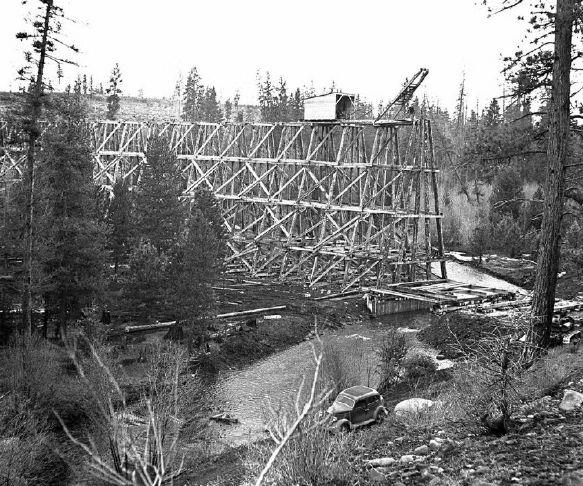
And if needed, Shevlin-Hixon or one of its assignees, would have the right to cross the park with a logging railroad at any time if needed. That actually occurred a couple of decades later, when Brooks-Scanlon, as an assignee of Shevlin-Hixon, built a logging railroad trestle over the park built over the course of three months by seven men. It connected a logging camp a short distance northwest of Shevlin Park to the Brooks Scanlon Mill in the current location of the Old Mill District.
The trestle was used until December 1956, and dismantling began in 1957, some of its timber used for an addition to the public library on Wall Street.
Concrete creek abutments that remained after the dismantling were used later when Disney’s “Homeward Bound” used them in the building of a covered bridge, after which Disney donated the bridge to Shevlin Park. It remained until wear and tear led the park district to dismantle it in 2019.
Today, you wouldn’t know either the trestle or the covered bridge had ever been there, but for a sign high above the former railroad bed high above the creek.
More Shevlin Park facts
The site’s earliest visitors
Ancestors of the Confederated Tribes of Warm Springs were hunter gatherers and often moved seasonally through Central Oregon. The earliest known Euro-Americans in the Shevlin Park area were fur trappers searching for beaver in 1834.
Area’s earliest written record
One of the coolest parts of the park is known as Fremont Meadow, campsite of none other than John C. Fremont during his second expedition of the West after mapping the Oregon Trail between Missouri and The Dalles. On Nov. 25, 1843, Fremont and 25 men headed south from The Dalles to explore and map the interior of Oregon and Nevada, and then on into the Sierra Nevada of California. Along with him were frontiersman Kit Carson, Prussian surveyor and cartographer Charles Preus and Billy Chinook, among others. Then just 19, Chinook later became a Wasco chief. Jefferson County’s Lake Billy Chinook is named after him.
How big is Shevlin Park?
Initially 350 acres, it grew to 388 after the closure of the Tumalo Hatchery in 1929. Additions over the years since have brought that total to around 1,000 acres.
Another film made in Shevlin Park
In 1974, “Rooster Cogburn,” starring John Wayne and Katherine Hepburn, filmed in part in Shevlin Park. In lieu of rental fees for filming in the park, parks director Vince Genna arranged for the film construction crew to finish restoration of the hatchery building, which had begun the previous year but had run out of funding. A crew of 15 worked for two weeks repairing the building, which was later destroyed in a 1987 fire and replaced in 1988 by Aspen Hall.
For more details on Shevlin Park’s colorful history, visit bendparksandrec.org/parks-trails/centennial-celebration.