During the Sports and Active Nutrition Summit (SANS) in San Diego last week, presentations by a series of speakers suggested that a much more vetted performance-rather-than-sports supplement sector is emerging where efficacy, safety and precision are positioning fit-for-purpose products for fit-for-duty consumers.
In this type of market, supplements must meet policy mandates, good manufacturing practices and identity, safety and labeling requirements, confirmed by third-party testing. These products are supported by the most rigorous evidence available for desired outcomes that account for baseline values and individual performance needs, while answering to an increasingly prominent government call for identity testing and industry self-regulation.
The evolution of sports and active nutrition into performance nutrition could also have far reaching implications for third-party certification across the broader supplement market—where what once served as a niche safeguard may increasingly become a mainstream trust signal.
Ensuring readiness, recovery and resilience at the elite level
During his keynote speech at the summit, Jordan Mazur, director of nutrition for the San Francisco 49ers, pulled back the curtain on how nutrition feeds into a performance system that supports his team’s readiness, recovery, resilience.
Mazur’s model is a holistic one that accounts for nutrient status, training load, meal planning, travel execution and game day requirements. It makes room for supplement protocols to correct insufficiencies and deficiencies, fuel the intense training demands and ensure return to play—but with a caveat.
“I’m sure there are a lot of people here that might have something to say about third party certifications, but we have governing bodies […], and the athletes get tested for performance enhancing substances randomly all the time,” he said, adding that he cannot make allowances for any supplement that is not NSF Certified for Sport or Informed Choice.
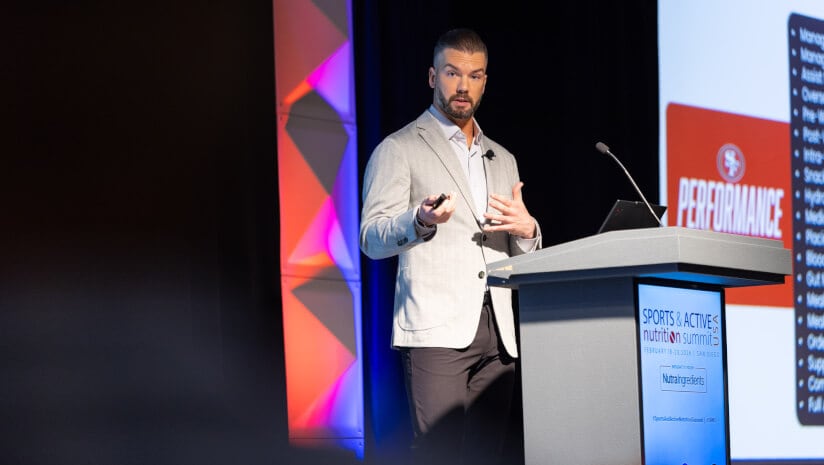 Jordan Mazur, director of nutrition for the San Francisco 49ers, speaking at the 2026 Sports and Active Nutrition Summit on Feb. 18. (Justin Howe / NutraIngredients)
The NFL maintains a strict, list of prohibited substances, like anabolic steroids, prohormones and stimulants, along with a list of companies associated with manufacturing tainted products. It provides a list of certified, safer options but does not encourage supplement use, favoring a food-first approach to nutrition. Advertising for supplement companies is restricted during official game broadcasts, including the Super Bowl.
Among the supplements that Mazur recommends as part of a sample 8-to-12 week AM and PM protocol for tissue repair and metabolic restoration are a precisely administered selection of products from the Thorne Health, Mend Nutrition, Designs for Sport and Momentous brands.
During the recent NutraIngredients+ Business Leaders Forum, Colin Watts, CEO at Thorne, emphasized the critical role of correctly structured third-party certification, citing ongoing government funding constraints that make it increasingly difficult to rely solely on the FDA or other regulators as the sole arbiters of product quality and safety.
“We’ve had a huge amount of success in embracing NSF certified, for example, for many of our products, not just our sports products,” he said. “We believe that at the end of the day, the trust that at times is lacking in our industry really is sourced from […] sometimes outlandish claims that are being made by actors that are not supporting the industry as a whole, and some of it, frankly, comes from quality gaps that show up in lousy ways.”
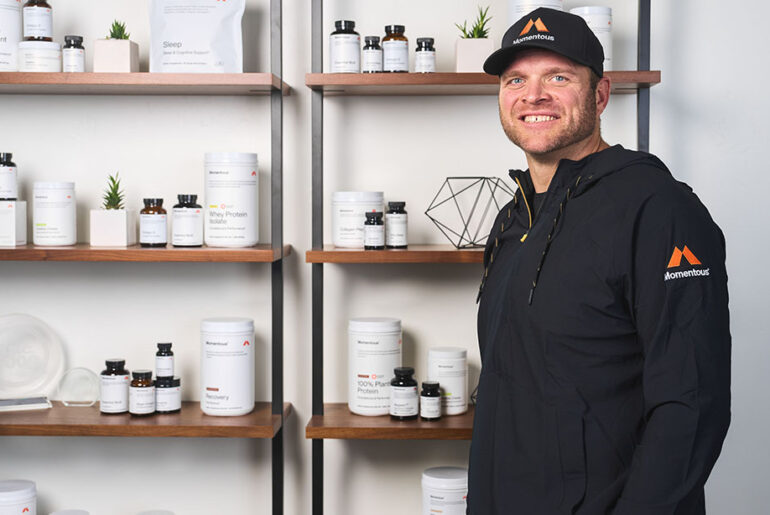
The Momentous brand that features in Mazur’s supplement protocols is also one of the few wellness and nutrition companies working with the military. Its focus, supported by Department of Defense innovation and research contracts, is on optimizing human performance through the development of solutions to reduce musculoskeletal injuries and improve cognition and sleep for service members. Last year, the Utah-based company also became the official supplement partner of USA Rugby and earlier this year, entered its first national retail partnership with The Vitamin Shoppe to provide a selection of products from its fully NSF for Sport-certified portfolio including whey protein isolate, creatine and collagen.
“As our customers set new health and performance goals for the new year ahead, our partnership with Momentous helps equip them with elite-level nutrition trusted by professional athletes,” Muriel Gonzalez, CEO of The Vitamin Shoppe, said following the announcement.
Preparing and protecting the troops
Much like players on the field, military service members in the field must be prepared for intense operations at peak physical condition and able to withstand high-attrition, high-impact tasks. Not only must they maintain functional strength, cardiovascular endurance, mobility and power but the mental toughness and focus needed to make critical, split-second decisions under high pressure and fatigued conditions—but often in much more austere environments.
Speaking during series of tactical active nutrition presentations at SANS, Erik Bustillo—who recently started his post as the first registered dietitian of the U.S. Navy’s Human Performance Optimization Initiative—stressed the importance of scientific communication and advocates for a “people before profits, humans over hardware” approach.
“That is an important part of what I do, communicating what the research shows,” he said. “As far as supplements and dietary strategies, I think it’s important for people to know, because there’s a lot of misinformation out there, and quite frankly, it’s pretty frustrating that there’s so much misinformation.”
He noted that, much like the general population, service members are exposed to the dupes on social media but “because they want to be the best at what they do, they’re probably more likely to fall for it.” He advises to focus on the basics—adequate calories, protein, hydration, use of third-party tested supplements and education.
Dietary supplement education and condition of use throughout the military community have been mandated since 2022, when the Department of Defense issued the DoDi 6130.6 policy and established Operation Supplement Safety (OPSS) as the official program charged with a mission of propagating informed dietary supplement use.
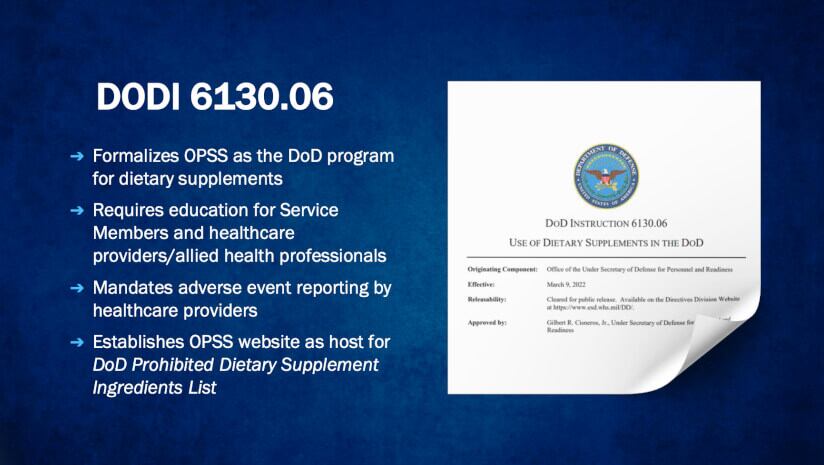 DoDI 6130.06 established Operation Supplement Safety as the DoD program for dietary supplements. Its mission is the informed use of health, wellness and performance products. (Andrea Lindsey)
During her presentation at SANS, Andrea Lindsey, director of OPSS, explained that the genesis of the program dates to a 2012 call to educate service members on the safe use of supplements following a rash of severe adverse events linked to Oxy-Elite Pro and Jack3D supplements. These products, since banned by the U.S. Food and Drug Administration (FDA), promised weight loss, performance enhancement and muscle building but contained a synthetic stimulant called DMAA.
“Service members have to know what they’re consuming—that’s very, very important,” she said. “We want them to be performing optimally. This is about human performance optimization[…], not potentially impairing the performance. We do not want to have a situation where a service member is taken out of service for any reason.”
To educate military personnel and the wider community, OPSS has developed several tools including the DoD Prohibited Dietary Supplement Ingredient List, which currently contains approximately 800 items with some 4,600 synonyms. Its website also houses a Ask the Expert, Check Your Dietary Supplement (OPSS Scorecard), adverse event reporting modules to tackle questions about supplement safety and mitigate risks, and a more recently added performance enhancing substances section.
Examples of current targeted efforts include initiatives to warn service members about the risks of unapproved investigational peptides like BPC-157, Kisspeptin-10 and Retatrutide, none of which are supplements or currently approved by the FDA for general, unrestricted human use. OPSS also recently added Eurofin’s Clean Sport Certified to its list of vetted programs, which includes USP Certified, BSCG Certified, Informed Sport and NSF Certified for Sport.
“Our education on only searching for products that are third-party certified is really a big focus this year, and you all know why we have to do that,” Lindsey said.
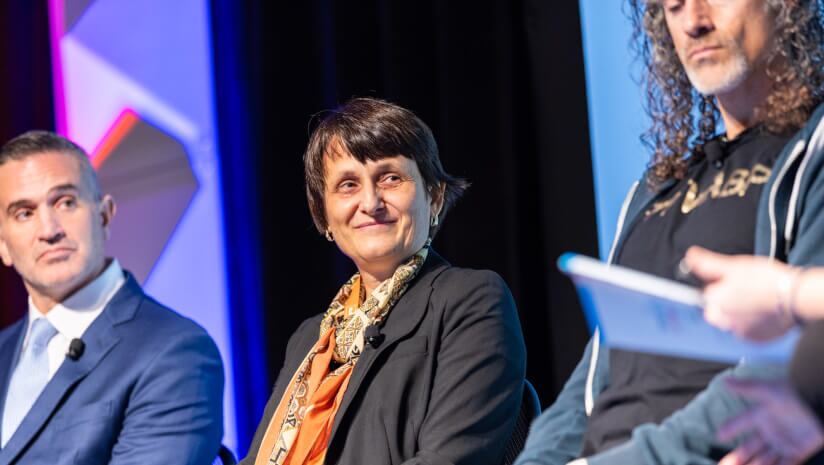 A panel discussion at SANS brought together experts in military nutrition science, ingredient innovation and performance fueling to examine how nutrition and dietary supplements can safely and effectively enhance performance and operational readiness. (From left to right) Stefan Pasiakos of the Pennington Biomedical Research Center, Elena Draganoiu of Lubrizol and performance enhancement dietitian and coach Erik Bustillo. (Justin Howe / NutraIngredients)Finding the middle ground for return on investment
Included in the National Defense Authorization Act for Fiscal Year 2026 is the SOCOMS sports food and supplement provision.
“The Commander of the United States Special Operations Command may authorize, from amounts appropriated to the Department of Defense for Major Force Program (1) the procurement of sports foods and dietary supplements; and (2) the distribution of such foods and supplements to members of the Armed Forces assigned to the United States Special Operations Command,” the provision states.
It specifies that procurement and distribution must be compliant with DoDi 6130.06 and its prohibited dietary supplement ingredients list, certified by one of the OPSS-vetted third-party certifying organizations and be free of prohibited ingredients and substances. In addition, sports foods and dietary supplements may be issued to Armed Forces members only by a credentialed and privileged registered (performance) dietitian or a prescribing clinician assigned to or supporting SOCOMS at the operational unit level, under the oversight of a primary care sports medicine physician.
By Sept. 30, 2026, the Secretary of Defense must submit to the congressional defense committees a report assessing the feasibility and advisability of expanding this section’s authority to allow the military departments to procure and distribute of sports foods and third-party certified dietary supplements.
Across these Army, Navy and Air Force military departments, over 70% of the population reported using dietary supplements at least once a week over the last six months, according to the U.S. Military Dietary Supplement Use Study.
Dr. Stefan Pasiakos, director of the Center for Human Performance Optimization at the Pennington Biomedical Research Center and former director of the Office of Dietary Supplements at the National Institutes of Health, explored this data during his SANS presentation. He highlighted that dietary supplement use is primarily driven by performance-related factors.
“This is a very clean story—people take dietary supplements because they believe they will help them perform at their best when they’re asked to perform at their best,” he said. “What is interesting is when you start getting into the questions of why.”
A general service member’s reasons for use are not usually guided by science or aversion to potential adverse events but rather by the sway of “super soldier” supplement marketing and what others in their company, squad or platoon are taking. What’s more, Dr. Pasiakos noted that only a small fraction of the vast number of supplements marketed for military performance have been tested in military-relevant trials and that while an absence of evidence does not equate to evidence of no effect, restraint and prioritization is needed.
He commended the work of OPSS but sees further opportunity in defining the research gaps through academia-industry collaboration to address the primary consequences of operational stress—whether loss of muscle and bone, declines in strength, endurance and power, higher injury risk, inflammation and impaired nutrient metabolism or the increasing focus on cognitive performance. This requires definition of the stressor, optional dose and timing to identify the right supplement in the right operational context.
“The solution here is never to avoid dietary supplements, it’s never gross promotion of dietary supplements,” Dr. Pasiakos said. “It’s to use the science to deliver precision, targeted strategies to optimize the health of war fighters in the environments during which they do their jobs. I think if we do that, we will make a difference.”
Stay one step ahead
To support in-depth market, conference and category reporting beyond the important daily news coverage, sign up to NutraIngredients+ for full access to editorial content. For a preview of the latest content, visit plus here.