Herbal Beauty Product Market
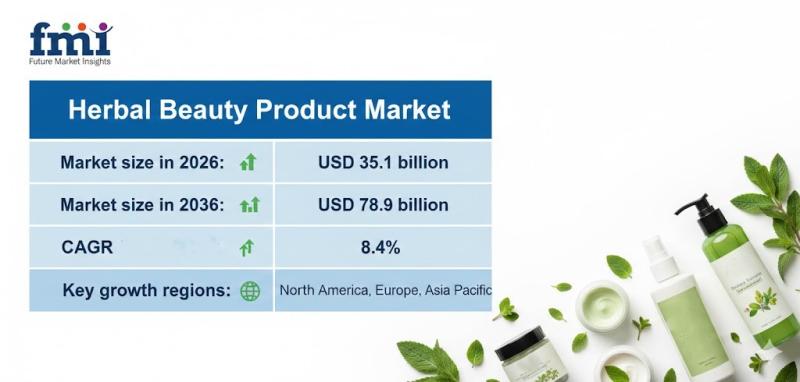
The global herbal beauty product market is projected to grow significantly over the next decade, expanding from USD 35.1 billion in 2026 to USD 78.9 billion by 2036, registering a CAGR of 8.4%. According to the latest analysis by Future Market Insights (FMI), accelerating consumer preference for plant-based personal care solutions and ingredient transparency is driving sustained demand across skincare, hair care, and color cosmetics categories.
In 2025, the market surpassed USD 32.4 billion, signaling the transition from niche natural alternatives to mainstream cosmetic adoption. Absolute dollar growth of USD 43.8 billion between 2026 and 2036 reflects structural industry expansion rather than incremental category gains.
Herbal Beauty Product Market Snapshot (2026-2036)
• Market size in 2026: USD 35.1 billion
• Market size in 2036: USD 78.9 billion
• CAGR (2026-2036): 8.4%
• Leading product type: Skincare products (~52% share)
• Dominant source: Botanical extracts & essential oils (70-75% formulation value)
• Key growth regions: North America, Europe, Asia Pacific
• Fastest-growing countries: United States, Germany, Japan, China, South Korea
Discover Growth Opportunities in the Market – Get Your Sample Report Now : https://www.futuremarketinsights.com/reports/sample/rep-gb-567
Market Momentum
The herbal beauty product market enters 2026 with strong structural demand fueled by clean beauty adoption and verified botanical sourcing practices. By 2031, sustained innovation in plant-based actives and expansion of premium direct-to-consumer channels push market valuation beyond USD 55 billion.
Between 2031 and 2036, supply chain traceability technologies, third-party ingredient certification, and omnichannel retail integration intensify growth. By 2036, the market reaches USD 78.9 billion, sustaining an 8.4% CAGR across the decade.
Why the Market Is Growing
Demand for herbal beauty products is rising due to growing consumer skepticism toward synthetic ingredients and heightened awareness of environmental and health considerations. Millennials and Gen Z consumers increasingly prioritize ingredient transparency, cruelty-free positioning, and botanical authenticity.
Manufacturers are responding by investing in:
• Sustainable botanical sourcing partnerships
• Standardized extraction techniques for consistent efficacy
• Third-party certification and ingredient authentication systems
• Direct-to-consumer digital platforms for premium positioning
As regulatory frameworks for natural cosmetics evolve, ingredient traceability transitions from a marketing advantage to a compliance requirement-strengthening the competitive position of brands with integrated sourcing networks.
Segment Spotlight
Product Type: Skincare Leads with ~52% Share
Skincare products dominate the herbal beauty market, driven by botanical formulations addressing hydration, anti-aging, acne treatment, and sensitive skin care. Hair care and color cosmetics follow as consumers extend clean beauty preferences across broader personal care routines.
Source Type: Botanical Extracts & Essential Oils Anchor Value (70-75%)
Botanical extracts and essential oils represent the highest formulation value share, reflecting consumer preference for plant-derived actives. Ingredient verification technologies are increasingly deployed to validate authenticity and maintain quality consistency despite seasonal sourcing variability.
Distribution Channel: Specialty Retail Holds ~31.2% Share
Specialty beauty stores remain the primary channel for premium herbal beauty brands, offering product education and personalized consultations. However, online retail platforms are rapidly expanding, supported by influencer marketing integration and omnichannel purchasing strategies.
Regional Growth:
North America, Europe, and Asia Pacific Drive Expansion
North America leads in clean beauty awareness and regulatory-driven transparency standards. The United States is projected to grow at a 9.1% CAGR through 2036, supported by strong e-commerce penetration and specialty beauty retail expansion.
Europe functions as a regulatory benchmark region. Germany grows at 8.7% CAGR, driven by certified organic cosmetic demand and structured retail ecosystems that support premium botanical brands.
Asia Pacific serves as both a high-growth consumer market and a botanical sourcing hub. China (7.8% CAGR), Japan (8.3% CAGR), and South Korea (7.4% CAGR) benefit from traditional herbal knowledge integration and advanced cosmetic formulation infrastructure. Government initiatives such as the National AYUSH Mission (NAM) in India further stimulate domestic botanical product development.
Drivers, Opportunities, Trends, Challenges
Drivers:
• Clean beauty movement and natural ingredient adoption
• Ingredient transparency and regulatory standardization
• Expansion of premium direct-to-consumer channels
Opportunities:
• Ingredient authentication technologies
• Sustainable sourcing infrastructure
• Premium botanical storytelling strategies
Trends:
• Omnichannel retail integration
• Third-party organic certification growth
• Consumer education-driven brand differentiation
Challenges:
• Seasonal variability in botanical ingredient sourcing
• Supply chain traceability complexity
• Regulatory compliance costs across multiple regions
Competitive Landscape
The herbal beauty product market remains moderately fragmented, characterized by multinational beauty conglomerates and specialized botanical brands competing on ingredient authenticity, certification standards, and brand storytelling.
Leading companies include:
• Unilever PLC
• L’Oréal S.A.
• The Estée Lauder Companies Inc.
• Procter & Gamble Co.
• Shiseido Company Limited
• Weleda AG
• The Body Shop International Limited
• Origins Natural Resources Inc.
• Aveda Corporation
Companies with vertically integrated sourcing and certified organic supply chains demonstrate superior scalability while maintaining botanical integrity. Strategic acquisitions, brand portfolio diversification, and digital channel expansion continue to define competitive positioning.
Outlook
As herbal beauty transitions from alternative to mainstream, the industry’s trajectory reflects a structural shift in consumer behavior rather than a short-term trend. By 2036, with USD 78.9 billion in projected valuation, botanical authenticity, traceability infrastructure, and sustainable sourcing partnerships will define long-term market leadership.
Find Out More-Read the Complete Report for Full Insights : https://www.futuremarketinsights.com/reports/herbal-beauty-products-market
Herbal Beauty Product Market:
1. What is the projected market size by 2036?
The market is expected to reach USD 78.9 billion by 2036, growing at a CAGR of 8.4%.
2. What is driving market growth?
Rising demand for clean beauty products, ingredient transparency, and preference for plant-based formulations.
3. Which product segment leads the market?
Skincare products, holding approximately 52% market share.
4. Which region shows the strongest growth?
North America leads in clean beauty adoption, while Asia Pacific serves as a major sourcing and growth hub.
5. Who are the key players?
Major companies include L’Oréal S.A., Unilever PLC, The Estée Lauder Companies Inc., and Shiseido Company Limited.
Why FMI: https://www.futuremarketinsights.com/why-fmi
Explore more research reports by FMI
Wine Cellar Market: https://www.futuremarketinsights.com/reports/wine-cellar-market
Facial Care Products Market: https://www.futuremarketinsights.com/reports/facial-care-products-market
Exfoliating Pads Market: https://www.futuremarketinsights.com/reports/exfoliating-pads-market
Contact Us:
Future Market Insights Inc.
Christiana Corporate, 200 Continental Drive,
Suite 401, Newark, Delaware – 19713, USA
T: +1-347-918-3531
For Sales Enquiries: sales@futuremarketinsights.com
About Future Market Insights (FMI)
Future Market Insights, Inc. (FMI) is an ESOMAR-certified, ISO 9001:2015 market research and consulting organization, trusted by Fortune 500 clients and global enterprises. With operations in the U.S., UK, India, and Dubai, FMI provides data-backed insights and strategic intelligence across 30+ industries and 1200 markets worldwide.
This release was published on openPR.