Keep our news free from ads and paywalls by making a donation to support our work!
Notes from Poland is run by a small editorial team and is published by an independent, non-profit foundation that is funded through donations from our readers. We cannot do what we do without your support.
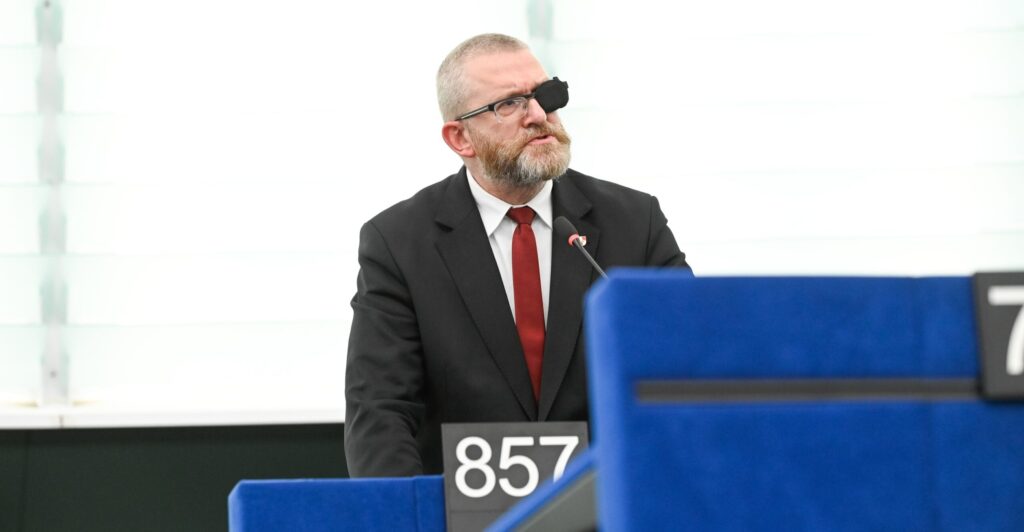
Poland’s justice minister has asked the European Parliament to again strip Polish far-right leader Grzegorz Braun of legal immunity so that he can face charges in his homeland for denying German-Nazi crimes, an offence that carries a potential three-year jail term.
He is accused of refuting the fact that gas chambers were used to kill victims at the Auschwitz and Majdanek camps.
Nie ma i nie będzie zgody na zakłamywanie historii i łamanie prawa.
Skierowałem do Przewodniczącej Parlamentu Europejskiego wniosek o uchylenie immunitetu europosłowi Grzegorzowi Braunowi. Sprawa dotyczy publicznego, wbrew faktom, zaprzeczania zbrodniom ludobójstwa popełnionym…
— Waldemar Żurek (@w_zurek) February 27, 2026
Braun is already on trial in Poland for a number of other alleged crimes, including attacking a Jewish religious ceremony in parliament. Now prosecutors also wish to charge him under a law that makes it a criminal offence to “publicly and contrary to the facts deny” Nazi or communist crimes.
“There is and will be no consent to distorting history and breaking the law,” wrote justice minister Waldemar Żurek, announcing on Friday that he had asked the European Parliament to lift Braun’s immunity.
“This is a question of historical truth, respect for the victims, and accountability for one’s words,” added Żurek, who also serves as prosecutor general. “The Polish state has a duty to respond to the denial of Nazi-German crimes.”
Żurek revealed that the accusation against Braun relates to “denial of genocide crimes committed by functionaries of the Third Reich in the Auschwitz-Birkenau concentration camp and the Lublin concentration camp (Majdanek)”.
In a further statement, Poland’s Institute of National Remembrance (IPN), a state historical body that has prosecutorial power, said that the accusation related to the use of gas chambers at those two camps.
Neither the IPN nor Żurek confirmed what specific words Braun had said that prompted the planned charges against him. However, the IPN noted that they had come at a live event broadcast online on 27 September 2025.
On that date, Braun took part in a discussion with Jan Żaryn, a right-wing historian and former senator for the national-conservative Law and Justice (PiS) party, titled “The Polish Underground State and the Jewish Issue”. A recording of the event is still available online.
During his remarks, Braun referred to the “fake gas chambers of Majdanek and Auschwitz”, calling them “a dark, monstrous fantasy that has no satisfactory historical or academic support”.
He suggested that the idea of the gas chambers had been invented as part of “propaganda and black PR operations conducted by the Soviet and Anglo-Saxon security services during World War Two”, and that the false claim continues to be exploited by Jews today.
Far-right leader Grzegorz Braun says the gas chambers at Auschwitz are “fake” and it is a “fact” that Jews have committed ritual murder.
Prosecutors have launched an investigation into whether he violated Poland’s law against denying Nazi crimes https://t.co/7UUKzH5ndG
— Notes from Poland 🇵🇱 (@notesfrompoland) July 10, 2025
In actual fact, historians estimate that around 900,000 people were killed in the gas chambers at Auschwitz. The vast majority were Jews, but victims also included Roma, Soviet prisoners of war, and ethnic Poles.
Meanwhile, gas chambers at Majdanek were used to kill tens of thousands, again mainly Jews. Today, the ashes of the camp’s cremated victims are preserved in a memorial at the site of the former camp.
Braun, who has a long history of promoting antisemitic conspiracy theories, has repeatedly sought to cast doubt on the veracity of Nazi crimes against Jews. In a separate interview last year, he also called the gas chambers “fake”.
In response, last September, Żurek filed a similar request to the European Parliament to lift Braun’s immunity so that he could face charges for denying Nazi crimes.
Poland has asked the European Parliament to strip far-right leader Grzegorz Braun of immunity to face charges for calling the Auschwitz gas chambers “fake”.
Denying Nazi crimes is an offence in Poland that carries a prison sentence of up to three years https://t.co/W2wzGncs8y
— Notes from Poland 🇵🇱 (@notesfrompoland) September 5, 2025
In December, Braun went on trial over a separate set of charges relating to four other incidents, including his attack on a celebration of the Jewish festival of Hanukkah in parliament in December 2023 and his disruption of a lecture by a Holocaust scholar.
“I am standing before this court because I dared to defend myself against oppression and the ritual manifestation of Jewish supremacy,” declared Braun at the start of the trial.
In November, the European Parliament also stripped Braun of immunity to face charges for six alleged crimes, including inciting religious hatred against Jews, assaulting a doctor involved in carrying out a late-term abortion, and vandalising an LGBT+ exhibition.
The trial of Polish far-right leader Grzegorz Braun for his attacks on a Hanukkah celebration in parliament and a Holocaust lecture has begun.
He declared in court that he was facing trial because he had “dared to defend myself against Jewish supremacy” https://t.co/NRZLw7yzyo
— Notes from Poland 🇵🇱 (@notesfrompoland) December 8, 2025
Amid his legal troubles, Braun has seen his popularity rise. When he stood as a candidate in last year’s presidential election, he began as a rank outsider but ended up finishing fourth, with 6.3% of the vote, following a campaign characterised by antisemitic, anti-Ukrainian and anti-LGBT+ rhetoric.
Meanwhile, the radical-right party that he leads, Confederation of the Polish Crown (KKP), has surged in the polls, where it now averages support of around 8%.
Notes from Poland is run by a small editorial team and published by an independent, non-profit foundation that is funded through donations from our readers. We cannot do what we do without your support.
Main image credit: Genevieve Engel, © European Union 2025 – Source : EP

Daniel Tilles is editor-in-chief of Notes from Poland. He has written on Polish affairs for a wide range of publications, including Foreign Policy, POLITICO Europe, EUobserver and Dziennik Gazeta Prawna.