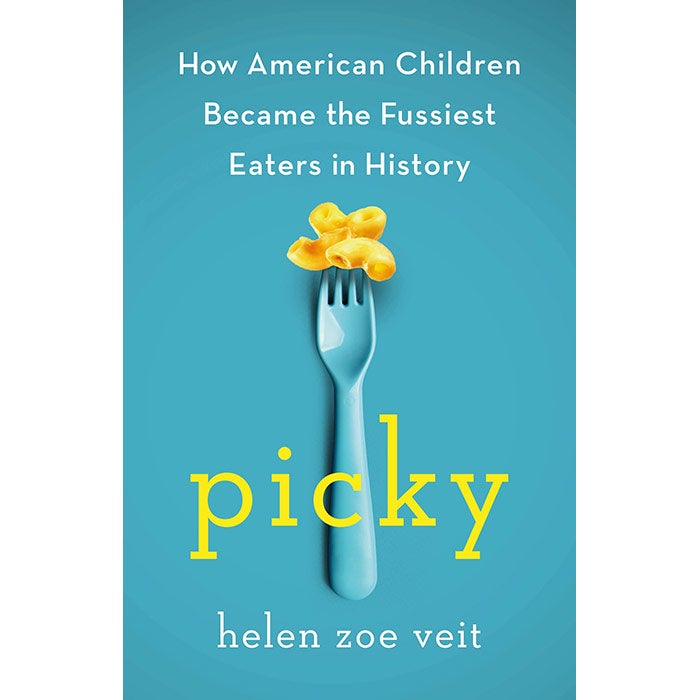
The following essay is excerpted from Picky: How American Children Became the Fussiest Eaters in History by Helen Zoe Veit. Copyright © 2026 by the author, and reprinted with permission of St. Martin’s Publishing Group.
Dr. Spock admitted he’d been wrong. By the 1970s, 30 years after he’d published his mega-bestselling Common Sense Book of Baby and Child Care, he sorely regretted what he’d said about children’s food. He knew that if you read his book carefully, you’d see that he’d recommended nutritious foods and assumed that children would want to eat them. He’d said that pickiness might last a few months, at most, and that by age 2 children should be eating “a pretty grown-up diet.” But having been a child in the early 20th century himself, a time when most children had quickly learned to eat like their parents, he’d assumed that good eating simply happened by “instinct,” and he’d warned mothers that telling children what to eat was oppressive, annoying, and counterproductive. And that was the message his tens of millions of readers had taken away. Critics parodied his advice: “Feed ‘em whatever they want.” To Spock’s dismay, this caricature was turning out to be a better description of American children’s food than the wholesome, vegetable-heavy diets he’d proposed himself.
By the time Dr. Spock was revisiting his advice, American ideas about children’s tastes had fundamentally changed. Fast food, processed food, and nutritionally empty snacks and sweets had become mainstays. Children’s diets were “poor and they are getting worse,” Spock noted, with too few nutrients and too much high-calorie junk. When he’d written in his original book that it was fine to give children ice cream even if they hadn’t eaten their spinach, he’d envisioned that as a rare scenario, but it wasn’t rare at all by the late 20th century. Instead, “nice parents” by then said yes to treats and didn’t insist on vegetables. And many kids now weren’t eating a “pretty grown-up diet” until adolescence or later—a possibility that had never occurred to Spock back in the 1940s.
The rise of mass childhood pickiness is a story about Americans’ crumbling confidence in children’s ability to love diverse foods. By the late 20th century, it came to seem cruel to expect children to eat the same meals as their parents because “common sense” now said that children’s tongues and taste buds were biologically different. More and more Americans scathingly rejected earlier feeding methods as old-fashioned, controlling, and even abusive. Older methods had become the Joan Crawford character of the 1981 movie Mommie Dearest: an aging narcissist forcing sad, unappealing food on a sad, vulnerable child.
By Helen Zoe Veit. St. Martin’s Publishing Group.
Slate receives a commission when you purchase items using the links on this page.
Thank you for your support.
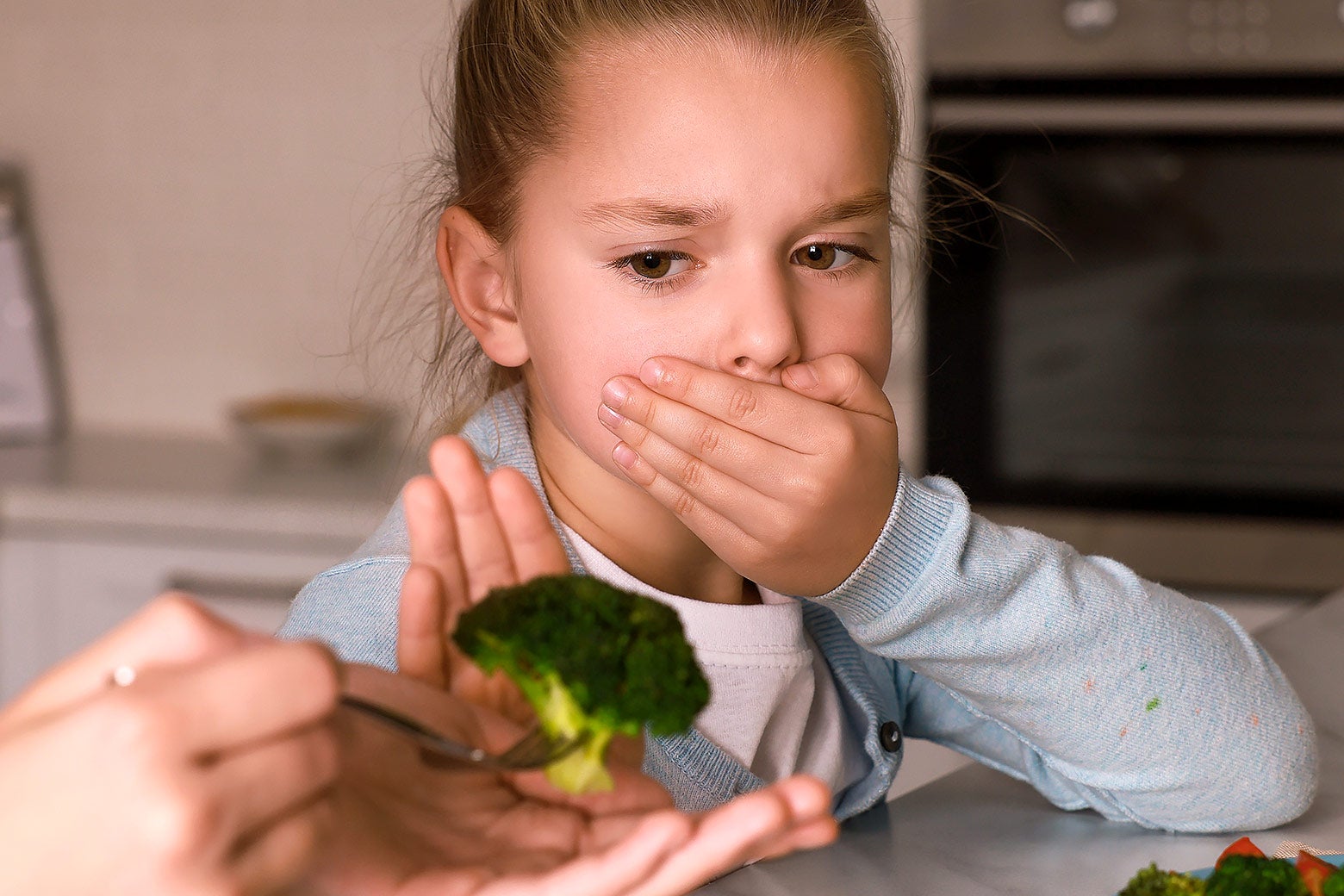
And that’s more or less been the story ever since. Today, many Americans take it for granted that pickiness is mainly biological and that it stems from children’s physically unique responses to food’s taste, texture, and color. By these lights, food rejections are signs that a child naturally dislikes a food and isn’t going to be capable of liking it anytime soon. Strict parents might succeed in forcing a child to chew and swallow something—and “force” has been the verb of choice for critics. But when adults believe that children reject food out of innate biological revulsion, it seems obvious that nobody can get children to enjoy food they reject. As a result, insisting that children either eat family meals or leave the table hungry looks like a cruel violation of their bodily autonomy, and even a violation of the ideal of consent. And it’s become common to claim that expecting children to eat the same dishes as their parents leads to misery and maladjustment around food.
Nothing in the history of American children’s food is more important than this pivot. For centuries, Americans thought it was good parenting to expect that children would eat family meals or go hungry for a few hours. But since the late 20th century—as myths about the science of taste took over popular culture—more and more people have seen it as terrible parenting.
What does it mean to be a good parent around food today? There are a lot of rules, but don’t worry! Really, don’t. Not worrying about what your children eat is one of the biggest rules of all.
Good parents know about health, but they aren’t uptight about vegetables. They don’t withhold snacks or use desserts as rewards, and they don’t imagine that children could care about nutrition. Good parents offer new foods, but they don’t push too hard. They recognize dislikes and they consider children’s aversions when planning meals and shopping for food. Above all, good parents are nice parents, and they never “force” children to eat something. If children don’t want to eat what the rest of their family is eating, good parents don’t have them leave the table hungry. They give them something else.
These spoken and unspoken rules about what it means to be a good parent around food today have all flowed from two beliefs about childhood that were enshrined in the last quarter of the 20th century: First, children’s tastes are biologically and unchangeably unique. And second, it’s cruel and psychologically harmful to expect children to eat the same food as adults.
But just think for a moment how different our parenting rules around food are from those that govern other parts of daily life with children—even the many physical parts that could also potentially raise questions about bodily consent. Sometimes young children tearfully reject baths, but we matter-of-factly get them into the tub and soon they’re giggling and splashing. Young children refuse to put on pants, but through humor or persuasion or by wriggling them onto their little limbs ourselves, we get them clothed before leaving the house. Children sometimes throw tantrums when it’s time to go to school or when it’s time to leave a playdate, but we don’t see those tantrums as signs that they’re biologically destined to be illiterate or to live at their friend’s house. Children twist their faces away from sunblock and clamp their jaws as the toothbrush approaches, but we don’t think that means it’s OK for them to get sunburns or cavities. Children whine about car seats and seat belts. We insist anyway, children learn to wear them, and sometimes they save their lives.
In other words, in most parts of daily life we’re confident that parents are wiser than preschoolers, and we’re confident that kids can get used to all sorts of things they initially fear or reject. We don’t think of ourselves as “forcing” children to do something against their will when we manage to shimmy the toothbrush past the clamped jaws most nights. If we reflect on it at all, we think that good parents teach children to do what’s safest and best for them, even if it upsets them temporarily. If we heard about a parent who always let a child decide whether to wear a seat belt or brush their teeth or go to school, we’d find it strange. We might call it bad parenting.
Food used to be in the parents-are-wiser-than-preschoolers category, too. Without thinking about it much, Americans well into the early 20th century were casually confident that children would get used to new foods, and they were as firm and persuasive at meals as we are today in other parts of our children’s lives. As a result, children in earlier eras almost always did learn to like family foods, reinforcing the normalcy of these methods and quietly bolstering everybody’s confidence.
Of course, parents in the past sometimes doubted themselves, and parenting methods and families themselves were diverse. Some families had abundant food and servants to cook it for them, and others struggled to fill children’s bellies. Not all children in the past lived with their parents and not all families sat down together at meals for a variety of reasons. And some parents in the past were tyrannical, neglectful, or abusive, just as some parents are today. But to the extent that it’s possible to generalize about something as diverse as parenting, the ways American adults responded to children’s reluctance to eat changed dramatically over the 20th century.
Before the 1930s, being a picky eater didn’t exist as a concept, much less as a normal or expected part of children’s identities. Earlier generations hardly noticed occasional food rejections or they saw them as “whims,” not as central parts of childhood—just as we don’t see children’s attempts to reject toothbrushing or snow boots as crucial parts of their identities today. Children in the past occasionally went hungry for a few hours if they rejected a family meal because few parents in the past would have rewarded a child’s strange refusal to eat with new food. Plus, it was hard to conjure up instant meals before refrigerators, microwaves, or processed foods, and some people didn’t have any extra food on hand at all. When a child left the table without eating, they would usually have come to the next meal with a good appetite, a sense of their parents’ confidence in their ability to enjoy family foods, and a feeling that they were an important participant in family meals. The emphasis in the past was never on forcing children to eat. In fact, Americans generally rejected that idea quite vehemently. The emphasis was on teaching children “to like and to want” food that the rest of the family was eating. By far the most striking theme in historical sources about children’s food isn’t food rejection or discipline. It’s pleasure. American children from all regions and backgrounds used to find a lot of joy in eating.
And this gets to one of the most glaring ironies in the history of pickiness. In the early 20th century and before, back when American parents took it for granted that children could learn to like the same food as themselves, most children were enthusiastic eaters who acquired broad tastes early and grew up to be adults with healthy body weights and stable eating habits. But starting in the mid-20th century, it became common to claim—without evidence—that expecting children to eat the same food as adults was deeply and lastingly harmful. Americans lampooned older parenting methods as cruel, and by the late 20th century they claimed that expecting children to eat anything specific led to all sorts of problems: to prolonged stress and family conflict; to rebellion and long-term food aversions; to children having no sense of their own fullness and so to overeating and obesity; to unhealthy relationships with love and food and thus to eating disorders; and to general unhappiness, instability, and dysfunction as adult eaters.
Red States Are Racing to Outdo Each Other on Their Favorite Fake Issue. But One Just Jumped to the Head of the Pack.
Everyone Hates Fine Dining’s Most Silly, Overwrought Tradition. So Why Are We Still Paying for It?
The irony is that none of these things—not prolonged meal-time conflict, not elaborate food aversions, not obesity, and not eating disorders—were common in the early 20th century or before, when American parents had expected their children to share their meals. These problems only became common in the second half of the 20th century, at exactly the same time that parents lost confidence in children’s ability to love diverse foods and started catering to individual preferences. This doesn’t mean that modern child-feeding methods necessarily cause these problems. But it’s nonsensical to suggest that older parenting methods cause them, since those problems were all extremely rare just when those older parenting methods were most common.
Parents today don’t want their children to be picky. Having a picky eater “means a lifetime of extra work and daily frustration,” as one exhausted 1990s mother put it. It can also mean shouldering enormous worry, guilt, and anger. But modern parents have inherited a set of expectations that puts them in an almost impossible position. Many are terrified that no matter what they do, they will somehow hurt their children. The inherent contradictions in trying to be a “good parent” around food today aren’t lost on parents when every meal feels like a war between concerns for children’s health and desires to make them happy. But when parents believe that children’s tastes are biological and that they naturally dislike most healthy foods, it doesn’t seem like children or their parents can possibly win.
Sign up for Slate’s evening newsletter.