Report Overview
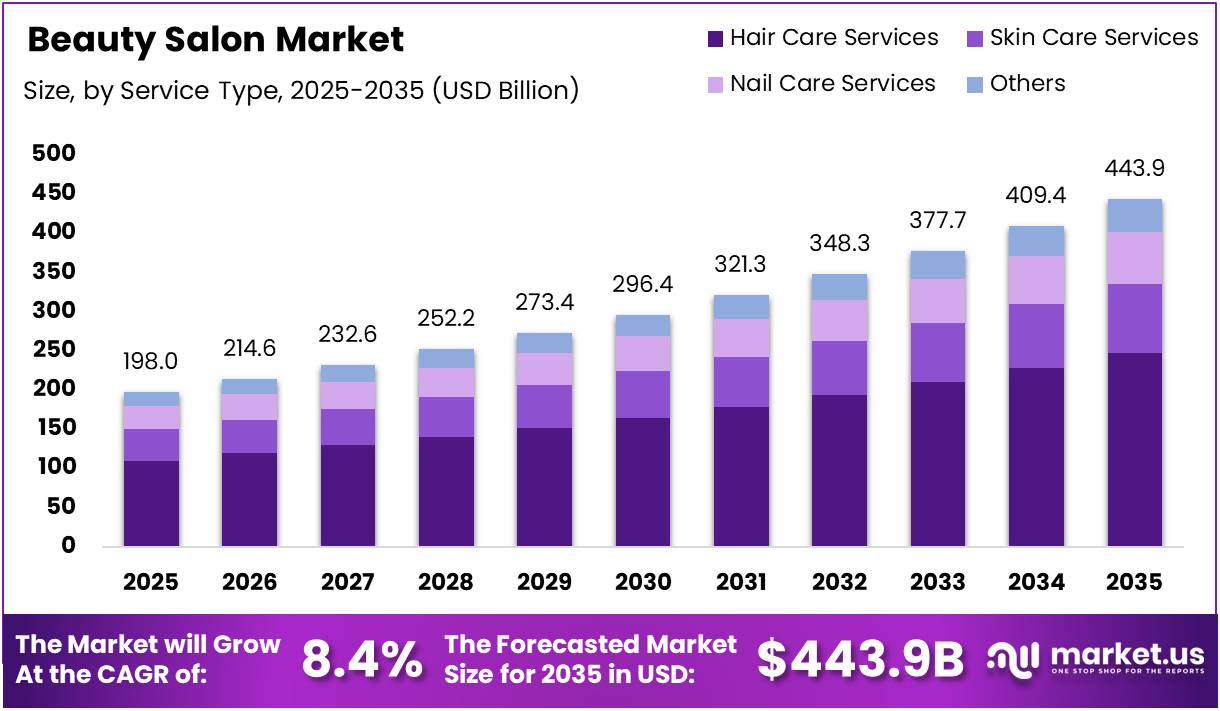
The Global Beauty Salon Market size is expected to be worth around USD 443.9 Billion by 2035 from USD 198.0 Billion in 2025, growing at a CAGR of 8.4% during the forecast period 2026 to 2035.
The beauty salon market encompasses a wide range of professional personal care services, including hair care, skin care, nail care, and other grooming treatments. These services are delivered through organized salon chains, independent studios, and specialty outlets. Moreover, the market serves both individual consumers and corporate clients across urban and semi-urban regions.
Demand for professional beauty services has grown significantly due to rising consumer awareness about personal grooming and wellness. Salons are no longer viewed as luxury spending but as a regular lifestyle necessity. Consequently, service providers are expanding their offerings to meet diverse consumer preferences across all age groups and demographics.
Government initiatives supporting small business development and beauty education have strengthened the salon industry in several markets. Regulatory frameworks around health and hygiene standards have also raised service quality. Additionally, vocational training programs backed by public investment are helping bridge the skills gap in the professional beauty sector.
Technology adoption is reshaping how salons operate and attract clients. According to Yocale, over 35% of salon appointments are booked outside of regular working hours or on holidays. Furthermore, salons in urban centers like Los Angeles and New York City reported a 25% increase in efficiency after implementing technology-based solutions.
Consumer loyalty is closely tied to convenience and service personalization. According to Zenoti, 48% of hair and beauty salon clients say they would be much more likely to return to a salon that allowed them to book or change appointments at any time. Additionally, according to Boca Beauty Academy, 68% of male clientele are visiting salons more frequently, with 67% booking multiple services in one visit, indicating robust growth potential across gender segments.
Key Takeaways
The global Beauty Salon Market is valued at USD 198.0 Billion in 2025 and is projected to reach USD 443.9 Billion by 2035.
The market is growing at a CAGR of 8.4% during the forecast period 2026 to 2035.
By Service Type, Hair Care Services dominates with a market share of 56.5% in 2025.
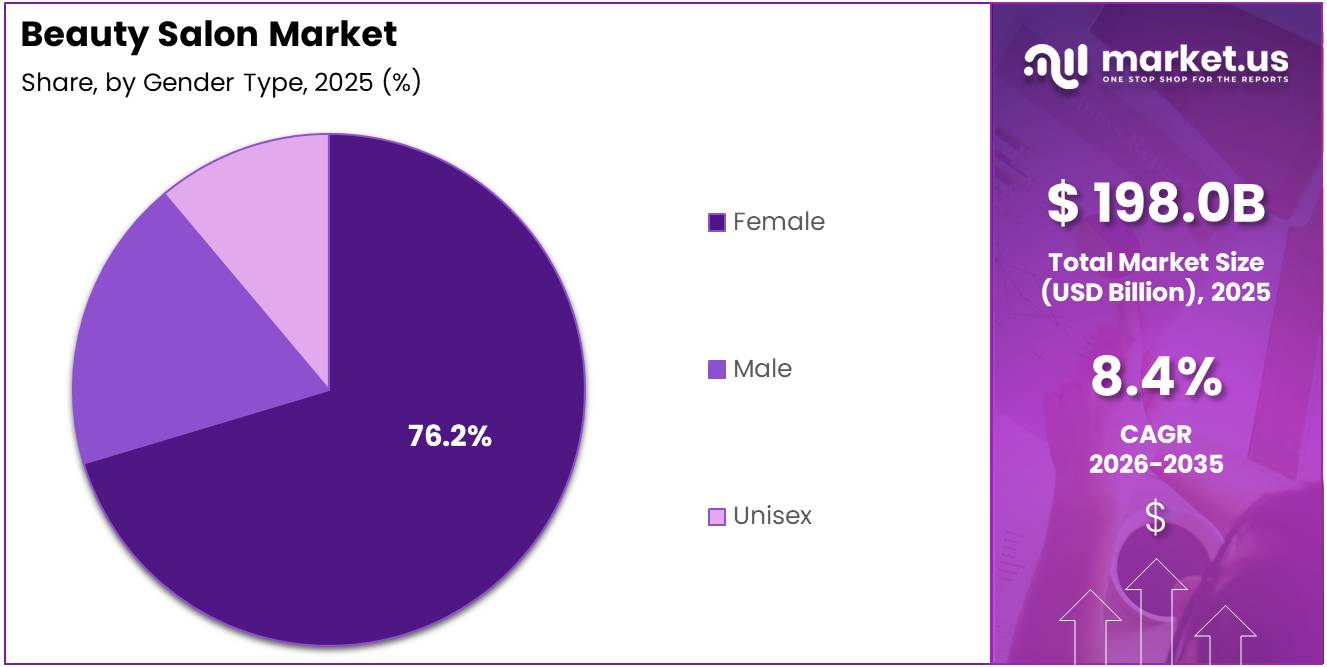
By Gender Type, Female segment holds the largest share at 76.2% in 2025.
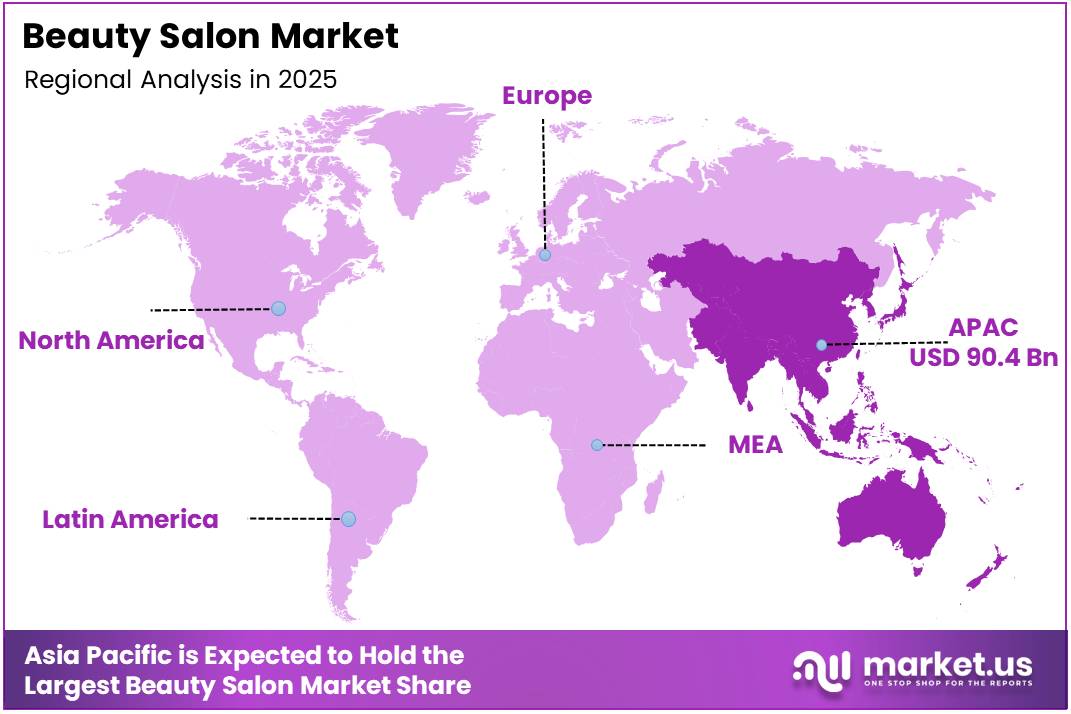
Asia Pacific is the dominating region, holding 45.70% market share, valued at USD 90.4 Billion.
Service Type Analysis
Hair Care Services dominates with 56.5% due to high frequency of visits and broad consumer demand across all age groups.
In 2025, Hair Care Services held a dominant market position in the By Service Type segment of the Beauty Salon Market, with a 56.5% share. Hair care remains the most frequently availed salon service globally. Consumers visit regularly for haircuts, coloring, and treatments, making this segment the primary revenue driver for most salon businesses.
Skin Care Services represent a fast-growing sub-segment within professional beauty. Increasing consumer focus on skin health, anti-aging treatments, and facial therapies has boosted demand. Moreover, the rise of medical-grade skincare services offered within salon settings has further elevated this segment’s importance across urban markets.
Nail Care Services continue to attract a loyal consumer base, particularly among female clients. Services such as manicures, pedicures, and nail art have gained popularity as affordable personal care rituals. Additionally, rising social media visibility of nail trends has expanded the consumer base for this segment significantly.
Others include services such as waxing, threading, massage, and makeup. These complementary offerings allow salons to upsell and increase per-visit revenue. Consequently, many salons are bundling these services into packages to improve client retention and overall service value.
Gender Type Analysis
Female segment dominates with 76.2% due to higher frequency of salon visits and broader range of services consumed.
In 2025, Female held a dominant market position in the By Gender Type segment of the Beauty Salon Market, with a 76.2% share. Female consumers continue to drive the majority of salon revenue globally. Their diverse grooming needs across hair, skin, nail, and body care services make them the most consistent and high-value client segment in the market.
Male grooming represents one of the fastest-growing sub-segments in the beauty salon industry. Changing social attitudes toward male self-care and appearance have accelerated visit frequency. Moreover, salons are now offering dedicated male grooming menus including beard shaping, scalp treatments, and skin services to better capture this expanding audience.
Unisex salon concepts are gaining traction across modern urban markets. These inclusive environments cater to all genders without differentiation, appealing to younger, more progressive consumer segments. Additionally, unisex salons reduce operational complexity while broadening their potential client base, making them an increasingly viable and scalable business model.
Key Market Segments
By Service Type
Hair Care Services
Skin Care Services
Nail Care Services
Others
By Gender Type
Drivers
Rising Disposable Income and Social Media Influence Drive Beauty Salon Market Growth
Rising disposable incomes across emerging and developed economies have made professional grooming services more accessible to a broader consumer base. Consumers are increasingly willing to spend on premium beauty treatments as part of their regular lifestyle. Consequently, salon service providers are introducing higher-value offerings to meet growing demand for quality personal care.
Social media platforms have significantly influenced consumer behavior around personal appearance and grooming. Visual content on platforms such as Instagram and TikTok drives awareness of beauty trends and new service formats. Moreover, influencer marketing has created strong aspirational demand for professional salon experiences among younger and digitally active consumer segments.
Rapid urbanization is expanding the addressable market for professional beauty services in key regions. As more consumers move into cities, their exposure to organized salon formats and premium grooming options increases. Therefore, salon businesses operating in high-density urban areas are experiencing consistent growth in footfall and overall service revenue.
Restraints
Freelance Competition and Skilled Workforce Shortage Limit Beauty Salon Market Expansion
The beauty salon industry faces growing competition from freelance and home-based service providers who offer lower-cost alternatives to traditional salons. These providers often operate with minimal overheads, enabling them to undercut established salon pricing. Consequently, organized salon businesses must work harder to differentiate through service quality, experience, and branding.
A significant shortage of skilled and certified beauty professionals continues to constrain market growth in multiple regions. Training pipelines have not kept pace with rising industry demand, leaving many salons understaffed. Moreover, high employee turnover in the sector further disrupts service consistency and affects client retention for established businesses.
The combination of price pressure from informal competitors and limited talent availability creates a challenging operating environment for salon businesses. Owners must balance competitive pricing with investment in staff retention and training programs. Therefore, addressing the skills gap and building strong employer brands are increasingly critical priorities for sustainable salon business growth.
Growth Factors
AI Integration, Organic Services, and Subscription Models Accelerate Beauty Salon Market Expansion
The integration of AI-based skin analysis tools is enabling salons to offer highly personalized treatment recommendations to individual clients. These technologies improve service accuracy and consumer confidence in professional beauty advice. Moreover, data-driven personalization creates a differentiated salon experience that drives repeat visits and strengthens long-term client relationships.
Growing consumer preference for organic, clean-label, and natural beauty products is opening new service opportunities for salons. Clients are increasingly seeking treatments formulated with safe, sustainable, and ethically sourced ingredients. Consequently, salons that align their service menus with clean beauty principles are well-positioned to attract health-conscious and environmentally aware consumers.
Membership and subscription-based service models are gaining traction as a scalable revenue strategy for salon businesses. These models provide predictable income streams while incentivizing clients to visit more frequently. Additionally, subscription programs improve customer loyalty, reduce churn, and create a foundation for upselling higher-value beauty services across existing client bases.
Emerging Trends
Inclusive Concepts, Digital Payments, and Sustainable Practices Reshape the Beauty Salon Market
Gender-neutral and inclusive salon concepts are becoming increasingly mainstream across urban markets. These spaces cater to all identities without gendered pricing or service separation, reflecting broader cultural shifts. Moreover, inclusive salons tend to attract younger, more diverse clientele who prioritize welcoming environments and equitable service pricing models.
The adoption of contactless booking platforms and digital payment systems is transforming how salons manage operations and client interactions. Online and app-based scheduling tools reduce no-shows and improve appointment efficiency. Therefore, salons that invest in seamless digital experiences are seeing measurable improvements in customer satisfaction and operational productivity.
Sustainability is emerging as a defining value in the beauty salon industry. Consumers are increasingly favoring salons that use eco-friendly products, minimize waste, and adopt green operational practices. Consequently, businesses that commit to environmentally responsible standards are building stronger brand loyalty and aligning themselves with the long-term expectations of environmentally conscious consumers.
Regional Analysis
Asia Pacific Dominates the Beauty Salon Market with a Market Share of 45.70%, Valued at USD 90.4 Billion
Asia Pacific leads the global beauty salon market, holding a dominant share of 45.70% and valued at USD 90.4 Billion in 2025. The region benefits from a large, young, and increasingly affluent population with high grooming awareness. Moreover, rapid urbanization and a strong beauty culture across markets such as China, South Korea, Japan, and India continue to fuel sustained demand.
North America Beauty Salon Market Trends
North America represents a mature and high-value market for professional beauty services. The United States drives the majority of regional revenue, supported by strong consumer spending on personal care and a well-established network of salon chains. Additionally, growing male grooming demand and technology adoption are further strengthening market performance across the region.
Europe Beauty Salon Market Trends
Europe maintains a stable and sophisticated beauty salon market underpinned by premium consumer expectations and strong wellness culture. Key markets including Germany, the UK, France, and Italy lead regional demand. Moreover, increasing interest in organic and sustainable beauty services is creating new opportunities for differentiated salon operators across the continent.
Latin America Beauty Salon Market Trends
Latin America is an emerging growth market for beauty salon services, driven by a vibrant beauty culture and expanding middle-class population. Brazil and Mexico are the primary contributors to regional revenue. Consequently, increasing urbanization and rising social media influence on beauty trends are accelerating professional grooming service adoption in the region.
Middle East and Africa Beauty Salon Market Trends
The Middle East and Africa region presents growing potential for beauty salon expansion, particularly in GCC countries where luxury grooming services are in high demand. Rising female workforce participation and increasing consumer spending on appearance are key drivers. Furthermore, government-backed tourism and hospitality development in the region supports ancillary beauty service growth.
Key Regions and Countries
North America
Europe
Germany
France
The UK
Spain
Italy
Rest of Europe
Asia Pacific
China
Japan
South Korea
India
Australia
Rest of APAC
Latin America
Brazil
Mexico
Rest of Latin America
Middle East & Africa
GCC
South Africa
Rest of MEA
Key Company Insights
Bluemercury operates as a luxury beauty retail and spa brand known for its personalized skincare services and curated product offerings. The company has built a strong presence in the premium segment by emphasizing expert consultations and high-quality treatment experiences. Its boutique salon model appeals to affluent consumers seeking bespoke, science-backed personal care solutions.
Bumble and bumble is a professional hair care brand with a strong foothold in the salon industry through its flagship salons and extensive stylist education programs. The brand is recognized for its innovation in professional hair products and cutting-edge styling techniques. Moreover, its training academy strengthens its position as a thought leader within the professional salon ecosystem.
Great Clips is one of the largest salon franchise operators globally, offering affordable, no-appointment haircut services across an extensive network. The brand competes effectively on convenience, value, and accessibility. Its technology investments, including online check-in tools, have significantly improved the client experience and operational efficiency across its franchise locations.
Regis Corp. is a major player in the global beauty salon industry, operating and franchising thousands of salon locations under multiple brand names. The company has undergone significant strategic restructuring in recent years, focusing on franchise expansion and operational streamlining. Consequently, its broad geographic footprint and multi-brand portfolio position it as a key competitive force in the market.
Key Players
Bluemercury
Bumble and bumble
Cost Cutters
Fantastic Sams
Floyds Barbershop
Great Clips
Hair Cuttery
LOreal SA
Regis Corp.
Shiseido Co. Ltd.
Sola Salon Studios
Recent Developments
January 2026 – Salon Communications was acquired by Colin Sutherland, publisher of Modern Salon and Salon Today, consolidating ownership of leading North American beauty media brands. This acquisition strengthens the reach of professional beauty publishing across key salon industry audiences in North America.
December 2025 – Blake Charles Salon expanded its international footprint through the acquisition of the iconic Saint-Tropez salon Le Boudoir. This move marks a significant step in the brand’s global growth strategy within the luxury beauty segment.
July 2025 – Blackstone entered talks to acquire South Korea’s top salon chain Juno Hair in a deal valued at $590 million. The proposed acquisition signals growing private equity interest in premium salon brands across the Asia Pacific region.
January 2025 – Regis Corp. repurchased 314 franchise salons for $22 Million, bringing them back under direct corporate ownership. This strategic move reflects the company’s ongoing efforts to optimize its franchise network and improve operational control.
Report Scope