In January, Ryan Murphy’s new show The Beauty premiered on FX and Hulu. The premise: A sexually transmitted infection results in physical perfection, so people start trying to catch it, even when it becomes clear that the side effects kill.
It’s a lot to unpack, particularly for gay and queer people who know firsthand how a virus can be mythologized, weaponized, feared, desired: It strikes me as an obvious reference to bug-chasing and AIDS panic as much as it is a commentary on consumer culture and the beauty industry. In Murphy’s glossy, body-horror nightmare — starring Evan Peters, Anthony Ramos, Jeremy Pope, Rebecca Hall, and Ashton Kutcher — the flesh you’re born with becomes a kind of poverty, but upgrading it might kill you.
Aren’t we there already?
It’s sci-fi, but it feels like the “manosphere,” which has also been making headlines lately. This is a catchall term for the online world of ads, clickbait, and masculinity influencers bent on examining, displaying, dissecting, enhancing, and “fixing” what many men seem to perceive as a global problem: broken masculinity.
Around the time The Beauty hit TV screens, my phone started offering me a deluge of ads targeting all my insecurities, everything from neck-and-jaw training devices to grip-strength tools to “male optimization” supplements. And is anyone else — at least, any other queer men — seeing an insane increase in the number of gym and fitness influencers on their feed? It seems I am not alone. In late January, The Guardian reported on new research published in Social Science & Medicine — a peer-reviewed medical and public health journal — that analyzed 46 high-engagement Instagram and TikTok posts promoting testosterone tests and treatments. Those accounts had a combined audience of 6.8 million followers, and the posts commonly framed everyday moods and libido shifts as symptoms of “low T,” nudging men toward tests, subscriptions, supplements, and clinics.
The pitch is simple: You are broken. You are falling behind. But with a new product or treatment, you can buy your way back to being a real man.
On the one hand, the underlying logic is trans-affirming. My biweekly testosterone injections are gender-affirming care, the same category of medicine that can be life-changing for trans men. I think about Paul B. Preciado’s seminal text Testo Junkie: Sex, Drugs, and Biopolitics in the Pharmacopornographic Era, a genre-bending “body-essay” about taking testosterone outside a formal medical transition — less self-help than cultural autopsy and often very funny about the way gender gets built through products, institutions, and desire. Early in the book, Preciado calls it “a testosterone-based, voluntary intoxication protocol.”
And I recognize the symmetry: Masculinity marketing now mirrors what women have experienced for decades. Still, I fear the mental and emotional toll this will take on all of us — on men and on society as a whole.
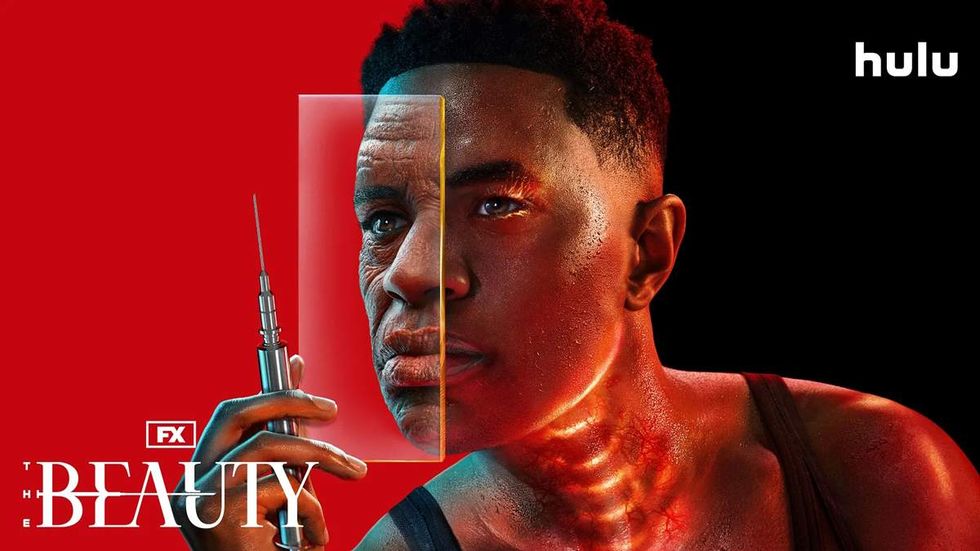 Promotional art for FX series ‘The Beauty’FX
For decades, beauty marketing treated women as the default customer and men as a niche. That’s changing. In a recent forecast from Fortune Business Insights, the global men’s grooming market was valued at about $64.6 billion in 2025 and is projected to keep climbing through the next decade. The language of online “low T” ads is almost always medical, even when the solution is a subscription box or mystery powder. They warn against low testosterone, erectile dysfunction, and hair loss — real medical issues for some people — but the pitch often comes from marketers first and clinicians second. In a recent CBS News report about “manopause” marketing, doctors warned that telehealth sites and online ads promoting testosterone drugs are flawed — maybe even dangerous — and often imply that normal aging and ordinary fatigue are hormonal emergencies.
It’s not just testosterone. In a 2025 investigation, KFF Health News — an independent nonprofit newsroom from KFF, a U.S. health policy organization — reported that direct-to-consumer telehealth companies have poured money recently into ads for stigmatized conditions, including erectile dysfunction and hair loss, across social platforms and podcasts, encouraging people to self-diagnose and then buy a fix.
As a result, it seems more men are showing up in clinics. In its 2024 procedural report, the American Society of Plastic Surgeons noted that men accounted for 7 percent of all plastic surgery patients in 2024 and described “increasing awareness” and “less stigma” around men seeking cosmetic procedures. The same report noted that neuromodulator injections (Botox) included men as 6 percent of patients, and that a notable share of laser skin treatments (16 percent) were performed on men.
Globally, the International Society of Aesthetic Plastic Surgery reported that total surgical and nonsurgical procedures among men increased sharply from 2018 to 2024, with eyelid surgery ranking as the most common surgical procedure among men.
Men taking their skin seriously or treating hair loss isn’t automatically wrong or worrying. But shame is an effective business model, and it seems a lot of money is being used to weaponize it and blur the line between self-care and insecurity.
It is most worrying that the content doesn’t read like advertising. It reads like advice. In 2024, Urology Times summarized research presented at a major urology meeting, warning that popular TikTok videos about “low testosterone” often promoted testosterone replacement therapy like a lifestyle upgrade while failing to mention key long-term risks, including impacts on fertility. In The Guardian’s report on that same testosterone-influencer research, researchers said 72 percent of the low T posts had clear financial motives — selling supplements or directing viewers toward paid services — and conflicts of interest often were not disclosed. Separate reporting, including a January dispatch circulated by Agence France-Presse, described a surge in men in the U.K. seeking testosterone injections after social media and influencer marketing encouraged young men to test their hormone levels.
The cultural moment feels telling. Gender norms are shifting in the wake of #MeToo, and there’s a real rise in far-right recruitment efforts using “hypermasculine” fitness culture as an on-ramp, framed as moral and political purification. The Week, citing reporting by the antifascist group Hope Not Hate, has described how extremist “active clubs” use fitness culture and violence-ready posturing as recruitment infrastructure.
What if more people are just getting into muscle? Well, yes. A February 2 New York Times report on the history of strength training describes this shift in a tangible way: “National gym chains are swapping out cardio machines for weight benches and power racks,” while “roughly one in three Americans now says they regularly strength-train — up from about one in five in the early 2000s.” You can see the change on the ground too. Axios reported last year that Crunch Fitness and Planet Fitness were cutting cardio equipment by more than 40 percent at many locations to make room for weights.
What used to be a subculture is now the default. Lifting weights is no longer niche.
Researchers have warned for years that muscularity-focused social media can worsen body dissatisfaction and disordered thinking in men. One recent study using data from a large North American sample found that viewing muscularity-oriented social media content was associated with more symptoms of muscle dysmorphia — the feeling that you’re never big enough. But this is where I stop pretending the manosphere is a straight men’s invention.
Gay men have lived inside a version of this for a long time. In gay land, the manosphere isn’t new. It is the rule. We’ve dealt with testosterone and steroid culture in ways straight culture is only now catching up to. A 2024 paper in Harm Reduction Journal noted that use of anabolic-androgenic steroids — synthetic forms of testosterone — is widespread among gay, bisexual, and queer men, and that the harms and care gaps between us and our straight counterparts are real. This may be the right time to confess that I, like many gay men I know, am a gym-addicted steroid user and am just as much participatory in the beauty and darkness of gay image culture as I am wary and lamenting of it.
When straight men tell me they feel newly suffocated by male beauty standards, part of me wants to say: welcome. There was a time in living memory when the difference between a gay guy and a straight guy was a gym membership. That stereotype doesn’t hold anymore. Straight men are lifting, chasing cosmetic tweaks, and posting glow-ups. And the marketing machine is thrilled, because it has found a giant new audience.
So here is what I want to tell straight men — and all men: Be wary of the online world and do not trust Instagram to diagnose your testosterone or your life. This sounds hokey, but true things often do: You are beautiful. You are enough. If you want to lift, lift. If you want Botox, get Botox. But don’t let an algorithm diagnose your masculinity. Or else we’ll all be living in The Beauty.
Alexander Cheves is a writer, sex educator, and author of My Love Is a Beast: Confessions from Unbound Edition Press. @badalexcheves
This article is part of Out’s March/Apr 2026 print issue, which hits newsstands March 24. Support queer media and subscribe — or download the issue through Apple News+, Zinio, Nook, or PressReader starting March 16.