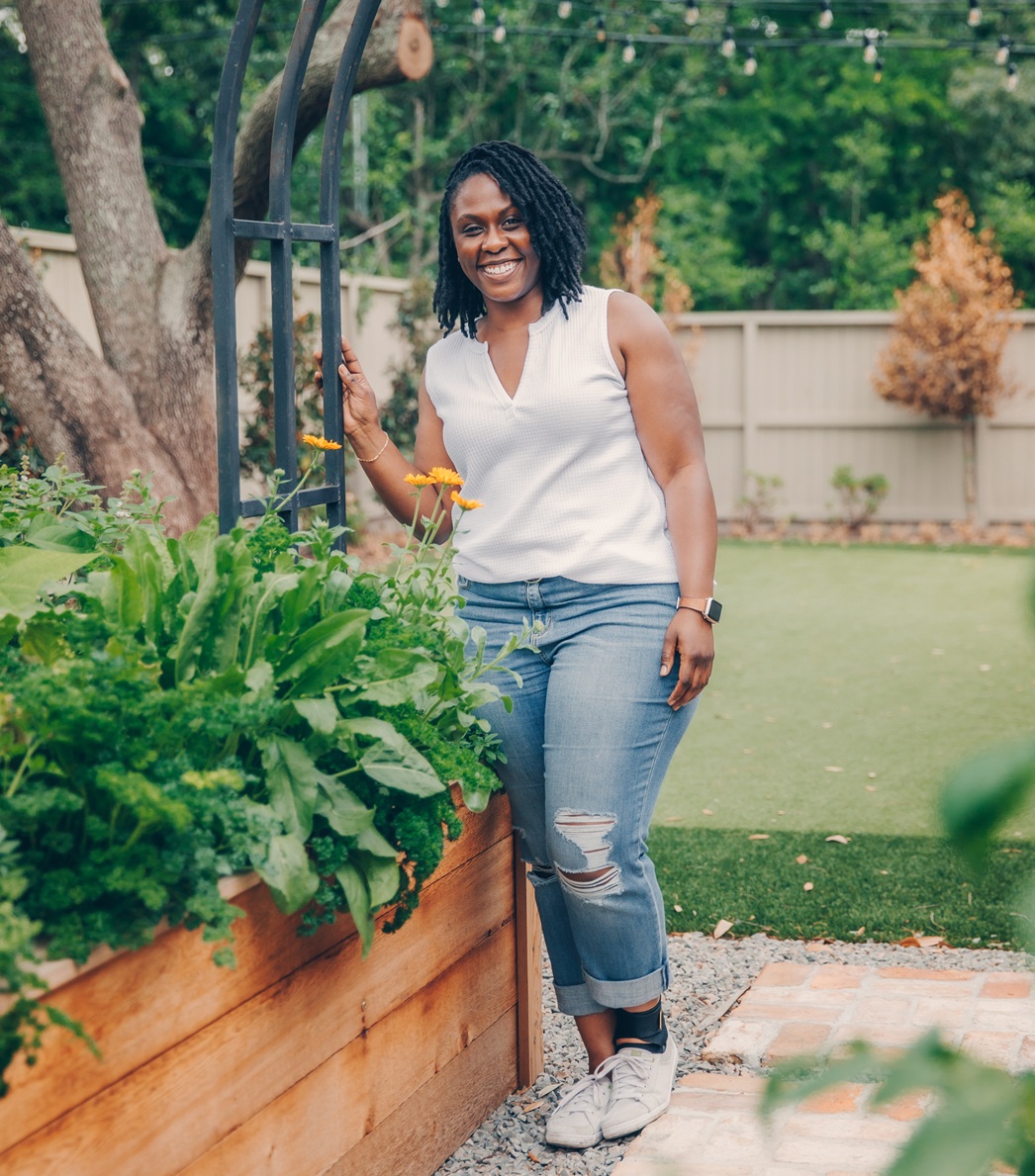
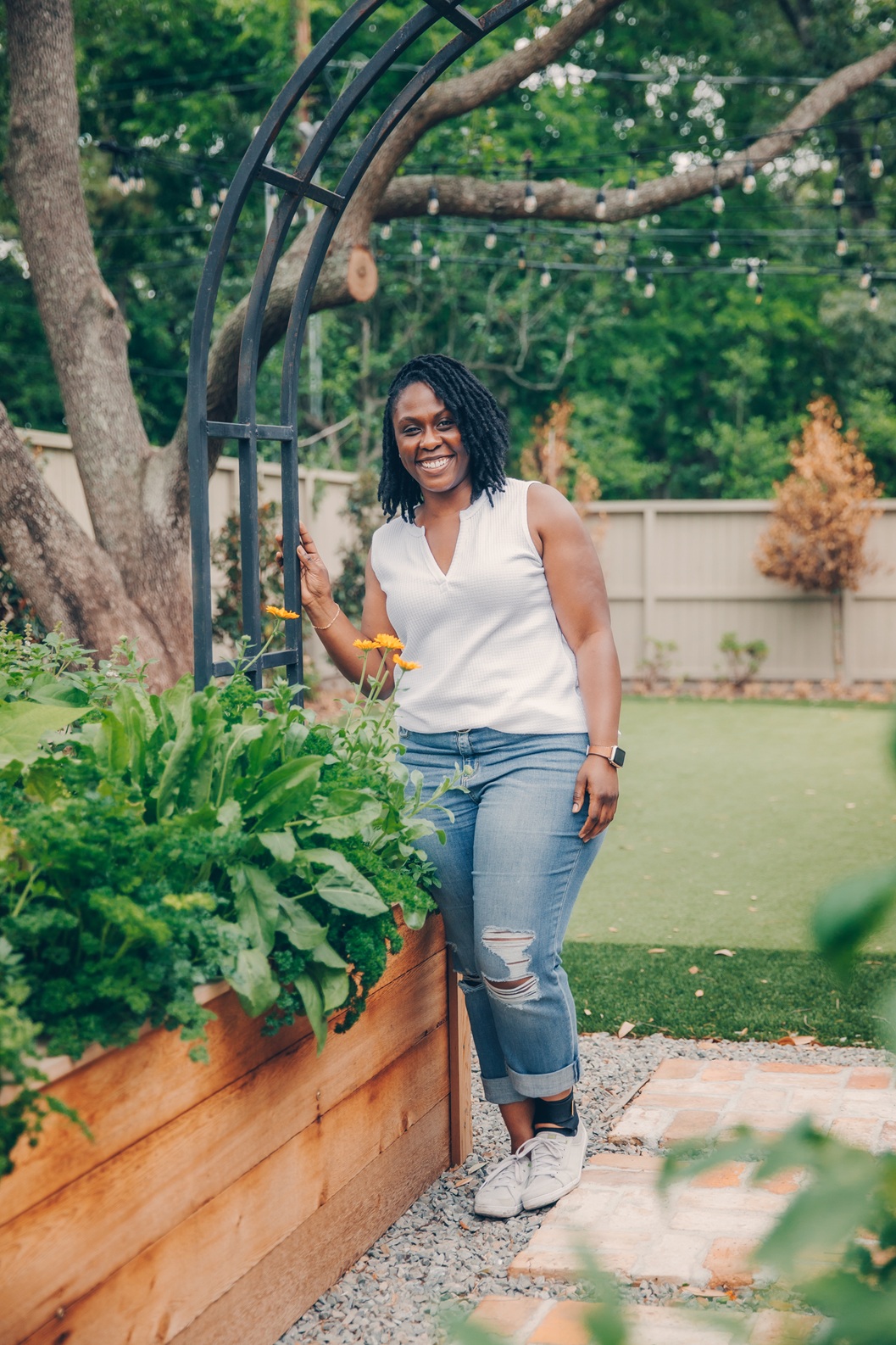
 NaTasha Lax is an advocate for sustainable living and community gardening.
She founded Carolina Foodscapes to promote food security, environmental
stewardship and community empowerment through innovative gardening
projects. Photo by Mac Elliott Media.
Certified Garden Coach and Therapeutic Horticulturalist NaTasha Lax is changing the gardening game in Fayetteville.
Lax initially started a business to help people transition to vegetarianism or veganism, or even just to eat more vegetables. She was already a skilled gardener and decided that it would be a good idea to share her knowledge of growing food with these clients as well, so they could grow the veggies they wanted to add to their diet. That branch of the business took off, and Lax rebranded to Carolina Foodscapes about two years ago.
Potential clients schedule a consultation with Lax through her website. Once she’s worked with them to identify their needs and wants for their garden and has walked through their space, she creates a 3D rendering of the garden to show what the final product will look like before they install it. After the design is approved, the garden is installed, which can take anywhere from four hours to two days. Then, Lax remains available as a coach. For clients looking to be more hands-off, Carolina Foodscapes also offers maintenance packages where Lax will maintain the garden for them, teach them how to harvest everything or even do the harvesting herself if the client is unable to.
Carolina Foodscapes provides workshops and educational seminars to the community to empower people with the knowledge and skills needed to grow their own food. The business also invites people to join the GROW community, a community for those who are not ready to install a garden but want to start on their own and need some guidance.
In addition to helping home gardeners, Carolina Foodscapes partners with schools, businesses and other organizations to design custom gardens and deliver therapeutic horticulture programs. They build gardens and offer programming for nonprofits like Greater Life of Fayetteville, Myrover-Reese and Veggies for Vets. Lax shared that she is also working towards partnering with senior homes to provide her services, as she has learned about ways in which gardening can be therapeutic for people with dementia and memory issues.
Therapeutic horticulture is a practice that uses different activities to improve physical, mental, social and emotional well-being, and that happens through different kinds of activities. Lax provided several examples of how this could work.
“For instance, if we have a child or student who’s autistic, we would develop a garden specifically for them…we can have sensory gardens with specific smells and colors that would help calm them. Additionally, with dementia patients, we have a consultation to learn what they grew up around, so specific plants, maybe from childhood or a great part of life, that we could grow that could help trigger memories and improve their memory while they’re also in memory care. For those who have dexterity problems, we would use certain kinds of adaptive tools and all kinds of techniques to plant or harvest or tend that will help them build their muscles in their hands. So, depending on the situation, we basically do an interview to get all the information we can, and then we build their garden specifically around what challenge they’re trying to overcome,” explained Lax.
Lax is dedicated to growing as a student as well as a teacher. She is completing a Master of Professional Studies in Sustainable Food Systems, with an expected graduation in June 2026.
“When I started this degree, I thought I knew exactly what I wanted to do, but as I was learning the material and the content they had us researching, I found a new passion. I’ve always been passionate about everybody having access to healthy and nutritious foods. But then, when I learned about how much food waste we have in America, and then doing the research here in Cumberland County, it’s astronomical. Our food waste levels, which are about 40% [in the U.S.], could feed all of the homeless. So my heart, it just broke, but I also developed this new passion to want to do something about that,” shared Lax.
For her capstone project, Lax has partnered with Cumberland County Schools to assist them in developing systems to divert food waste into efforts to feed the hungry and to compost wasted food that cannot be used to feed people.
Lax is still working to increase brand awareness and reach a wider audience with her services. Carolina Foodscapes is also working to debunk common misconceptions that hold people back from starting gardens. For instance, many people believe you can only grow food in the spring and that gardening is inherently back-breaking and time-consuming. In contrast, Carolina Foodscapes designs low-maintenance, no-till gardens that can support year-round growing in their region and significantly reduce the labor typically associated with traditional gardening.
The work Lax does is deeply personal, and she believes that it is reframing the historical relationship between Black people and agriculture.
“In this particular industry, growing food, in my culture, it can be frowned upon simply because of the history of Black people being slaves and working in the fields and things like that. So in my culture, having to reshape our mindset, but then also looking at the generations before me, my grandparents and their parents, how they farmed the land even after they were free to do what they wanted to do, I think is beautiful, and it’s amazing tribute to my family and to those who came before them,” shared Lax.
Lax chooses to reclaim her legacy as something beautiful and empowering. She is proud to come from a long line of innovators, providers and entrepreneurs.
“I have a family of entrepreneurs, so I feel like I’m following their footsteps, no matter the challenges that they faced, and that I still currently face, which is not surprising, just disappointing that I still have to deal with challenges as a Black woman in this industry, but it is what it is. But I’m able to stand proud and believe that my grandparents, my great grandparents, are looking like, ‘Yep, that’s my girl. She’s doing it,’ regardless of what happened before. But also, I get to learn through these challenges. So it’s really awesome to see, and the fact that my kids get to see it too. So I’m hoping that it passes down to at least one of my kids, so they can be a Black entrepreneur in our society and be successful and also be amazing examples for those coming after,” added Lax.
From personalized veggie garden designs and workshops to therapy and eliminating food waste, Carolina Foodscapes demonstrates the vast ways in which gardening can feed our bodies and our souls.
To learn more about Carolina Foodscapes, visit www.carolinafoodscapes.co.