
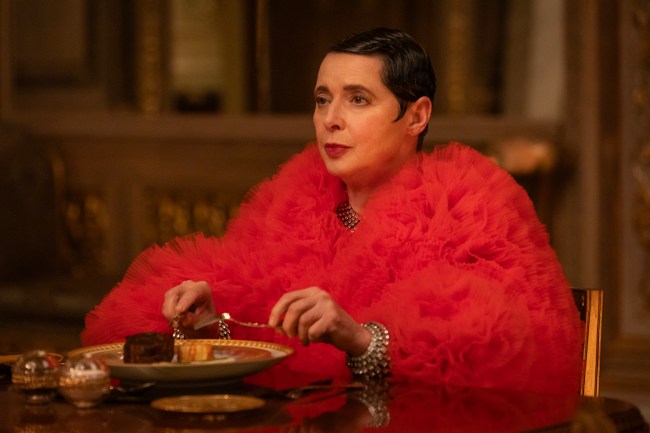
Forty years ago, Isabella Rossellini entered our collective pop culture consciousness with her haunting rendition of “Blue Velvet” in the late David Lynch‘s eponymous film. Flash-forward four decades and she gets an exit to remember in the Season 1 finale of Ryan Murphy‘s FX thriller, The Beauty — one that’s scored to that vintage ’80s Guns N’ Roses track “Sweet Child o’ Mine.” Rossellini last scene serves as the very first scene of the episode that closes out the freshman year of Ryan Murphy’s wild FX thriller about a sexually transmitted disease that turns its carriers into younger, hotter, and supposedly better versions of themselves.
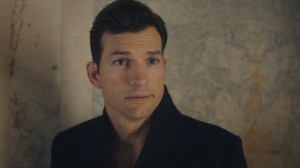
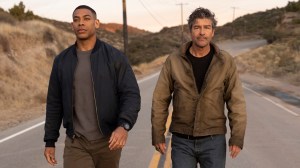
Being on the receiving end of a Beauty-assisted makeover is precisely the fate that her alter ego, Franny Forst, has been trying to avoid all season. As the wife of the blowhard who developed the STD — entrepreneur Byron Forst, who looked like Vincent D’Onofrio before a dose of his own medicine turned him into Ashton Kutcher — Franny could have dosed up at any time. But unlike everyone else on the show, she’s supremely comfortable in her aging skin. Unfortunately, she’s also supremely blind to the betrayal that’s about to hit very close to home.
As Axl Rose sings about childhood memories and eyes of the bluest skies, Franny happily dances with her two Beauty-transformed sons, who then plunge a syringe filled with the virus into their mother. When we see her again, Rossellini is gone forever — replaced by Nicola Peltz.
Speaking with Gold Derby, the daughter of Hollywood legend Ingrid Bergman and Italian auteur Roberto Rossellini says that she remembers the crew blasting “Sweet Child o’ Mine” on her last day to set the mood. “We had the music playing, but they would turn it off when the cameras rolled for sound,” she notes. “But we knew what they were playing, so our fantasies gave us the music.”
In a spirited exit interview, Rossellini explains what attracted her to The Beauty, the experience of trading barbs (and blows) with Kutcher, and why the late Dennis Hopper was like a “ticking bomb” on the set of Blue Velvet, which celebrates its 40th anniversary this summer.
Gold Derby: One of the things I love about the opening sequence is that Franny’s dance with her sons starts off as celebratory, but then it becomes a dance of death scored to this wild rock song. Did you think of it that way?
Isabella Rossellini: No, I thought of it the way that Franny does. She’s there dancing with her children who she adores even though they’re losers! [Laughs] In the script, those characters are described in the worst way — they smell, they’re ugly — but the actors playing them were so lovely, I felt like I had to apologize. The thing about Franny is that she’s turned off by the Beauty, but she accepts her children. She doesn’t accept her husband and their relationship is based in hostility. But she cannot resist her children.
And that’s what makes their betrayal all the more shocking.
It is a huge betrayal, and I played it that way. Franny is so principled while everybody else is corrupt. She believes in beauty as an expression of an inner idea, not as a physical change. In my own life, I define beauty and elegance as an expression of what is inside you. And on The Beauty, that [belief] is incredibly exaggerated by the character I play in terms of the fashions she wears. Franny has all these crazy clothes that are haute couture without being haute couture.
Part of Ryan’s genius is that we didn’t call a designer to create my clothing; we wanted to be artistic and absurd without having to be association with a brand. That’s the great freedom that Ryan has, and he’s the luckiest person on Earth because he’s as avant-garde as David Lynch, but David wasn’t as popular. He didn’t have the box office that Ryan has.
At the same time, Ryan also talks about things that are so profound. I don’t think I’ve ever seen anything like The Beauty. It’s science fiction, it’s comedic, it’s dramatic, it’s violent — I don’t know how to define it in the same way that I was unable to define a David Lynch film. He addresses these profound questions with such a sense of humor and a sense for entertainment.
Did you have a chance to coordinate with Nicola Peltz about who the younger version of Franny would be?
We did not have a chance to coordinate, but it was pretty precise. Ryan has a very succinct way of explaining things. For example, when he directed one of the earlier episodes, he told me: “When you’re in your house, you walk like Bette Davis in The Little Foxes and when you get to the window you look like Eva Perón.” I knew exactly what he was talking about; he has these fragments of popular culture that we all have in our minds. I don’t know if David had that or if David had references that were more personal. For him, it was about us entering his world. With Ryan, he enters our world.
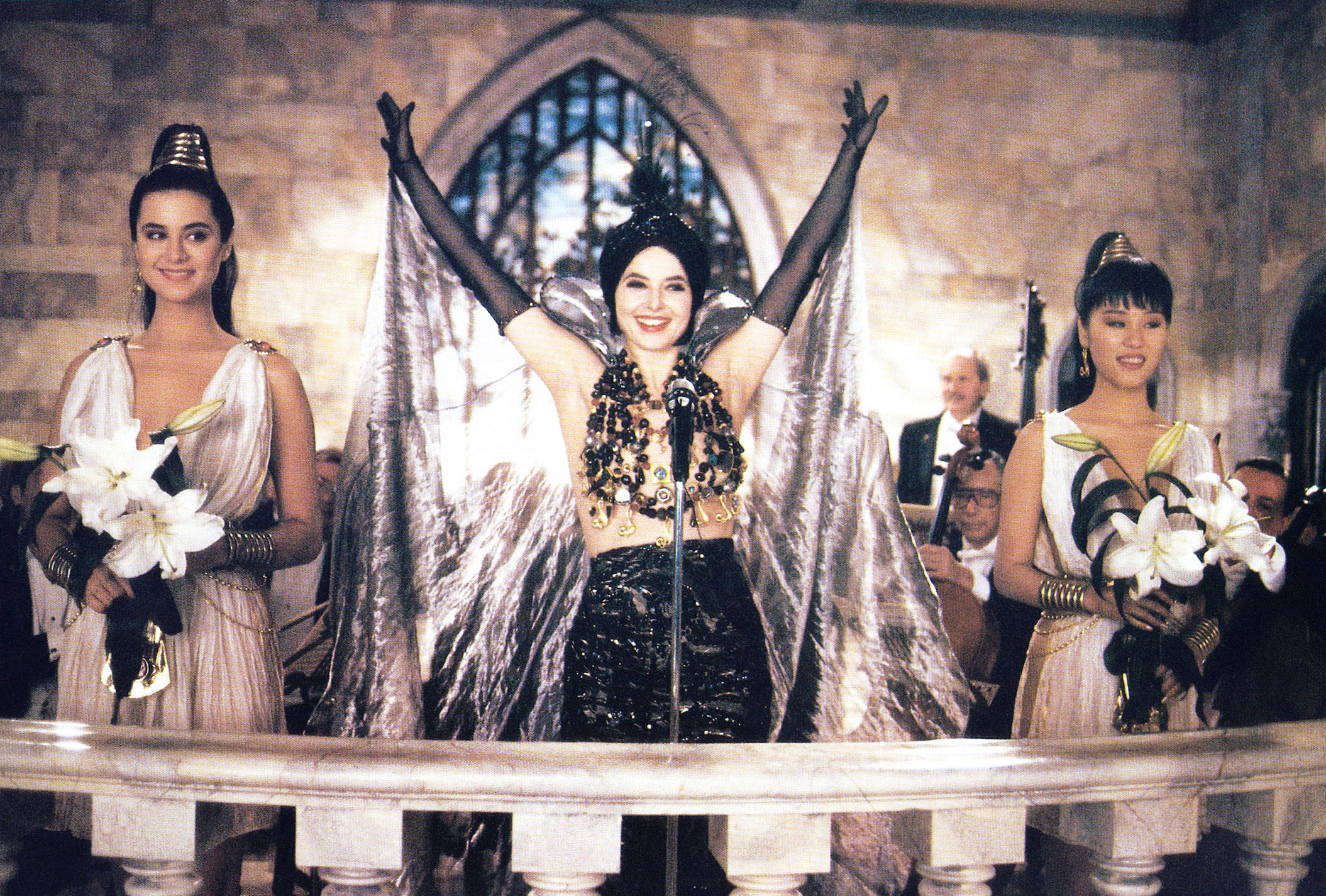 Rossellini in ‘Death Becomes Her‘Universal/Courtesy Everett Collection
Speaking of fashion, Nicola’s jewel-laden dress is definitely reminiscent of your Death Becomes Her look. Do you know if Ryan was directly referencing that film?
I hope so! [Laughs] When Death Becomes Her came out, it wasn’t very successful, but now it’s a big hit. When they premiered the musical on Broadway, the director called me and asked if I would do the pre-show announcement telling people to turn off their phones. I said, “Of course I’ll do it, but no one’s going to recognize that it’s me.” Then when I saw the show, everyone recognized my voice! And, of course, Death Becomes Her asks the same question as The Beauty — how far would you go to be beautiful? And both are also told with an enormous sense of humor.
You and Ashton had such a demented dynamic on the show, hurling insults at each other constantly. Did you enjoy being that nasty with him?
I did, but it was intimidating at the beginning because we didn’t have a lot of rehearsals. So I met him and had to insult him right away! But as soon as we ran the lines — and there were a lot of lines! — it was a lot of fun. It was like playing a tennis match with somebody that plays hard. I wish I could have fought with Ashton more in a way, because it reflects why Franny and Byron didn’t get divorced. One of the things we talked about is, “Why are these people staying together?” And we decided that they feel alive when they fight; there’s intimacy in that kind of violent relationship. Byron respects and fears her.
[In a separate interview with Gold Derby, Kutcher had this to say about Rossellini: “Going in, I was like ‘How am I going to tear apart this extraordinary human?’ But that played really well into our dynamic; Byron is almost reluctantly tearing her apart, because all he really wants is her approval. Every time that he does something he thinks is fantastic and she just dismisses him as a waste of humanity, it’s an emotionally damaging blow. So while he’s pummeling her with adjectives, he’s doing it reluctantly. And my reverence for Isabella played into our dynamic really, really well.”]
I’d be remiss not to mention that this year is the 40th anniversary of Blue Velvet. Your performance of that song in the film is so haunting — how did that scene come together?
We shot the film in North Carolina, and they hired a local band to play the song. The band had decided on the rhythm and I was going to follow them. But I went to David and said, “The band is okay, but I’m not a singer, so I won’t do the song justice.” And with that character, the moment she sings onstage, she’s free. Nobody can hurt her or beat her up. For that hour onstage, she can open up and express her deepest feelings.
David immediately understood and called [composer] Angelo Badalamenti, who was recommended to us by our producer, Fred Caruso. Angelo helped find the right rhythm and we created that version together in a couple of days and recorded it. When we shot the scene, I performed to a playback while Angelo is at the piano. That was the beginning of an incredible friendship between David and Angelo. David always had music inside of him, but he didn’t know how to express it because he didn’t have that discipline. So through Angelo, he could create his music.
Dennis Hopper’s performance in that film remains genuinely frightening. I can’t imagine what a live wire he must have been on set.
Dennis was the last one to be hired for the film. When David called me and said, “For Frank Booth, we have a Dennis Hopper,” I went, “Dennis Hopper?” Because he had disappeared at that point — he had been in rehab and all that. And David said, “Yes — it’s like sitting next to a ticking bomb.” That could have been a Ryan Murphy direction! [Laughs]



![[Photo News] Robots join K-beauty labs](https://www.vitaminrush.com/wp-content/uploads/2026/03/news-p.v1.20260305.efca5111171048639370f3fde3347534_T1.jpg "[Photo News] Robots join K-beauty labs")