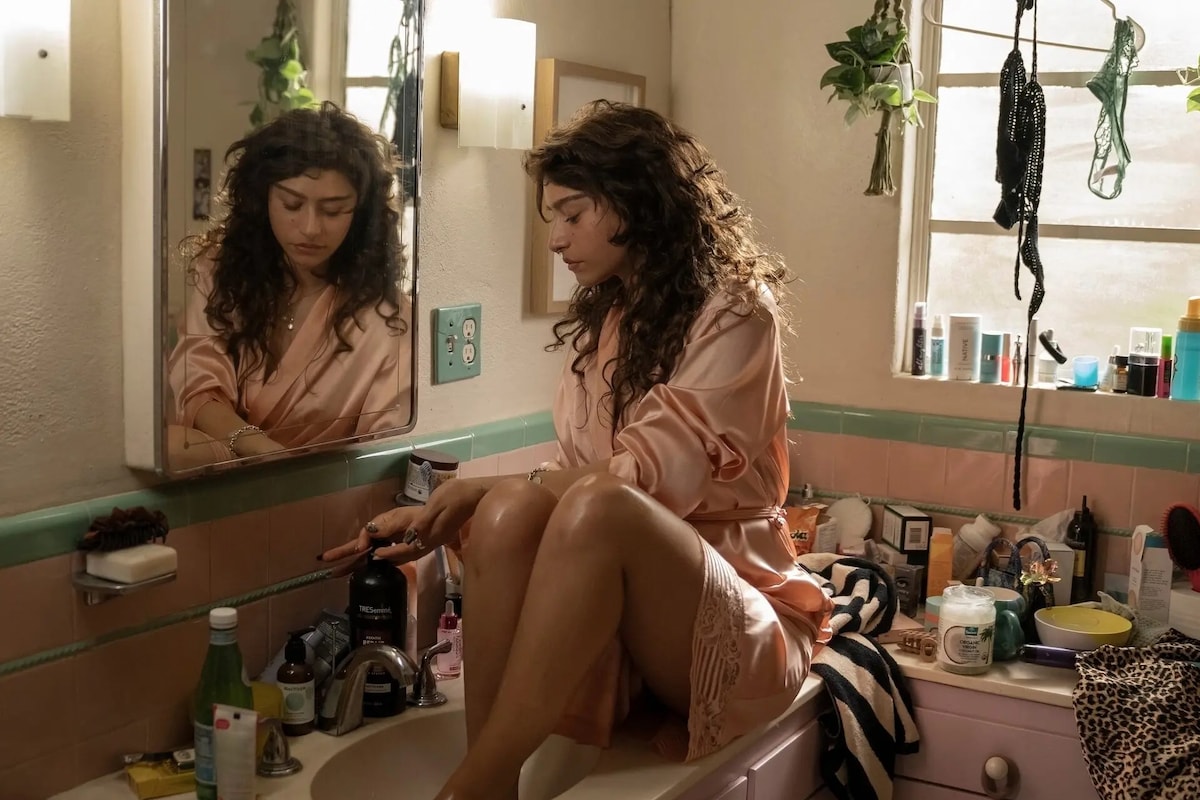
Anastasia, a 28-year-old in London, has a tip for surviving corporate culture: treat your hours at work as your “glow up” time. Working in the creative field in an administrative position, she books all her beauty appointments at work, oils her hair, sprays hydrating facial sprays, gets her steps in at lunchtime and researches what salons to go to and what supplements to take (she keeps them at the office). While on her laptop, she is Pinterest boarding, making to-do lists and asking ChatGPT questions like, ‘What’s the best hair colour for me?’ “I’ve diagnosed myself with a health issue at work using ChatGPT and basically fixed it,” she says. “My number one priority will always be my health, so I use work as time to really pour into myself.”
Last month, Anastasia shared some of her tips on TikTok. The comments were flooded with confessions of other people’s corporate wellness secrets. Some were actual beauty tips, like doing manicures while on Teams meetings, but others were merely acts of survival, like drinking water on company time. We know Gen Z and millennials are reporting “peak burnout” at earlier ages, and that young people are purchasing more wellness products and services than previous generations (probably because of the burnout). So, can incorporating beauty rituals into your nine-to-five really save you from today’s culture of overwork?
When Anastasia spoke to me on the phone, she added a disclaimer – she makes sure she gets all her work done before glowing up. But she doesn’t feel bad about prioritising beauty on company time either. “As much as I love work, these jobs in general don’t prioritise us as much as we prioritise them,” she says. “Gen Zers are looking at work and asking, what are you giving me in return for all this work and availability? I think there needs to be a wake-up call because if you lose your job, you can get another, but you only have one life.”
Only, the entry-level market in the US is shrinking, and it is extremely hard to land a job right now, so it’s easy to see why some young people who are employed would be scared to get caught, say, working out on company time. For others, it’s all just another indication that the workforce doesn’t care about people, so why bother caring back? To Anastasia, her beauty rituals are worth the risk, although her company’s inflexible office policy often gets in the way. “If I could work from home, God, I could do dry brushing!” she says.
Lauren, a 26-year-old freelancer in New York, has worked from Bathhouse twice. One time, she had to jump on an unexpected call after being in the sauna. “They said, ‘Oh, it looks like you’re in a different spot,” she says. “I said I’m in the coffee shop. Although people around me were in bikinis, I was in their cafe area, so it wasn’t completely out of pocket.” Working from a third space, like a spa, enhances Lauren’s work motivation. “I’m more productive at Bathhouse because I know I just want to wrap up and focus on my cold plunge,” she says.
I have a beauty ritual confession of my own: I have baby bangs, and they require a trim every few weeks. There’s a salon I’ve found that’s a five-minute walk from my house in Brooklyn, so when working from home, I can make it there and back with brand new bangs all within my lunch break. Last week, I did exactly that, and met a young woman, laptop in salon chair, working during a root touch-up. She told me her boss once accidentally turned on her Zoom camera while getting a facial. “Everyone laughed it off, and it was fine because she was still the smartest person, contributing fully to the meeting,” she says. “Sometimes I have to tell my hairdresser to pause on blow-drying because I need to say something on a call, but there are also times when I work till 11pm, so it balances out.”
“Sometimes I have to tell my hairdresser to pause on blow-drying because I need to say something on a call, but there are also times when I work till 11pm, so it balances out”
Unfortunately, not everyone’s boss is totally fine with a Zoom-facial. In the age of constant connectivity – where the lines are blurred between personal and company time, and emails are sent over the weekends (please don’t do this) – there’s less and less time to be a person. Integrating wellness into work, then, is being sold as the answer to a larger, deeper societal problem. Instead of being able to get outside, people post about “maximising” their steps with a walking pad at work, or doing “deep core” exercises while in an office chair. “When I worked a role that didn’t allow me to leave my desk, I was quite literally so busy I couldn’t even eat,” says Brooke*, a 30-year-old in Los Angeles. “I had no choice but to make all my appointments for Saturday or Sunday morning just to get things done.”
After Brooke left her previous position in 2024, she specifically looked for workplaces where she’d be able to take care of herself. She now works in a more flexible role, where she can book her nail, hair and other appointments during the workday. The hack? She simply puts them in her calendar under “busy”. “If we’re on camera twenty-four-seven on a remote job, your face matters and I would be lying if I said my physical appearance didn’t affect who wants to do business with me,” she says. “Once, I was told that I looked tired on a Zoom, and that was my introduction to getting Botox.”
What we think of as corporate beauty rituals is highly gendered. It’s why it’s socially acceptable to talk business over a round of golf (so manly!) but not at a yoga class. If we know that women leaders in the workplace face 30 different types of bias (including age, attractiveness, colour and body size), why are women then punished or labelled “vain” for attempting to keep up with the beauty standard? And why should women’s free time suffer for the sake of an often unspoken code of appearance that the corporate world requires? Black women especially bear the brunt of the burden of what’s considered workplace-appropriate hairstyles. If your natural hair is considered “unprofessional”, then hair appointments are technically part of the job.
Squeezing in nine-to-five beauty rituals won’t save us from overwork culture, especially considering that many women are only booking these appointments to keep up with professional beauty standards. Our beliefs around what wellness is have also become metabolised by corporate ideas of “productivity”, where the idea that all of our free time should be spent “working” on ourselves positions our bodies as just another project. Still, the guilt people feel for secretly carving out personal time within their long hours is a direct result of living in a culture that over-prioritises work. In whatever quiet or public way you can, advocating for more work-life balance is, at the very least, a starting point. Perhaps the bosses openly getting facials on a Zoom call can lead the way.
25-year-old Estella Struck is one of those managers. Struck works in marketing, doing brand consulting and running a talent management firm on the side. As her own boss, with a few employees, she’s tired of the double standard that frowns upon women’s self-care during work hours while accepting men’s. I call her while she is walking her dog – the type of “habit stacking” she openly encourages. “My favourite thing to do is read or start a concept on pen and paper on the stairmaster or in the sauna,” she tells me. “It helps me to be creative when I connect with myself and get my blood flowing.” If the workday is already consuming our lives, it’s no surprise people are finding ways to reclaim a little of it for themselves.