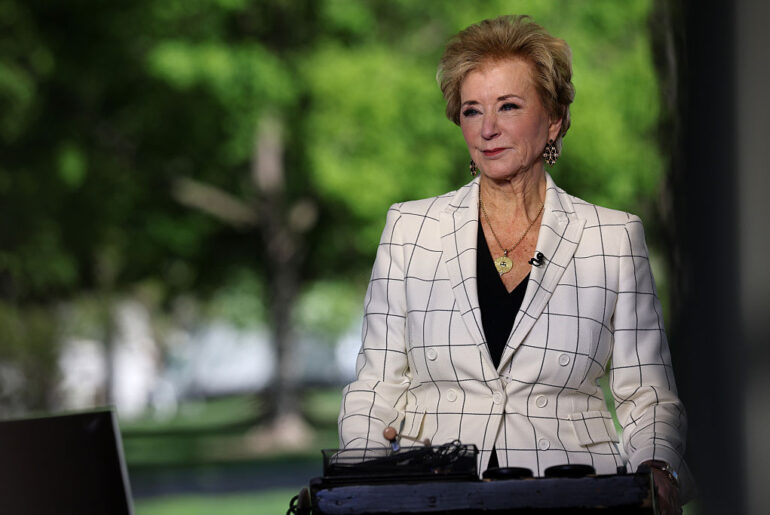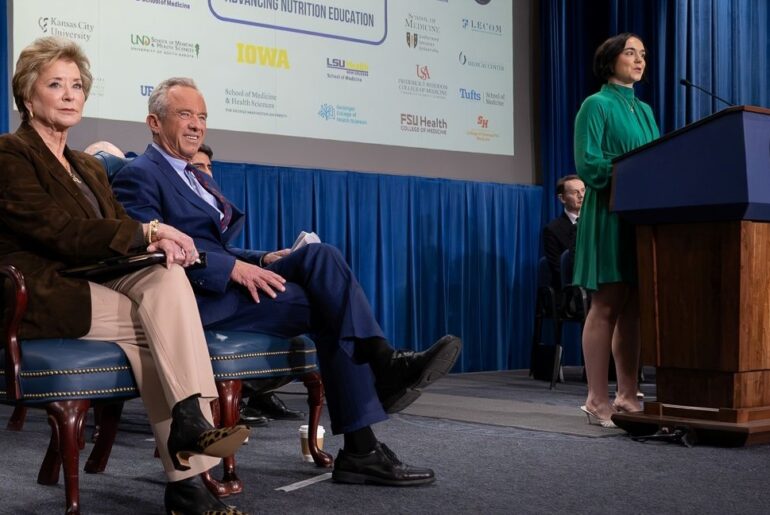
Secretary of Health Robert F. Kennedy Jr. announced Thursday that 53 medical schools across the country will start requiring doctors to receive 40 hours of nutrition education before graduating.
The inclusion of nutrition into physicians’ training marks a “transformative breakthrough in medical education that will reshape the way we train doctors in our country and deliver on President Trump’s promise to end the chronic disease epidemic in America,” Kennedy said during a press conference.
“This is how we implement the MAHA agenda. This is how we make America healthy again,” Kennedy said.

Download the SAN app today to stay up-to-date with Unbiased. Straight Facts™.
Point phone camera here
Currently, only about 25% of medical schools require clinical nutrition classes. There are over 200 accredited medical schools across the country graduating about 30,000 new doctors each year.
The response from physicians and health organizations was largely positive.
“We applaud the administration for recognizing that if we’re serious about prevention, nutrition must be foundational in medical education,” Bobby Mukkamala, the president of the American Medical Association, told Straight Arrow News. “Giving physicians the skills to have impactful conversations with our patients about food and lifestyle is one of the most practical, immediate steps we can take to improve health and prevent disease.”
However, some critics expressed concern that the Department of Health and Human Services (HHS) and the Department of Education (ED) pressured medical schools into curriculum changes by threatening to withhold federal funding.
While it remains unclear what negotiations or discussions HHS officials held with medical schools prior to Thursday’s announcement, the push raises broader questions about government interference in medical education and who decides what counts as scientifically valid nutrition science.
“As long as the school is using information they think is scientifically valid and nutritionally appropriate, that’s fine,” Louis Sullivan, President George H.W. Bush’s health secretary, told The New York Times.
“It certainly should not be a situation where schools are surrendering to the government.”
The chronic disease epidemic
Healthy eating has been a central focus of Kennedy’s health agenda, which frames diet as a critical foundation for addressing the rising burden of chronic disease in the United States.
Chronic diseases such as heart disease, cancer and diabetes are the leading causes of illness, disability and death nationwide. Roughly 60% of Americans live with at least one chronic disease, while about 40% have two or more, according to the Centers for Disease Control and Prevention.
Beyond reducing quality of life and contributing to premature death, chronic illnesses also carry a substantial economic cost.
Direct medical costs to treat chronic diseases, including mental health conditions, account for some 90% of the nation’s health care spending, or roughly $3.7 trillion every year. There are also additional indirect costs from missed workdays, diminished productivity or early retirement due to chronic conditions. The CDC estimated that heart disease and stroke cost the U.S. about $240 billion annually when considering productivity losses.
Decades of calls for nutrition education
Physicians and professional health societies have long called for medical schools to include more education and training in nutrition. In the 1960s, the American Medical Association held a conference on nutrition education, highlighting the inadequate attention given to the subject in medical schools.
A 2015 survey of 121 medical schools found that 71% of institutions failed to provide the recommended minimum 25 hours of nutrition education. Only seven schools required students to spend 40 hours learning about nutrition. A 2022 survey of more than 1,000 medical students found that respondents received on average just over one hour of formal nutrition education per year.
Start your day with fact-based news.
In 2022, Congress introduced a resolution calling for medical schools to better address nutrition education; the Biden Administration echoed those calls.
On Thursday, HHS announced it allocated $5 million to support medical and nursing schools and residency programs to integrate nutritional education into their curricula. The administration said it developed a nutrition curriculum and a competency-based alternative, which focuses not on coursework hours, but on assessing students’ skills and abilities.