
Jim Carrey didn’t just show up at the César Awards in Paris — he prepared for them. The actor spent months learning French and crafting a speech to accept an Honorary César for lifetime achievement on Feb. 26. But when photos of the 64-year-old comedian hit the internet, the conversation quickly shifted from his words to his appearance.
Side-by-side images of Carrey “then and now” circulated widely, with commenters zeroing in on what they perceived as a fuller, smoother look. The man known for his elastic facial expressions suddenly became the subject of a new kind of scrutiny — one long familiar to women in Hollywood.
More striking than the question of “What happened to Jim Carrey?” were the accusations that the man in the photos might not even be him, with claims that he had been cloned or impersonated by Alexis Stone.
The ongoing chatter points to a bigger issue, say experts — not specifically about Carrey but about a shift in how we view male aging and cosmetic intervention. Are male celebrities now stepping into the same ruthless beauty spotlight that women have endured for decades?
Changing the rules of men’s beauty
Women in the public eye have long faced a “lose-lose” equation when it comes to aging. “If they age naturally, they’re dismissed as ‘old and ugly,’” Sarah Kornfield, a gender studies expert and professor of communication at Hope College, tells Yahoo. “And if they intervene with Ozempic or plastic surgery, they’re critiqued for being ‘fake.’” In any case, cosmetic work has become expected in the industry.
Men, on the other hand, have largely been spared from this level of scrutiny. “They have a lot more leeway,” says Kornfield, pointing to the wider range of men deemed attractive in society, from the rugged cowboy and working-class hero to the dad bod. Because cosmetic intervention hasn’t been seen as an obligation for men — “It’s not like, ‘Well, of course, you’re going to get hair plugs,’” says Kornfield — any visible change is viewed as a jarring choice that sits outside the norm, rather than routine maintenance for their career.
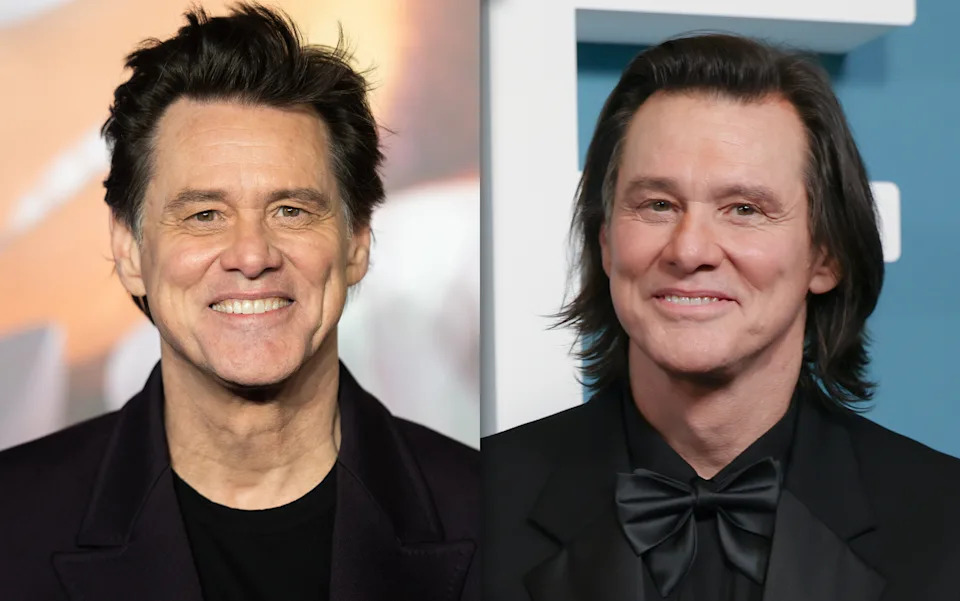
People on the internet posted a ton of “then and now” photos of Carrey to highlight the differences.
(Photo illustration: Yahoo News; photos: Samir Hussein/WireImage via Getty Images, Stephane Cardinale/Corbis via Getty Images)
Carrey isn’t the first to spark this conversation. In recent years, the appearances of Bradley Cooper, Zac Efron and Tom Cruise have all faced speculation about their appearances. While each has denied undergoing cosmetic surgery, the fact that the public is now analyzing the changes in their jawlines and cheekbones suggests that the scrutiny once reserved for women is expanding.
Still, Kornfield notes a distinction in Carrey’s case. The backlash seems rooted less in vanity and more in perceived authenticity. “We see a huge accusation of inauthenticity,” she says. For an actor whose career has relied on the mobility and expressiveness of his face, the idea that it has changed can feel, to some fans, like a betrayal.
The transparency gap
The frenzy surrounding Carrey’s face reflects another dynamic, according to plastic surgeon Dr. Paul Rosenberg: a gap in transparency. In recent years, female celebrities have moved toward radical openness about cosmetic procedures to the point where it’s normalized as self-care, while men still treat it as their best-kept secret.
“It has a lot to do with the male ego,” Rosenberg tells Yahoo. “Women talk about this almost like they’re wearing a handbag or jewelry. They’re not afraid to say they had a breast augmentation or a facelift. …But men believe it’s some sort of assault on their masculinity, which it doesn’t have to be.”
While more men are seeking cosmetic procedures, influenced by social media, “looksmaxxing” culture and anxiety about aging, they’re still likely to be more hesitant about surgery. As a result, Rosenberg says, some opt for less invasive treatments.
“They’re more fearful, and they’re afraid. They enter into doing something moderate in order to avoid what they believe are going to be some telltale scars,” says Rosenberg. “So they’ll have filler, for instance, but the filler is overfilled.”
The outcome, however, can subtly alter facial shape without necessarily creating a more youthful or conventionally attractive appearance. This is what Rosenberg assumes happened with Carrey. “If you compare his before and after, whatever the procedure was, his brows are still furrowed, he still has excess skin on his upper eyelids, he still has crow’s feet. So he has not had facial skin tightening or a facelift. He’s had something added,” Rosenberg speculates. “The addition of those products changed the shape of his face and even the expression of his face.”
When your image is your livelihood, any change in appearance can be risky. For male celebrities, there’s an added layer: Altering their looks can run up against long-standing ideals of masculinity. “A very outstandingly handsome man that makes changes, people might consider him less manly or less hunky,” Rosenberg says.
Kornfield says that part of the reaction to Carrey may be less about the procedure itself and more about what it signals. “The change that was noted in him isn’t one that makes him more masculine,” she says. “We’re primarily seeing what appears to be a change in age dynamics.” For men, that terrain is still relatively new.
A familiar double bind
Kornfield says that, ultimately, the scrutiny is less about Carrey and more about a culture recalibrating its expectations.
Over the past two decades, she says, men have increasingly entered the same beauty economy that women have long navigated, from hair implants and other cosmetic procedures to to weight loss drugs. But the social script hasn’t caught up.
“There’s a sort of tension here,” Kornfield says. “No one should be subjected to oppressive beauty standards. But we also want people to have the autonomy to make choices about their bodies.”
Her hope is that a celebrity’s decision over whether to tweak their appearance wouldn’t spark viral theories about cloning or impostors. “If he were to make a statement, in an ideal world, he might just tell us that he did what he wanted and that we should all mind our own business,” says Kornfield.
Until norms shift, however, male stars like Carrey may be discovering what women in Hollywood learned ages ago: When it comes to growing old in the spotlight, there’s often no way to win.