
Daily vitamins were found to slow down ageing by as much as 4 months younger in 2 years (Getty Images)
Your body runs on thousands of biochemical reactions every second. Each one depends on micronutrients that are measured not in grams, but in milligrams or micrograms. Miss enough of them, and the system slows down. Provide them consistently, and the system keeps running smoothly. A new study published in Nature Medicine suggests something intriguing. Researchers analyzing data from the COSMOS Trial (a large randomized study involving older adults) found that people who took a multivitamin for two years showed slower biological ageing when measured using epigenetic clocks.
The difference was as much as four months less biological ageing over two years. The new study examined 958 healthy older adults with an average age of around 70. Scientists looked at something called epigenetic clocks (tools that measure biological ageing by analyzing changes in DNA methylation). These clocks track chemical tags that regulate gene activity. As we age, those patterns shift. Researchers found that people taking a daily multivitamin showed slower changes across five epigenetic clocks, including two linked to mortality risk.
The study’s senior author, epidemiologist Howard Sesso, said, “It was exciting to see the benefits of a multivitamin linked with markers of biological ageing. This study opens the door to learning more about accessible, safe interventions that contribute to healthier, higher-quality ageing.”
Multivitamins might represent a simple, accessible intervention that contributes to healthier ageing, especially for people whose biological age is already ahead of their chronological age.
Why Take Vitamins?
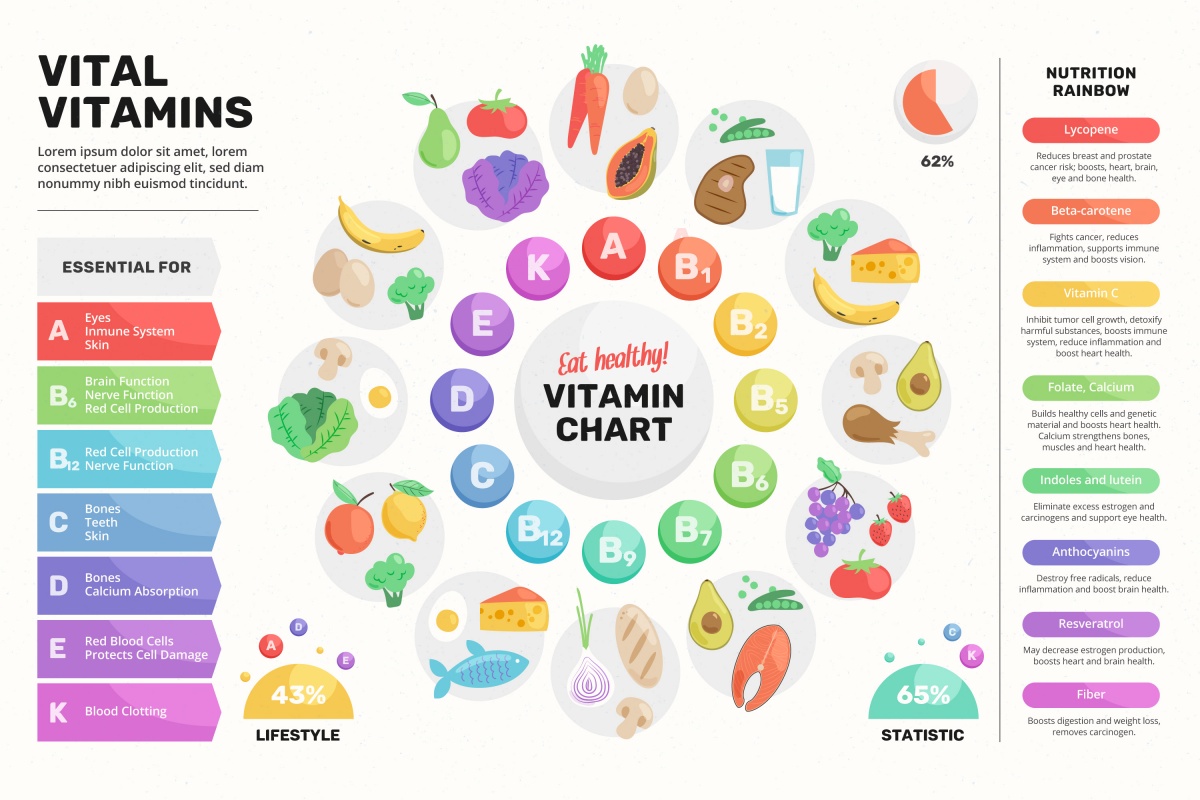 Nutrition chart (ETV Bharat)
If you ask most nutrition scientists for their honest answer, it usually sounds something like this: Start with food. A balanced diet rich in vegetables, fruits, whole grains, legumes, nuts, and healthy fats will supply most essential nutrients. But modern lifestyles (processed food, indoor living, soil depletion) sometimes make it difficult to hit every target. That’s where a daily multivitamin becomes useful.
Think of your body as a system running billions of biochemical programs simultaneously. Vitamins and minerals are the software dependencies that keep those programs running. Without them, things break. But unlike calories or protein, vitamins are needed in microscopic quantities, which makes their role both subtle and powerful. The list includes about 13 essential vitamins and 15 minerals. Each plays a different role in the body’s internal architecture.
Recommended Daily Intake (RDI)
Here’s the basic nutrient stack most multivitamins try to cover according to the FDA:
1) Vitamin A: This vitamin supports vision, immune function, and skin health.
Recommended intake for adults: about 900 micrograms (mcg) per day for men, and about 700 mcg per day for women. Too much vitamin A, however, can be harmful, especially in supplement form.
2) Vitamin C: The internet’s favourite vitamin is also one of the most versatile. Vitamin C helps with immune defence, collagen production, antioxidant protection.
Recommended intake: 90 mg per day for men and 75 mg per day for women. Many supplements contain more than this because excess vitamin C is generally excreted.
3) Vitamin D: This is where things get interesting. Vitamin D is technically a hormone precursor that regulates calcium balance, bone health, and immune function.
Recommended intake: Adults under 70: 600 IU (15 mcg) Adults over 70: 800 IU (20 mcg). Real-world deficiency is common because vitamin D is produced through sunlight exposure. For many people, supplements become the easiest fix.
4) Vitamin B Complex:
The B vitamins are like the power grid of metabolism. They help convert food into energy and support nerve function.
This group includes
B1 (thiamine)B2 (riboflavin)B3 (niacin)B5 (pantothenic acid)B6B7 (biotin)B9 (folate)B12
Vitamin B12 deserves special attention. Older adults and vegetarians often struggle to absorb enough of it.
Recommended intake: 2.4 micrograms per day
5) Vitamin E: A powerful antioxidant that protects cell membranes.
Recommended intake: 15 mg per day. Most people meet this through diet, but it’s included in multivitamins as a protective nutrient.
6) Vitamin K
Essential for blood clotting and bone metabolism. Leafy greens are the richest natural source.
Recommended intake: 120 mcg per day for men and 90 mcg per day for women
Essential Minerals
Multivitamins also include a collection of minerals that function like structural hardware for the body. These usually include calcium (for bones and teeth), magnesium (regulate muscle and nerve function), zinc (immunity and healing wounds), iron (oxygen transport in blood), selenium (supports antioxidant enzymes), iodine (critical for thyroid hormones). Not every multivitamin contains full doses of each mineral because some (like calcium) require large amounts that won’t fit inside a small pill.
References:
Read more:
Eat Better, Breathe Better: 9 Lung-Healthy Foods To Try This Pulmonary Rehabilitation WeekRethink Protein On The Indian PlateWhat Is The Switch On Diet, Get To Know The Popular 4-Week Diet Plan From KoreaAre You Gaining Weight Even After Eating Very Little? Do You Know What To Eat And How Much?