Andrew Mock, MD, admittedly, has had a different experience with exercise and pain than most doctors.
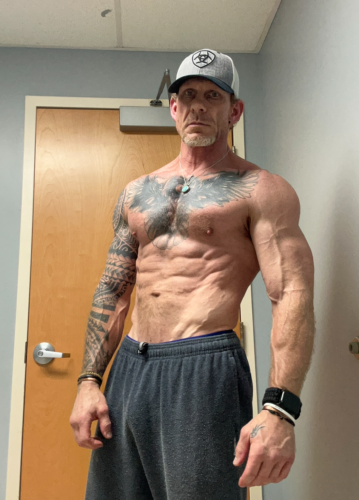
In addition to being a physician at Hoag Medical Group in Southern California — one who’s board-certified in family, preventive, lifestyle, and obesity medicine — he’s also a professional strongman competitor and four-time winner of California’s Strongest Man.
In 2021, he pushed himself to the breaking point to reach the finals of Clash on the Coast, which elevated him to pro status. His reward for making it? His left anterior cruciate ligament blew out in the first event of the televised contest.
He stayed in the competition, and his reward for that was reinjuring his left biceps, which he’d partially torn during training.
“In both of those injuries, the warning signs were definitely there, but I was actively overriding them,” he said. “It was one of those, ‘Do as I say, not as I do’ moments.”
You would expect Mock to express regret for the way he trained in the runup to the contest. But he doesn’t. He not only achieved his goal, he gained “a deeper perspective” on what it means to work around an injury without giving up on exercise altogether.
It also helped him solve one of the most frustrating subjects between doctor and patient: How to convince someone to keep moving even if it hurts.
Pain and Exercise: The Odd Couple of the Human Condition
“The worse pain feels, the less we move and exercise,” said psychologist Rachel Zoffness, PhD, an assistant clinical professor at the School of Medicine, University of California San Francisco, and author of Tell Me Where it Hurts. And yet “the less we move and exercise, the worse pain feels.”
Therein lies the dichotomy: While physical activity can often exacerbate pain in the short term, consistent exercise can be the most effective way to reduce pain over time.
To understand why — and to help patients move more when it hurts or they don’t want to — we need to reframe what pain is, why we have it, and how exercise affects it.
Zoffness emphasized that chronic pain is a biopsychosocial problem. It’s not “all in your head,” she said, nor is it entirely physical. It’s a complex neurologic event impacted by thoughts, emotions, social health, and even our environment.
The idea that pain isn’t a fixed, targetable phenomenon can be hard for people to wrap their minds around. Even harder is the notion that exercise, which so often seems like part of the problem, can be such an important part of the solution.
That’s why kinesiophobia, the fear of movement, affects so many patients — especially those whose pain was initially caused by a sports- or activity-related injury.
“It’s normal and adaptive to be scared of movement and exercise when we have pain,” Zoffness said. “We reasonably believe that it’s dangerous to move.”
That makes perfect sense when we’re talking about acute pain in the immediate post-injury period. Not moving gives a broken bone or torn ligament time to heal.
But the opposite is true for chronic pain, which is usually defined as lasting more than 3 months. Inactivity doesn’t just prolong the pain, it makes it worse.
“How confusing is it that something that saves your life in one context is actually maladaptive in another context?” Zoffness said. “But that’s, excuse my language, the f***ery of chronic pain.”
Selling Exercise as a Pain Reliver
Physical activity reduces chronic pain through a variety of mechanisms, said Kathleen Sluka, PhD, professor of physical therapy and rehabilitation science at the University of Iowa, Iowa City, Iowa, and co-director of the university’s Pain Research Program.
For starters, she explained, exercise improves functional abilities like strength, mobility, and endurance. That makes everyday activities easier to do.
“It also changes the immune system, so it increases chemicals that reduce pain and reduces chemicals that turn on pain,” she said.
That phenomenon, called exercise-induced analgesia, was the subject of a 2018 review by Sluka and her colleagues.
It also makes your nervous system less reactive. With chronic pain, Zoffness said, the brain acts like a malfunctioning car alarm, the kind that’s triggered by a bicycle rolling past. The longer you have pain, the better your brain gets at maintaining it, producing bigger responses to smaller stimuli.
Exercise makes your nervous system less excitable, raising your pain tolerance while reducing your sensitivity.
In a moment, we’ll discuss how to help patients with chronic pain safely begin or return to an exercise routine.
First, though, it’s important to realize that not every patient with acute or chronic pain is exercise averse. Some are, if anything, too eager to get back to their training. That can also be a problem.
Work With What Still Works
Mock’s strongman injuries illustrate what happens when a patient pushes too hard — but it also highlights how he approaches patients dealing with injury or chronic pain.
“We need to find a way to move all the things that can move without symptoms and then modify how we’re moving the thing that’s having symptoms,” Mock said.
That way, the healthy muscles stay strong, and you maintain some of your cardiovascular fitness. You also remain in the habit of exercising.
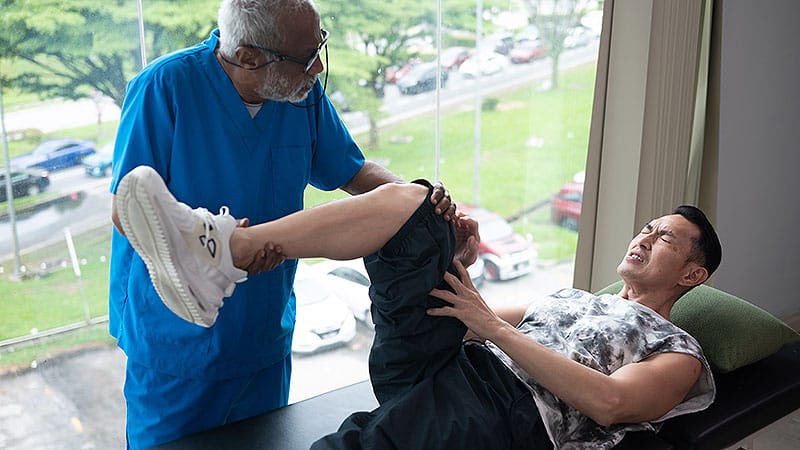
He estimates that as many as three quarters of his patients come to his office with some sort of pain. Rather than focusing exclusively on what they can’t do, he looks for what they can handle without aggravating their symptoms.
“How do you modify range of motion?” he said. “How do you modify intensity? Then you find an amount of work they can do today. They really do want that guidance from their doctor.”
Don’t Be the Bearer of Bad Vibes
What they don’t want from their doctor, but too often get, is what Zoffness calls “nocebic messages.”
A nocebo is a placebo’s evil twin. Instead of promising a benefit — reduced pain, for example — it plants a message of imminent harm in a patient’s mind. Examples include “there’s no cure for chronic pain” or “you have the spine of an 80-year-old.”
“If you have chronic [knee] pain and your doctor says, ‘It’s just bone on bone in there,’ are you going outside for a run?” Zoffness asked “Or are you going to be too scared to move your body because you’re positive bad things are going to happen?”
Even if the doctor really does see tissue degeneration on the patient’s x-rays, they should be careful about how they describe it.
“There is absolutely no correlation between the findings on back scans and the amount of pain” a patient has, Zoffness said. As she writes in her book, “Pain can occur in the absence of damage, and damage can occur in the absence of pain.”
Similarly, doctors shouldn’t assume that age determines what a patient can or can’t do.
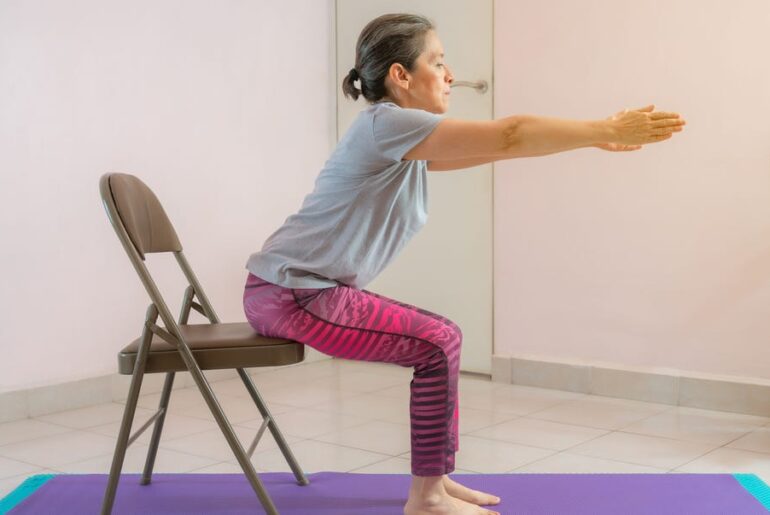
“We’re stuck in this mindset that just because you’ve accumulated more laps around the sun, you need to work out in a certain way,” Mock said. “You have to adjust it to the individual sitting in front of you. Their goals, their abilities, what they have the resources to do. It’s not like, ‘Oh, you’re this age, so you should do chair yoga.’”
The Slow Road to Success
In her clinical practice, Zoffness specializes in treating patients who’ve been described as “untreatable medical mysteries” because of their chronic pain.
There’s one thing they have in common: “I’ve never met anyone in pain who wasn’t resentful about at least one thing that pain has taken away from them,” Zoffness said. It could be anything from exercise to gardening to baking.
Once the patient identifies something they want to return to, Zoffness works with them to create a pacing plan. “Pacing is a critical part of pain management,” she said, comparing it to training for a marathon.
If you’re serious about running 26.2 miles nonstop, you don’t run yourself into the ground on your first day out. The goal is to start with a baseline distance you can run in every training session, while recovering in time for the next workout.
Zoffness starts with two questions:
What can you do on a good day?What can you do on a bad day?
Let’s say the patient can walk for 20 minutes on a good day but doesn’t walk at all on a bad day. The average of the two is 10 minutes. Now, you give the patient a cushion by subtracting 4 minutes, and ask them to walk 6 minutes per day, every day.
They can go as slow as they want on bad days, as long as they keep at it for 6 minutes. And they can go as fast as they want on good days, as long as they don’t go longer than 6 minutes.
If they feel good after the first week, you’ll set a higher baseline for the second week.
The choice of exercise doesn’t appear to make much difference, according to Sluka’s research. “Any type of aerobic or strengthening exercises can reduce pain,” she said. “You should choose the exercise routine that works best for you.”
Mock said it also helps to give patients symptom-specific guidelines. For example, you might tell them their pain shouldn’t exceed three to five out of 10. But that doesn’t mean they should stay completely within their comfort zone.
“Discomfort is sometimes expected,” he said. “For our body to adapt, we have to expose it to something it’s not used to doing already.”
To quote an old gym adage: If you do what you’ve always done, you get what you already have.
In this case, what they already have is pain. By actively engaging with it, Mock said, “you get this learned behavior that it’s okay to move.”
Pain Is Never Simple
Zoffness has studied pain for more than 30 years and knows some questions may never have an answer.
“Why do different bodies decide to hurt in different places?” she asked. “Why for some people is it back pain, and for other people it’s migraines? No one really knows for sure.”
One thing she can say with certainty: There’s no quick fix to be found in a magic pill, superfood, or supplement. Nothing makes her madder than hucksters and influencers who say there is.
“The true hack for pain,” she said, “is looking at the whole recipe, and treating pain like a whole-person problem that requires a whole-person solution.”