image:
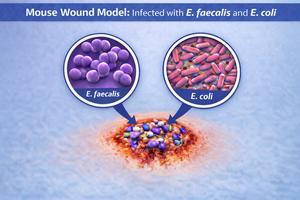
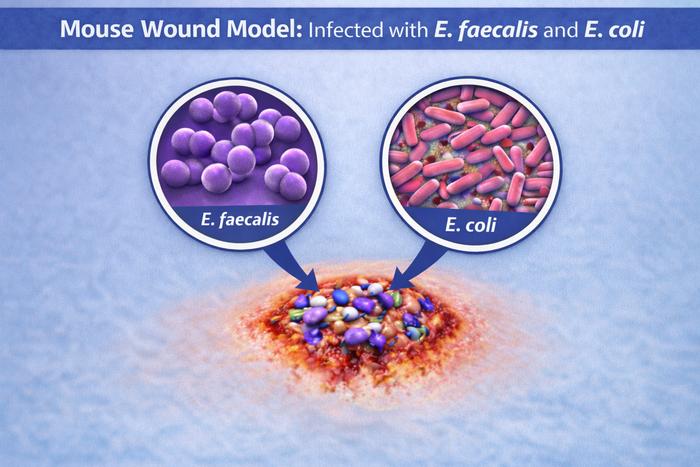
A mouse wound infection model demonstrated that wounds infected with E. faecalis had dampened immunity, allowing E. faecalis to persist and even enabling co-infecting bacteria like E. coli to thrive. The model allowed researchers to study how lactic‑acid‑driven immune suppression promotes persistent, polymicrobial infections. (Photo: SMART AMR)
Credit: SMART AMR
A common bacterium, Enterococcus faecalis, can suppress the body’s early warning system in wounds, causing infections to persist and create an environment that allows other bacteria to take hold
The bacterium releases large amounts of lactic acid in the wound, which lowers pH, weakens immune cells and prevents them from fighting an infection
These findings could help develop better ways to treat stubborn wounds – such as diabetic foot ulcers and post-surgical infections – which could lead to faster healing
Singapore, 12 March 2026 – Researchers from the Singapore-MIT Alliance for Research & Technology’s (SMART) Antimicrobial Resistance (AMR) interdisciplinary research group, along side collaborators from SCELSE, at Nanyang Technological University (NTU Singapore), Massachusetts Institute of Technology (MIT) and University of Geneva (UNIGE), have made a breakthrough discovery revealing how a common bacterium, Enterococcus faecalis (E. faecalis), releases lactic acid to acidify its surroundings and suppresses the immune-cell signal needed to start a proper response to infection. By silencing the body’s defences, the bacterium can cause persistent and hard-to-treat wound infections. This study explains why some wounds struggle to heal even with treatment and why infections involving multiple bacteria are especially difficult to eradicate.
Chronic wound infections are notoriously difficult to manage because some bacteria can actively interfere with the body’s immune defences. In wounds, E. faecalis is particularly resilient – it can survive inside tissues, alter the wound environment and weaken immune signals at the injury site. This disruption creates conditions where other microbes can easily establish themselves, resulting in multi-species infections that are complex and slow to resolve. These persistent wounds, including diabetic foot ulcers and post-surgical infections, place a heavy burden on patients and healthcare systems, and sometimes lead to serious complications such as amputations.
In a paper titled “Enterococcus faecalis-derived lactic acid suppresses macrophage activation to facilitate persistent and polymicrobial wound infections”, recently published in Cell Host & Microbe, the researchers documented how E. faecalis releases large amounts of lactic acid during infection, acidifying the tissue environment. This acidity suppresses the activation of macrophages – immune cells that normally help to clear infections – and interferes with several important internal processes that help the cell recognise and respond to infection. As a result, the mechanisms that cells rely on to send out “danger” signals are suppressed, leaving the macrophages unable to fully activate.
Researchers found that E. faecalis uses a two‑step mechanism to achieve this. Lactic acid enters the macrophages through a lactate transporter called MCT‑1 and also binds to a lactate-sensing receptor, GPR81, on the cell surface. By engaging both pathways, the bacterium effectively shuts down downstream immune signalling and blocks the macrophage’s inflammatory response, allowing E. faecalis to persist in the wound much longer than it should. Specifically, the lactic acid prevents a key immune alarm signal, known as NF-κB, from switching on inside these cells.
This was proven in a mouse wound model, where strains of E. faecalis that could not make lactic acid were cleared much more quickly, and the wounds also showed stronger immune activity. In wounds infected with both E. faecalis and Escherichia coli (E. coli), the weakened immune response caused by lactic acid also allowed E. coli to grow better. This explains why wound infections often involve multiple species of bacteria and become harder to treat over time, particularly since E. faecalis is among the most common bacteria found in chronic wounds.
“Chronic wound infections often fail not because antibiotics are powerless, but because the immune system has effectively been ‘switched off’ at the infection site. We found that E. faecalis floods the wound with lactic acid, lowering pH and muting the NF‑κB alarm inside macrophages – the very cells that should be calling for help. By pinpointing how acidity rewires immune signalling, we now have clear targets to reactivate the immune response,” said Dr Ronni da Silva, Research Scientist at SMART AMR, SCELSE-NTU Visiting Researcher and first author of the paper.
“This discovery strengthens our understanding of host-pathogen interactions and offers new directions for developing treatments and wound care that target the bacteria’s immunosuppressive strategies. By revealing how the immune response is shut down, this research may help improve infection management and support better recovery outcomes for patients, especially those with chronic wounds or weakened immunity,” said Prof Kimberly Kline, Principal Investigator at SMART AMR, SCELSE-NTU Visiting Academic, Professor at UNIGE and corresponding author of the paper.
By identifying lactic‑acid‑driven immune suppression as a root cause of persistent wound infections, this work highlights the potential of treatment approaches that support the immune system rather than rely on antibiotics alone. This could lead to therapies that help wounds heal more reliably and reduce the risk of complications. Potential directions include reducing acidity in the wound or blocking the signals that lactic acid uses to switch off immune cells.
Building on their study, the researchers plan to explore validation in additional pathogens and human wound samples, followed by assessments in advanced preclinical models ahead of any potential clinical trials.
The research was partially supported by the National Research Foundation Singapore under its Campus for Research Excellence and Technological Enterprise (CREATE) programme.
Journal
Cell Host & Microbe
Subject of Research
Cells
Article Title
Enterococcus faecalis-derived lactic acid suppresses macrophage activation to facilitate persistent and polymicrobial wound infections
Article Publication Date
27-Jan-2026
Disclaimer: AAAS and EurekAlert! are not responsible for the accuracy of news releases posted to EurekAlert! by contributing institutions or for the use of any information through the EurekAlert system.