Posted on March 11, 2026 by Lindsay Hughes
Lindsay Hughes
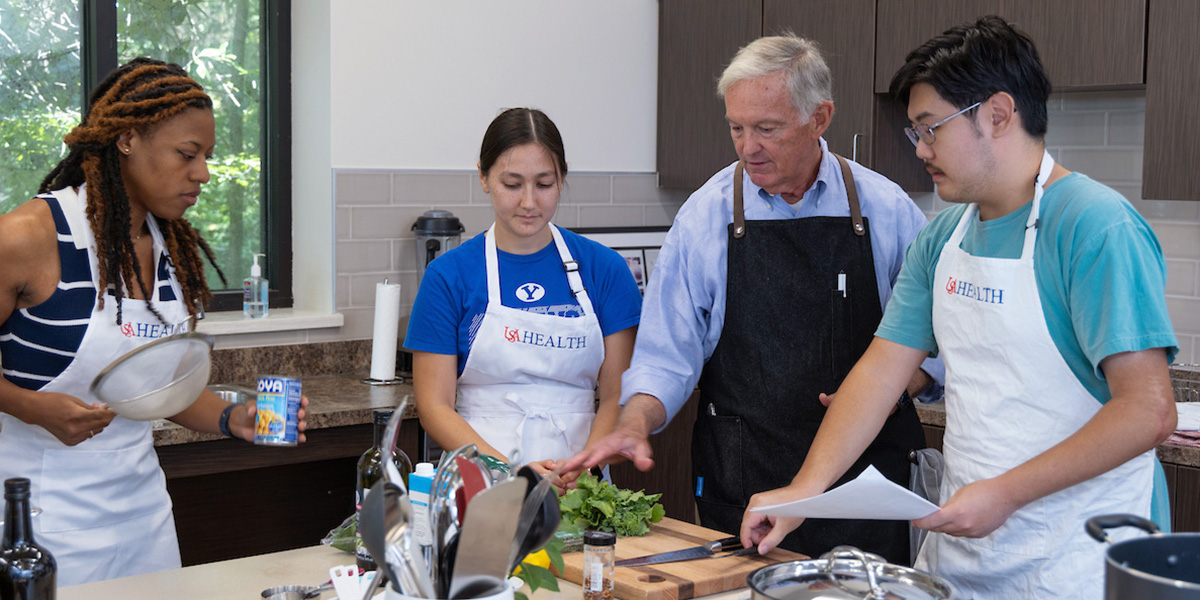
Robert Israel, M.D., an internal medicine physician and director of USA Health’s Integrative
Health & Wellness Program, provides culinary medicine training to medical students
in the teaching kitchen.
Building on its integrated nutrition and culinary medicine curriculum, the Frederick
P. Whiddon College of Medicine at the University of South Alabama has joined a national
effort aimed at expanding nutrition education for future physicians.
Led by the U.S. Department of Health and Human Services and the U.S. Department of
Education, the Advancing Nutrition Education Across the Medical Continuum initiative brings together 53 medical schools across 31 states. Participating institutions
will provide at least 40 hours of nutrition education — or a 40-hour competency equivalent
— for medical students beginning in fall 2026.
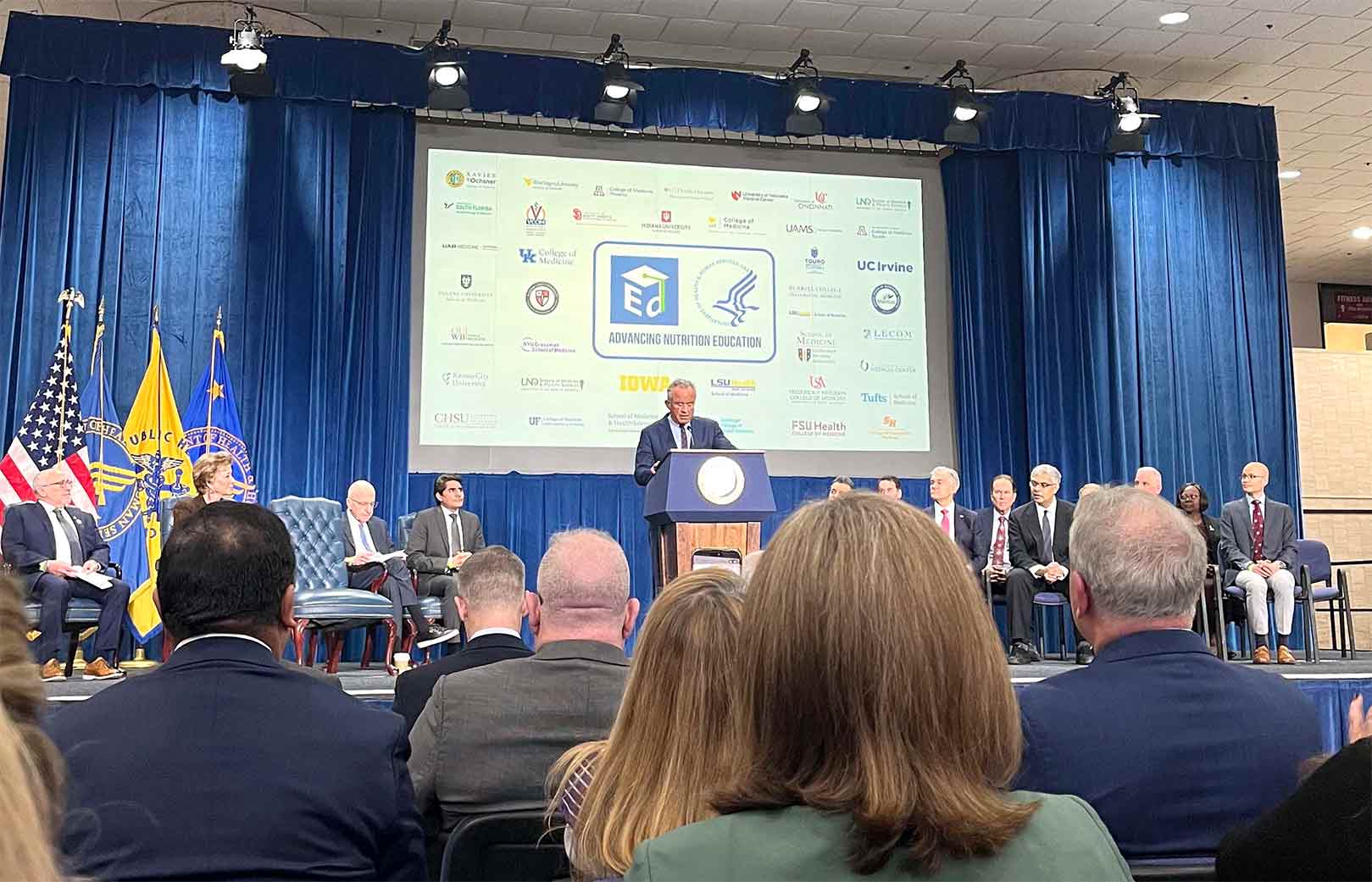 David S. Weber, Ph.D., assistant dean of medical education and professor of physiology
and cell biology at the Whiddon College of Medicine, represented the University of
South Alabama at a meeting of leaders from participating medical schools on March
5 in Washington, D.C.
“Given the importance of nutrition in overall health and disease prevention, participating
in this HHS initiative was a natural step for the Whiddon College of Medicine,” Weber
said. “This commitment aligns with our ongoing efforts since 2018 to expand nutrition
education in our curriculum and provides an opportunity to collaborate with like-minded
institutions across the country. Our goal is not only to provide students with a strong
foundation in nutritional science, but also to ensure they feel comfortable engaging
with patients on these topics and empowering them to use lifestyle approaches to improve
health outcomes across the Gulf Coast.”
Chronic diseases such as heart disease, cancer, stroke and diabetes are the leading
causes of death in the United States, according to the Centers for Disease Control
and Prevention. Many of these conditions are strongly influenced by diet and other
lifestyle factors. Yet despite strong evidence that nutrition plays a central role
in preventing and managing disease, many physicians receive little formal nutrition
training during medical school.
To help address this gap, the National Institutes of Health will dedicate $5 million
through a multi-phase nutrition education challenge to support medical schools and
other health professional programs developing coursework, clinical training and research
focused on evidence-based nutrition science.
A hands-on approach to nutrition education
At the Whiddon College of Medicine, nutrition education is already integrated throughout
the four-year medical curriculum to ensure graduates are prepared to address the unique
health challenges of the Gulf Coast region.
In addition to foundational instruction in metabolism and nutritional science, students
learn about disease-related nutrition, eating disorders, and the role of diet in preventing
and managing chronic conditions. Nutrition concepts are also reinforced through clinical
experiences, where students see firsthand how lifestyle and dietary choices influence
patient health.
A cornerstone of the College’s approach to nutrition education is hands-on culinary
medicine training. Every medical student participates in sessions in the teaching
kitchen, developed in collaboration with USA Health’s Integrative Health & Wellness Program. Directed by Robert Israel, M.D., an internal medicine physician with USA Health,
the program brings together partners across the academic health system to promote
nutrition, lifestyle medicine and preventive health.
“USA Health built its first teaching kitchen nearly 10 years ago, recognizing the
importance of nutrition in disease prevention and wellness,” Israel said. “However,
that commitment began even earlier, when the health system sent representatives to
learn how to better teach medical students, nursing students and the public not only
what foods to eat, but how to prepare them in ways that are both healthy and delicious.”
Israel said the participants quickly learned that handing patients a sheet of diet
instructions without ensuring they had the skills to prepare those foods at home was
often ineffective.
“USA Health, the Whiddon College of Medicine, and the University have been early adopters
and leaders in this ongoing effort,” Israel added. “We welcome the new attention to
this crucial component of health statewide and nationwide.”
In 2021, the University of South Alabama joined the Teaching Kitchen Collaborative, a global network dedicated to improving lives through culinary and lifestyle education.
Currently, two teaching kitchens support programming in Mobile and Baldwin County,
with a third planned for the new Whiddon College of Medicine building to open in 2027.
The College is exploring opportunities to expand the teaching kitchen curriculum by
incorporating additional sessions focused on dietary strategies commonly recommended
for patients with conditions such as cardiovascular disease, kidney disease, metabolic
disorders and obesity. The medical school is also developing standardized patient
encounters that allow students to practice counseling patients about healthy nutrition
in the context of food insecurity and programs such as SNAP.
“These experiences will help students better understand the real-world challenges
many patients face and equip them with practical strategies to support healthier choices,”
Weber said.
For students seeking more advanced training, the Whiddon College of Medicine offers
a fourth-year elective in lifestyle medicine that explores nutrition, exercise and
wellness in greater depth before they transition to residency. The course includes
multiple teaching kitchen sessions that allow students to apply nutrition principles
in practical, patient-focused ways.
The College’s sustained focus on nutrition education has also generated strong interest
among students. The Culinary Arts and Lifestyle Medicine (CALM) student interest group
regularly hosts invited experts in nutrition and lifestyle medicine and organizes
teaching kitchen sessions for fellow students. Many medical students also help lead
culinary medicine classes for USA employees and members of the local community, giving
them opportunities to discuss nutrition outside the traditional clinical setting.
The Whiddon College of Medicine’s culinary medicine program has also gained national
attention. Its teaching kitchen was featured on Alabama Public Radio and National Public Radio in March 2025, highlighting the University’s innovative approach to integrating nutrition
and culinary medicine into medical education.
Learn more about the Whiddon College of Medicine’s nutrition in medicine curriculum.